
Vung Tau, Soviet-style: how oil workers built a Russian town inside Vietnam
On the shore of the South China Sea, among palm trees, fish markets and Buddhist pagodas, stands a neighborhood that could pass for a film set depicting the late Soviet Union. Five-story apartment blocks, a Russian school, a general store, a canteen, a sports center and a kindergarten. The entrance was once controlled; every morning buses collected engineers from their homes, while the lights of offshore platforms burned somewhere beyond the horizon.
The area is still called the Russian Village, although it looks nothing like a village. It was not built out of homesickness for birch trees, nor as a small colony for Soviet citizens. It grew around one of the riskiest and most successful industrial projects in modern Vietnamese history.
The oil that brought Soviet specialists to Vung Tau helped a poor postwar country earn billions of dollars, start power plants, build its first refinery and create its own engineering tradition. Alongside pipelines, drilling rigs and offshore platforms, a strange tropical town took shape: Russian children celebrated Vietnamese Tet, Vietnamese students learned Russian, and people who did not know a word of one another's language somehow worked together, bargained at markets, repaired bicycles and started families.
Vietnam's search for oil of its own
After the war, Vietnam was a unified country only on the political map. Its economy had to be rebuilt almost from scratch. Electricity, fuel, roads, equipment and foreign currency were all in short supply. People had suspected that oil lay off the southern coast even before reunification, but turning a geological possibility into a working offshore well meant creating an entire industry.
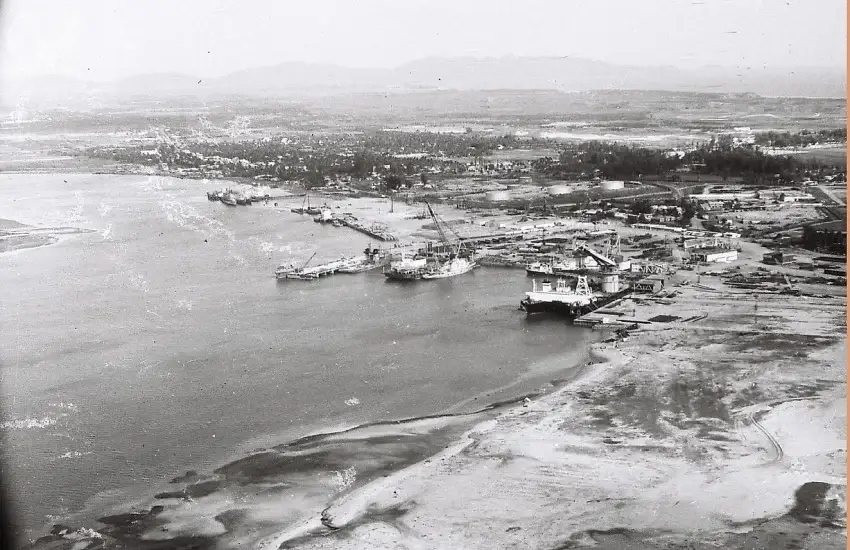
The country needed vessels, drilling rigs, laboratories, offshore platforms and people capable of understanding the geology of the continental shelf. Vietnam therefore turned to the Soviet Union. In 1981, the joint venture Vietsovpetro was established. Its name sounded like a product of Soviet bureaucracy, but its mission was almost adventurous: find commercial oil at sea and learn to extract it where neither infrastructure nor a major domestic petroleum school yet existed.
The Soviet side brought technology and experience. Vietnam provided the offshore area, land for the coastal base and local personnel, and was determined to obtain its own oil as quickly as possible. On paper, this was friendship between two states. In practice, that friendship had to withstand tropical heat, a language barrier, sea storms and wells that were slow to meet expectations.
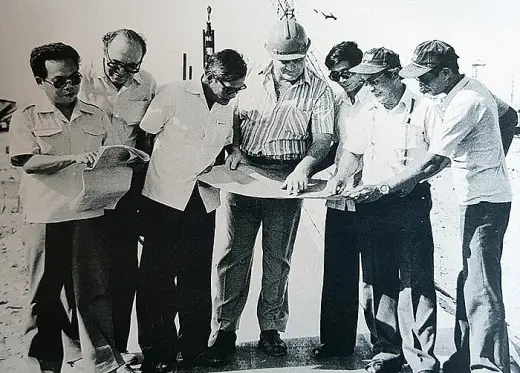
The first commercial oil from the White Tiger field was produced in 1986. For Vietnam, this was more than the discovery of a natural resource. The country now had a commodity it could sell for hard currency, along with the chance to build an entire economy around extraction.
The scale of the project became clear much later. By May 2024, Vietsovpetro had produced 250 million tonnes of oil—nearly 60 percent of all oil ever extracted in Vietnam. Its cumulative revenue exceeded 89 billion dollars, with the Vietnamese side receiving more than 58 billion in budget payments and profit.
At the beginning of the 1980s, however, there were no billions yet. There was the sea, the heat, a construction site and the first groups of specialists who had to turn a geological hypothesis into an oil industry.
A tropical assignment
Being sent to Vietnam was considered fortunate. A foreign assignment offered rare professional experience, a special status and a glimpse of a world that most Soviet citizens knew only from newspapers. Before leaving, specialists were advised to pack light cotton clothes, open shoes, wide-brimmed hats and remedies against mosquitoes and cockroaches. Such items in the official instructions quickly brought the future conqueror of the continental shelf back down to earth: deal with the mosquitoes first, then build an oil power.
In the early years, people arrived not in a completed residential compound but at a vast construction site. The climate was unfamiliar, the food strange and communication with home slow. The humid heat continued through the night, monsoon rains turned streets into streams, and ordinary household matters suddenly became separate challenges.
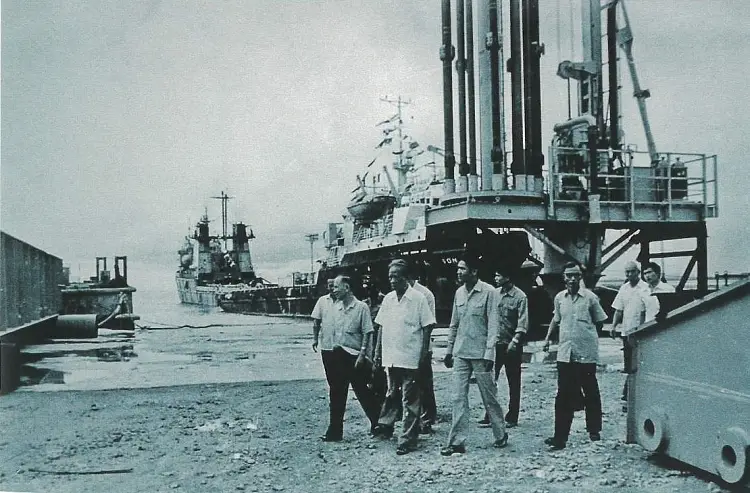
An overseas assignment did not automatically make a person rich. Soviet specialists' salaries were set in Moscow and, according to archival records, Vietsovpetro employees could earn less than Soviet personnel sent to Vietnam through other agencies. There were bonuses for long service: after several years, a worker received an extra monthly salary, and after five years, two. The system encouraged people not to make brief visits, but to build a real life in a new place.
After drilling equipment, the most important working tool was the interpreter. Many Vietnamese engineers spoke Russian because they had studied in the USSR or worked with Soviet teachers. Technical lectures, instructions and documents were translated into Vietnamese. Yet a complex industrial idea that passed through several layers of translation could change beyond recognition. Instructors' recollections sometimes complain that a manager's words reached the audience in a distorted form.
There is no evidence that all Soviet oil workers were required to study Vietnamese. At work they were often helped by interpreters and Russian-speaking colleagues. Beyond the company gates, however, another kind of language lesson began: market prices, names of foods, the way home, and a few greetings and phrases without which it was difficult to live alongside the same neighbors every day.
Sometimes no words were needed at all. Vietnamese newspapers told of a bicycle repairman near the Russian compound. He spoke no Russian and his customers spoke no Vietnamese, but someone would point to a chain, brake or wheel, mime the problem with their hands—and soon ride away on a working bicycle.
Five-story blocks under palm trees
Once it became clear that Soviet specialists would stay for years and many would bring their families, temporary accommodation was no longer enough. A Russian school opened at Vietsovpetro in 1984 with only 48 pupils. The first five-story residential block was completed in 1985, and the specialists began moving into their own neighborhood.
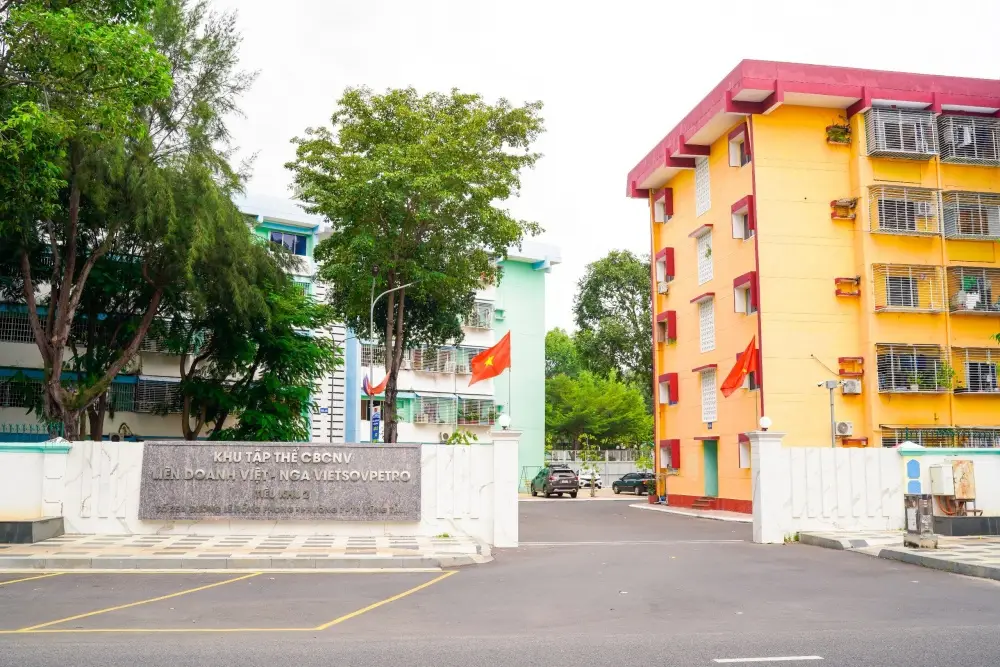
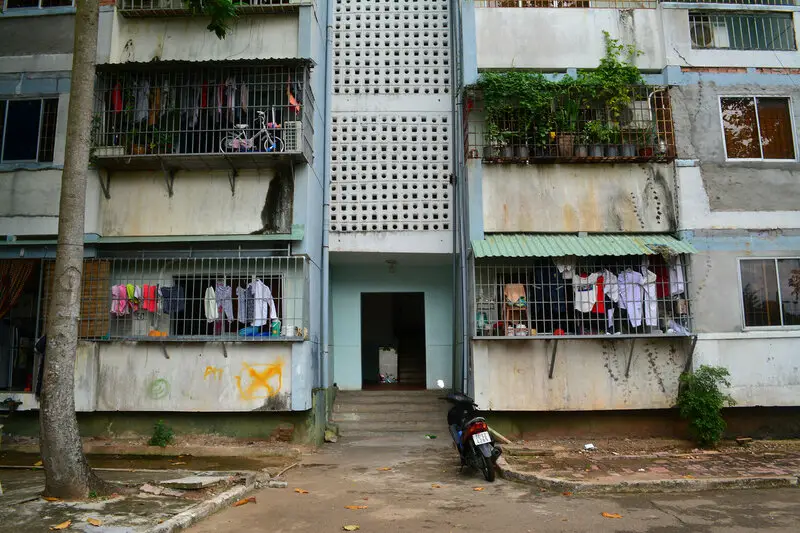
Gradually, the district acquired almost the full Soviet set: apartment buildings, a kindergarten, a school, a medical post, canteens, shops, a club, a library, a football field, tennis courts and volleyball grounds. Only tropical trees rustled between the buildings instead of birches and poplars, laundry dried on balconies within minutes, and the sea was within walking distance.
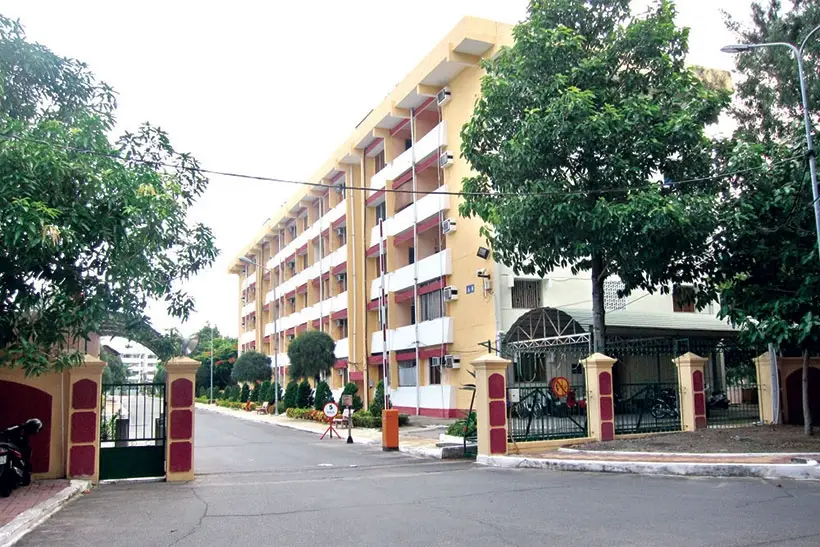
Sources disagree about the size of the community. Some count about 500 families and 1,200 residents; Vietnamese newspapers put the population at nearly 5,000 in its busiest years. They were probably counting different areas and categories of workers. In any case, this was no longer a small group of engineers but a large community with a life of its own.
The Vietnamese called the area not a Russian quarter or Russian street, but the Russian Village—làng Nga. Vietnamese journalists explained this almost poetically: here, “village” refers not to the size of a settlement but to an idea of neighborhood, community and people who know one another.
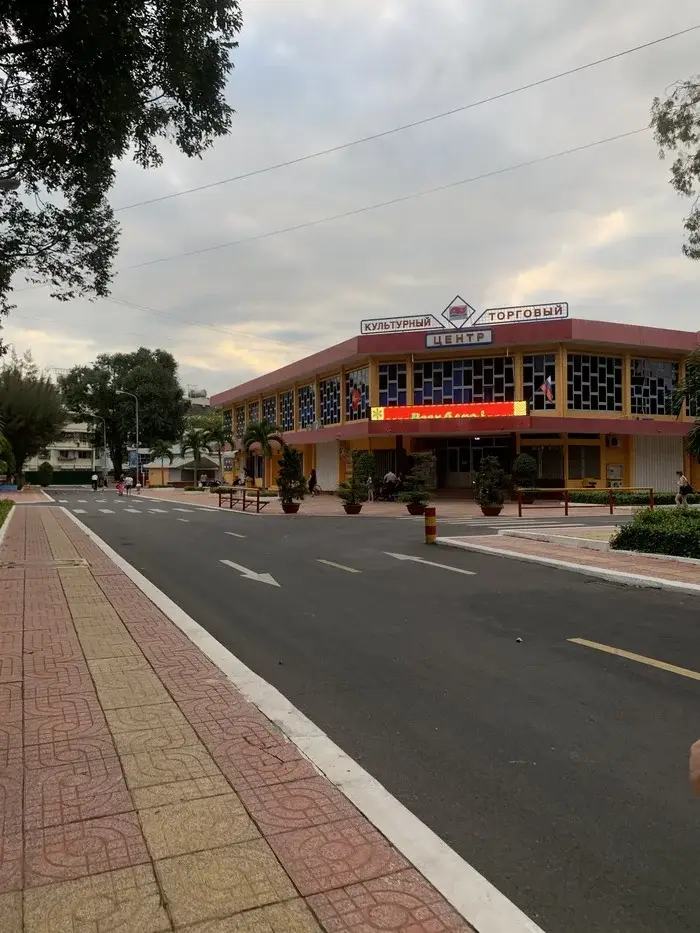
At the same time, the compound was a privileged place against the background of poor postwar Vietnam. The Soviet side proposed supplying the specialists separately with food from the USSR. Vietnamese authorities were wary: imported sausage, butter and other products behind a fence could turn a symbol of friendship into an uncomfortably visible display of inequality.
Life inside the five-story blocks was therefore never completely sealed off. Russians shopped at local markets, compared prices, learned to bargain and bought unfamiliar greens after their Vietnamese neighbors, sometimes without quite knowing what to do with them. Russian-language signs appeared around the compound.
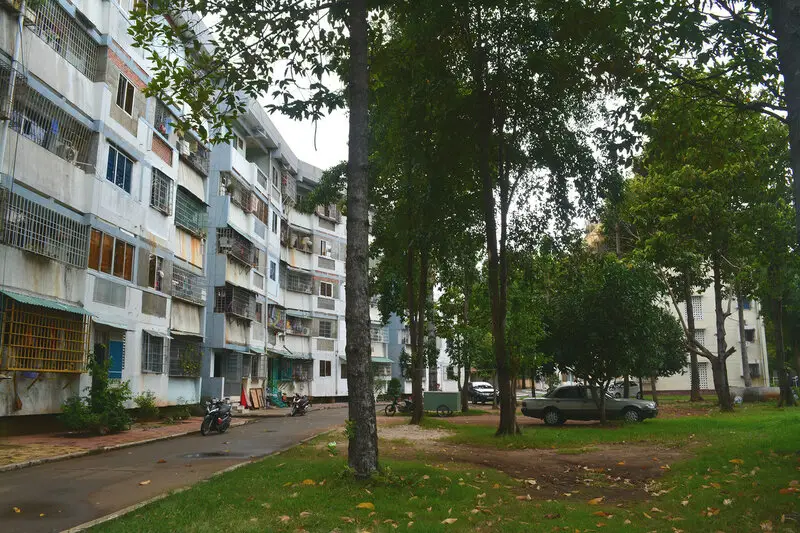
The boundary between the two worlds did not follow a wall but an ordinary internal road. Russians and Vietnamese walked along it to work every day. In the evenings, engineers and workers from both countries met on the volleyball court. Over the years, that road proved more important than any checkpoint.
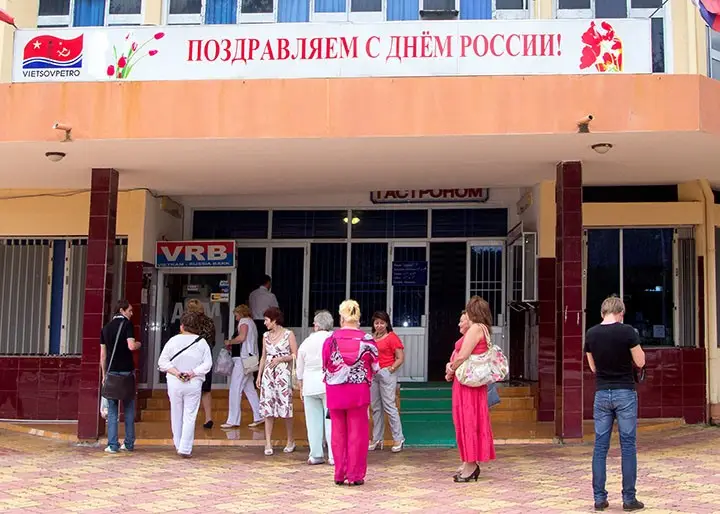
An ordinary life in an unusual place
For adults, Vietnam could remain a place of work. For children, it became childhood.
They lived in Soviet apartments, followed a Russian curriculum, read Pushkin and solved the same problems as schoolchildren in Tyumen or Baku. Beyond the school gates, however, lay the sea, tropical downpours, Vietnamese festivals and friends who spoke another language.
Vietnamese pupils eventually joined the Russian school. In the early 2010s, about 250 Russian and 20 Vietnamese children studied there together. Classrooms kept gifts that Vietnamese pupils had given their Russian friends. In the evenings, Vietnamese children from the neighborhood came to study Russian.
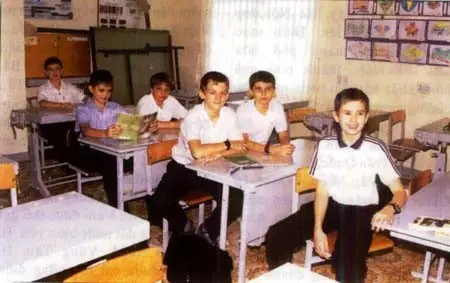
The school organized charity matches between Russian and Vietnamese pupils. Residents paid admission, and the money went to a local children's home. Children sold homemade pastries and national dishes at fairs, staged performances before Tet and bought gifts for the home's residents, from babies to teenagers. Russian pupils learned about Vietnam's Mid-Autumn Festival and then organized the celebration for other children themselves.
For parents, moving could mean a contract of several years. For a child, several years can be half a lifetime. Some started school here; some learned to swim in the South China Sea; some spoke Russian with their parents and switched to a mixture of languages and gestures with friends. Even today, pupils at the Russian school say they have both Russian and Vietnamese friends.
Sometimes working side by side turned into a family. One Russian student first visited Vietnam on an exchange, returned to Moscow and realized that she wanted to go back. A few years later she became an interpreter at Vietsovpetro, where she met an engineer from the Mekong Delta. A year later they married in his home province of Ben Tre. The language she had chosen as a profession led her to a family of her own.
Another story began in Russia in 1993. A young Vietnamese man arrived to study at a maritime technical university and met a Russian woman at a student gathering. They walked by the Volga, married two years later and moved to Vietnam. In Vung Tau, the husband worked as an industrial safety engineer and spent long periods on offshore platforms. His wife baked pastries at the shopping center in the Russian compound. When storms rose at sea, she went to the shore and looked toward the horizon where her husband remained.
They had three children. The two elder daughters later went to study in Canada, while the youngest stayed at the Russian neighborhood school. Russia, Vietnam and a third country met in one family, while home remained a five-story block in the oil workers' town.
In stories like these, “Soviet-Vietnamese friendship” stops being a slogan and becomes something entirely domestic: an invitation to Tet, a red envelope for a child, a football match, a homemade pie, worry for someone on a platform, and a wedding at which half the guests cannot understand the other half but celebrate together all the same.
White Tiger: the oil that changed Vietnam
If the Russian compound was the human heart of the project, its economic heart was the White Tiger field—Bạch Hổ.
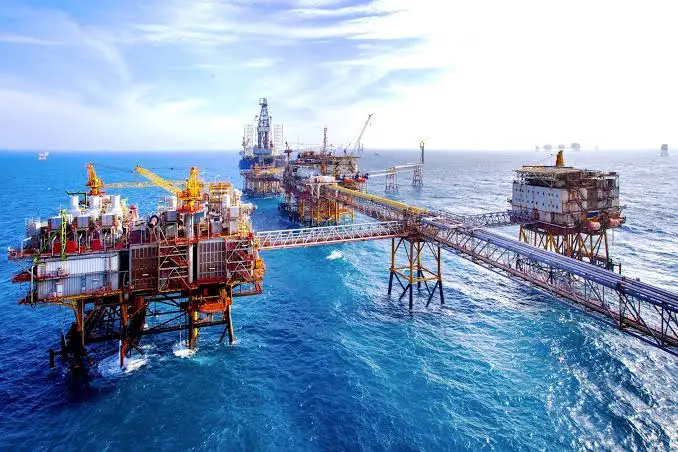
At first, oil workers looked where their textbooks told them to look: in sedimentary rock. Below lay ancient granite basement, considered the boundary beyond which no oil would be found. Yet in September 1988, a repeat test of one well produced a commercial flow of oil from fractures in that granite foundation.
The oil was not inside solid stone but in a network of fractures and cavities in an ancient weathered mass. For petroleum science at the time, the scale of the reservoir seemed almost incredible. The discovery entered industry literature as one of the most striking examples of production from granite basement.
About 200 million tonnes—four fifths of all the oil Vietsovpetro had produced by May 2024—came from these reservoirs. What first looked like a geological anomaly became the foundation of the country's oil prosperity.
Oil had a companion: associated gas. In the early years there was almost nowhere to use it, so it was burned on the offshore platforms. Flares glowed continuously over the sea. Vietnamese estimates suggest that roughly 4.5 billion cubic meters were lost before industrial collection began—in a country desperately short of electricity.
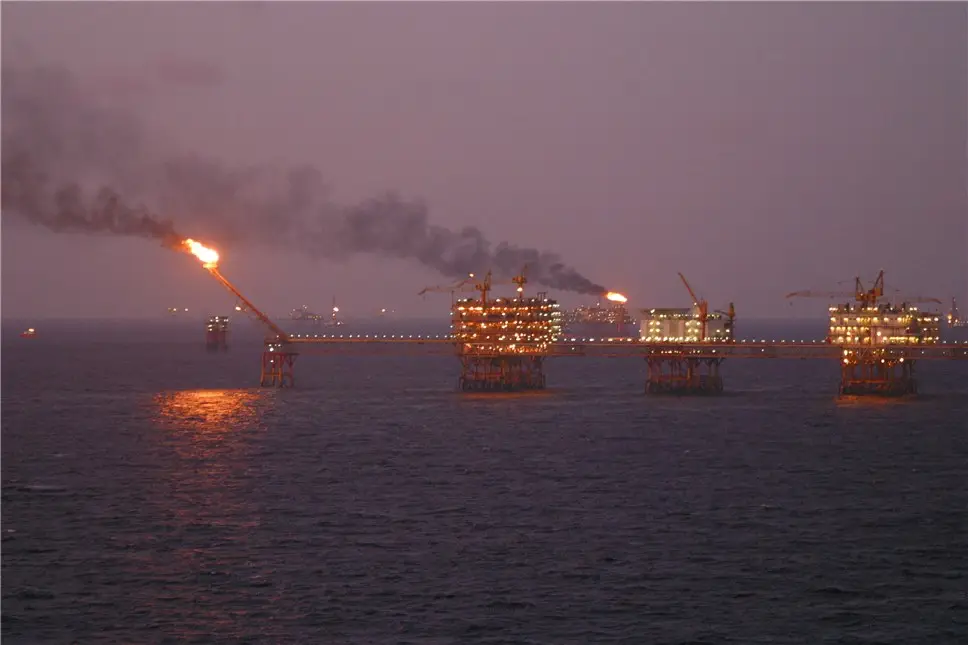
In the mid-1990s, the decision was made to bring the gas ashore. South Korea's Hyundai Industries laid the 106.5-kilometer offshore section, while Vietnamese oil and gas organizations built the onshore line to Ba Ria and the coastal stations. Vietsovpetro, the Vietnam Gas Company and Canada's SNC-Lavalin designed the system together. Rather than wait for an offshore compressor station, engineers used the gas's natural well pressure. Seawater cooled it as it traveled along the seabed pipeline.
The first gas reached shore in April 1995. A few days later, the Ba Ria power plant began feeding electricity into the grid and was able to stop using expensive diesel fuel. White Tiger gas later went to other power plants and to the Phu My fertilizer factory. What had once burned uselessly above the platforms became electricity for cities, energy for factories and fertilizer for Vietnamese fields.
Oil followed a similar path. At first Vietnam exported almost all of it because the country had no large refinery of its own. Then came the Dung Quat refinery, originally designed mainly for light, low-sulfur White Tiger crude or similar feedstock. It began producing petrol, diesel and Jet A-1 aviation fuel.
In 2011, Vietnam Airlines received its first shipment of jet fuel from Dung Quat. Petrolimex became a major buyer of the refinery's products, distributing fuel through its ordinary service-station network. The oil for which the Russian town had been built could therefore end up in the tank of a Vietnam Airlines aircraft or a car at a Petrolimex pump.
Today it is impossible to trace a particular batch. Dung Quat processes several Vietnamese and imported crudes; feedstocks mix in storage tanks and refined products enter a common supply system. But the chain itself is real: the sea off Vung Tau, a well in granite, a refinery, an aircraft in the sky and a petrol station by the road.
Vietsovpetro's production peaked in 2002 at about 13.5 million tonnes. White Tiger then began to age. Pressure fell, wells produced more water and less easily accessible oil remained. Engineers now have to coax it from microscopic fractures by injecting water, lifting oil with gas and submersible pumps, and constantly adjusting well operating modes.
What remains of Soviet Vung Tau
The Soviet Union has been gone for more than thirty years. White Tiger passed its production peak long ago. Many of the first specialists returned home or retired, and their children grew up and scattered across different countries. Yet the Russian compound did not become an empty stage set.
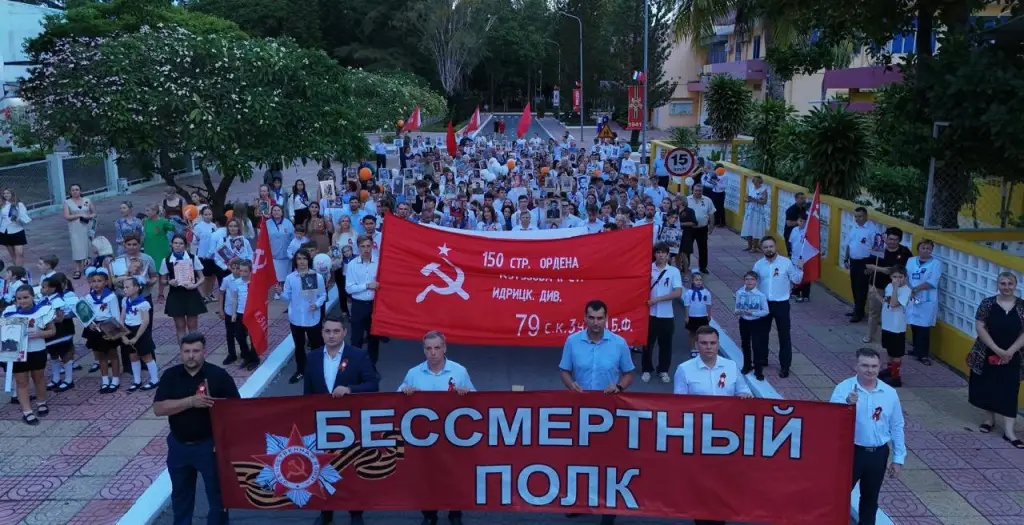
Official and media estimates say that roughly 400–500 employees representing the Russian side still work at Vietsovpetro, while Vung Tau's Russian-speaking community, including families, numbers about a thousand. Russian specialists receive apartments, and their children attend the same school that opened in 1984. It now has around 260 pupils.
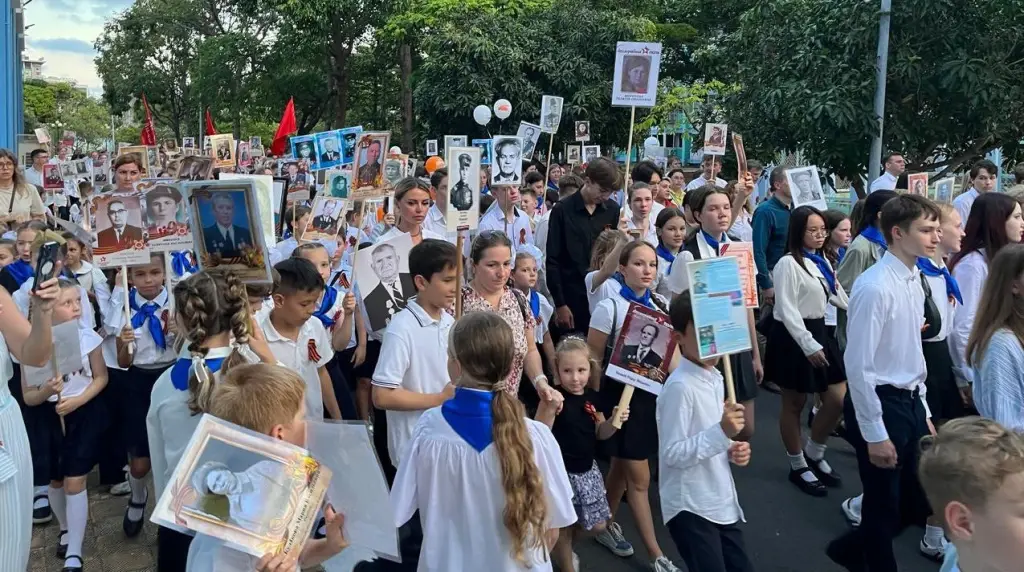
Vietnamese professionals have meanwhile taken over most jobs that once could be done only by Soviet specialists. Russians no longer come to build an oil industry from scratch. They arrive as geologists, drilling and production engineers, experts in automation, offshore structures and difficult mature fields, as well as managers, interpreters and teachers.
This is no longer a relationship between teacher and pupil. It is a collaboration between two engineering traditions that grew from the same project. Sometimes a Russian engineer's experience helps extend the life of an old platform. Sometimes a Vietnamese specialist knows the character of a particular well better than anyone after working with it for twenty years.
Foreign assignments continue. In a recent report, a Russian interpreter described moving to Vietnam with his wife and children in 2019. The family settled in the Russian compound, the children started school, and the parents grew accustomed to local food and Vietnamese coffee. For them, this is no longer a Soviet story but ordinary twenty-first-century life.
Work continues offshore as well. In 2025, a small automated platform called BK-24 began operating in the northern part of White Tiger. It has no permanent crew: the wells are controlled remotely, while oil travels through pipelines to existing White Tiger facilities. The first wells produced more than 400 tonnes per day. Almost forty years after development began, oil workers are still finding areas that can be brought into production.
Vietnam has long outgrown the oil economy of the 1980s. The country produces about ten million tonnes of oil a year but consumes far more fuel. It simultaneously exports some domestic crude and imports millions of tonnes from abroad. Dung Quat is better suited to light local feedstock, while Nghi Son is designed for Middle Eastern crude. Petroleum products made from Vietnamese and imported oil meet on the domestic market.
This is the central paradox of White Tiger's legacy. Oil helped Vietnam become wealthier, build industry and increase consumption so greatly that domestic production can no longer meet demand. A project created in pursuit of energy independence became one of the engines of growth—and that growth generated demand the country's own wells can no longer cover.
The Russian compound remains in place. In the mornings, vehicles once again leave the five-story blocks carrying specialists. The school bell rings. Children play outside, for whom the USSR is as much history as it is for their peers in Moscow or Hanoi. Out at sea, platforms built by generations of Russian and Vietnamese engineers continue to operate.
What may look like a fragment of a vanished era still exists in the present tense. The Soviet era ended, but the life it created did not.
Comments
Read also
All articles
Po Nagar Towers in Nha Trang: the goddess who outlived her kingdom
The story of the Mother of the Land and why people still bring her offerings.

A hotel of fantasies: how a Vietnamese revolutionary’s daughter built Crazy House
Concrete trees, family keepsakes and a building project that became a life’s work.
The “Long-Haired Army”: the story of Vietnam’s first female general
Women in southern Vietnam arrived at government offices with their entire families and spent weeks demanding the withdrawal of troops. One of the movement’s organisers…

Blood Oaths, Fire-Breathing Dragons and Hidden Mechanisms: The Story of Vietnamese Water Puppetry
How a rainy-season village pastime reached the imperial court and won over audiences around the world.
Tram Huong Tower in Nha Trang: why it is not a lotus and what is inside
Why the tower changed colour, what was displayed inside and how to visit.

Why Vietnam has two Women’s Days: the women who fought for rights and independence
A women’s newspaper, underground organizations, negotiations in Paris and letters from France: the history remembered in Vietnam on October 20.