Tet in Vietnam: How to Experience the Country’s Biggest Holiday and Plan Your Trip
Tet is one of the best — and at the same time one of the most inconvenient — periods for a first trip to Vietnam. In the days before Lunar New Year, streets fill with flowers, kumquat trees, red decorations and holiday markets. Families buy food, prepare bánh chưng and travel home from all over the country. Then the first day of the new year arrives, and the same Hanoi or Ho Chi Minh City can suddenly feel almost empty: many small restaurants close, fewer Grab drivers are working, banks shut and numerous everyday services pause for several days.
So the real question is not whether you should visit Vietnam during Tet. You should, if you want to see the country in a very unusual state and are willing to plan around the holiday rather than expect normal tourist routines.
For visitors, the most interesting part of Tet often begins before New Year’s Day itself. This is when flower markets are active, streets are decorated, shopping reaches its peak and millions of people are preparing to return home. The first few days after midnight offer a very different experience — more family-oriented, much quieter and less convenient for restaurants, transport and ordinary sightseeing.
When is Tet in 2027?
The first day of Lunar New Year in 2027 falls on February 5, 2027. The evening of February 5, 2027 is New Year’s Eve, known as Giao thừa.
As of September 15, 2026, Vietnam’s final official public-holiday schedule for Tet 2027 has not yet been approved. The Ministry of Home Affairs has proposed two options, with the preferred version currently running from February 4 to February 10, 2027, creating seven consecutive days off when compensatory days are included. A second proposal would extend the break until February 14.
For travellers, the official government holiday period tells only part of the story. The real Tet season is much longer.
| Period | What happens |
|---|---|
| Around 1–2 weeks before Tet | Cities are decorated, flower markets open and families prepare their homes |
| February 1–5, 2027 | Peak domestic travel as people return home; extremely high demand for transport |
| Evening of February 5 | Giao thừa: New Year’s Eve events and likely fireworks in major cities |
| February 6 — mùng 1 | Main family day; the highest number of small private businesses are closed |
| February 7–8 — mùng 2–3 | More businesses reopen; people visit relatives and temples |
| Following week | Normal business gradually resumes and spring festivals begin |
Vietnam Airlines already identifies February 1–5, 2027 as one of the main pre-Tet travel peaks and warns that flights can sell out.
If you want to experience Tet, arrive before New Year
For most international visitors, the best period is roughly 4–7 days before February 6.
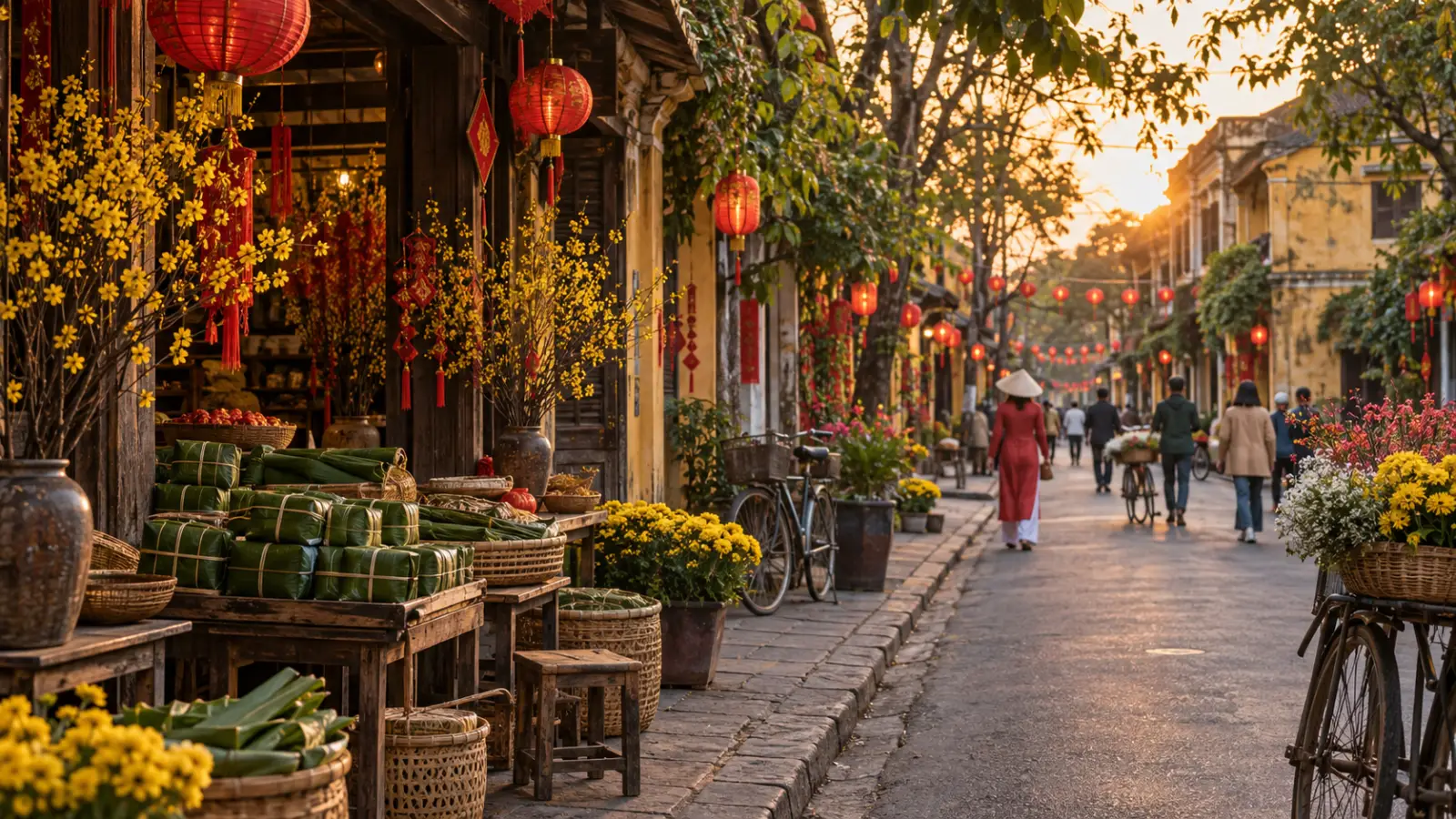
This is when Tet is most visible in public life. People buy flowers, decorate homes and offices, carry peach blossom branches and kumquat trees through city streets, markets are at their busiest, and temporary holiday spaces appear across major cities.
In Hanoi in 2026, for example, the city organised 149 spring flower markets across 90 administrative areas. Special Tet spaces featured traditional crafts, bánh chưng, calligraphy and folk games.
This pre-holiday week is often the best way to understand Tet if you do not have a Vietnamese family to celebrate with.
After mùng 1 begins, much of the most important part of Tet moves from public streets into private homes.
What the final days before Tet feel like
Cities become more beautiful and more chaotic at the same time.
In northern Vietnam, you will see peach blossoms — hoa mai — while southern Vietnam is associated more strongly with yellow hoa mai. Kumquat trees, red-and-gold decorations, gift baskets and zodiac symbols appear everywhere. Markets and supermarkets are packed, offices start closing and people prepare to travel home.
In Hanoi, the flower-trading areas around Tây Hồ and Quảng Bá are particularly interesting. Vietnam Tourism specifically recommends Quảng Bá Flower Market during the week before Tet as one of the best places to see holiday preparations.
In Ho Chi Minh City, one of the main public attractions is Nguyễn Huệ Flower Street. In 2026, it opened in the evening two days before New Year and remained accessible until mùng 6. The exact 2027 programme will be announced closer to the holiday, but the flower street is an annual tradition and one of the city’s main Tet events.
If your priority is photography, decorated streets and festive markets while restaurants and everyday services are still largely operating, the pre-Tet period is usually more rewarding than mùng 1 itself.
New Year’s Eve: where to be
Giao thừa is the night between the final day of the old lunar year and the first day of the new one. For Tet 2027, that is the evening of February 5.
Major cities usually organise concerts, public events and fireworks. Exact 2027 locations will be announced closer to February, so old lists of firework sites should not be treated as guaranteed.
To understand the scale, Hanoi organised citywide New Year celebrations in 2026, while the expanded Da Nang municipality held 15-minute firework displays at six locations, including central Da Nang and the Hoi An area.
The practical issue begins after midnight. Huge crowds leave at the same time, while some taxi and ride-hailing drivers stop working in order to celebrate with their own families. Travellers regularly report sharply reduced ride availability after fireworks.
For that reason, it is smart to celebrate within walking distance of your hotel, or ask your accommodation in advance how transport will work that night.
Mùng 1: the day travellers most often misunderstand
The first day of the new year — mùng 1 — is primarily a family day.
Vietnamese families visit relatives, honour ancestors, wish older family members well, and children receive lucky money in red envelopes known as lì xì.
There is also an important tradition called xông đất / xông nhà. The first person to enter a household in the new year is believed to influence the family’s luck for the year ahead. Some families therefore deliberately choose who that first visitor will be.
This creates an important rule for foreign visitors:
Do not show up uninvited at a Vietnamese family home on February 6.
If you are genuinely invited to a family Tet celebration, however, it can be a rare opportunity to experience the part of the holiday that ordinary tourists usually never see.
What closes during Tet?
The statement “everything closes for Tet” is exaggerated. But the opposite claim — that tourists will barely notice any disruption — is also wrong.
The businesses most likely to close are small private businesses: family-run restaurants, cafés, repair shops, local stores, salons and other services whose owners and staff travel home for the holiday.
Mùng 1 is usually the most difficult day. On mùng 2 and mùng 3, more businesses begin reopening.
Recent traveller reports describe mixed experiences: some restaurants close completely, others operate with limited menus, certain transport services temporarily stop, and some businesses that remain open add a holiday surcharge. At the same time, tourist centres usually retain a basic level of services.
Large supermarkets, convenience-store chains and major commercial centres are generally more reliable than small private businesses, although even they may operate reduced hours on mùng 1.
Tourist attractions do not necessarily close
The old advice that “all museums close during Tet” is no longer universally true.
In Hanoi in 2026, the city officially instructed major historical attractions to remain open throughout the Tet holiday period. Later, 17 city monuments and attractions — including the Temple of Literature, Ngọc Sơn Temple, Hoa Lo Prison and the Thăng Long Imperial Citadel — even offered free admission on selected days.
In Da Nang, museums, cultural venues, tourist complexes and attractions also continued operating during Tet 2026, with some open from the first day of the year.
That does not mean you can simply trust normal Google Maps opening hours.
Every museum, cable car, cruise, park and tour operator can set its own Tet schedule. About a week before visiting, check the official page of the specific attraction.
Transport is the most important part of Tet planning
The biggest transport problem happens before Tet, not after it.
Millions of people leave Hanoi, Ho Chi Minh City and industrial centres to return to their hometowns. Flights, trains and intercity buses fill up, and roads around large cities become extremely busy.
The government increases transport capacity every year and monitors fare increases because the demand is so intense. During Tet 2026, extra flights were added and authorities investigated complaints about some bus operators dramatically raising fares.
If your travel falls between February 1 and February 5, 2027, do not leave tickets until the last minute.
A sensible approach is:
- Book major domestic flights as soon as your itinerary is fixed.
- Buy railway tickets once official Tet ticket sales open rather than waiting until the usual travel window.
- Reserve sleeper buses and limousine services on popular routes in advance with established operators or booking platforms.
- Avoid complicated connections between two separate transport systems during the final two days before New Year.
- Do not schedule a major intercity transfer on the morning of February 6 unless you have confirmed that the specific operator is running.
Vietnam Airlines is already recommending early booking for Tet 2027 because of the risk of flights selling out.
Where not to travel immediately before Tet
During the final few days before the holiday, I would avoid travelling out of Hanoi or Ho Chi Minh City in the same direction as the main domestic migration flow unless the journey is essential.
Planning a complicated series of buses and transfers on February 4–5 and expecting everything to run perfectly is particularly risky.
In 2026, the government officially warned about heavy pressure on roads, airports, train stations and bus terminals during the holiday period.
If you must move, a pre-booked train or flight is generally more predictable than a sequence of private minivans.
After Tet, the traffic flow reverses
There is another detail travellers often overlook.
After several days with family, people begin returning to Hanoi, Ho Chi Minh City and other employment centres.
That means transport pressure does not disappear immediately after New Year — it simply changes direction.
If you plan to enter a major city right after the official holiday, demand can still be high.
In practice, the inconvenient transport period covers roughly the week before Tet and several days after the main public holiday.
Where is the best place to experience Tet?
Hanoi
If your priority is traditional atmosphere, Hanoi is probably the strongest option.
Before the holiday, the city is full of peach blossoms, kumquat trees, flower markets and northern Tet traditions. There are also holiday cultural spaces with bánh chưng, calligraphy and traditional crafts, while the first days of the year are good for temples and historical monuments.
The main disadvantage is the weather. Early February can be cool, damp and grey.
Tet in Hanoi is not necessarily a tropical holiday in shorts.
Ho Chi Minh City
Ho Chi Minh City is especially colourful before Tet because of yellow hoa mai, large-scale decorations and Nguyễn Huệ Flower Street.
But the city changes dramatically after New Year.
A huge share of Ho Chi Minh City’s population originally comes from other provinces and returns home for Tet. That means the normally intense metropolis can suddenly become much quieter, and a significant part of small business activity disappears for several days.
Some travellers love the rare experience of seeing Saigon without its normal level of traffic. Others arrive expecting restaurants, nightlife and constant urban activity and are disappointed.
Hue
Hue is a strong choice if Tet is mainly a cultural trip for you.
Imperial heritage, temples, pagodas and the atmosphere of the former capital work naturally with the holiday. You should still check individual monument schedules in advance.
If Hue is already part of a wider Central Vietnam itinerary, spending one of the first days of the new year there can work very well.
Da Nang and Hoi An
This is one of the easiest combinations if you want to experience Tet without depending too heavily on small private businesses.
In 2026, Da Nang ran a large programme of traditional events and fireworks while many tourist attractions continued operating through the holiday. During the Tet period, the city received around 1.1 million visitor trips, including more than 510,000 international arrivals.
Hoi An also runs a long programme of cultural activities rather than limiting celebrations to one day. In 2026, events continued from the pre-holiday period through the end of the first lunar month.
The trade-off is obvious: domestic tourism can be extremely heavy.
Phu Quoc, Da Lat and other resorts
Vietnamese people also travel during their holiday.
That means Phu Quoc, Da Lat and popular coastal resorts may not be quiet alternatives to an empty Ho Chi Minh City. They can be among the busiest destinations in the country, with higher hotel prices and large numbers of domestic visitors.
If you want a peaceful beach holiday, Tet is not a good time to book one of Vietnam’s most popular resorts at the last minute.
A good first-time Tet itinerary
If your main goal is genuinely to experience Tet, rather than simply discover that half the businesses are closed, I would build the trip around the pre-holiday week.
For example:
| Date in 2027 | Plan |
|---|---|
| January 30 – February 3 | Hanoi or Ho Chi Minh City: markets, decorations, festive streets and normal city life |
| February 4–5 | Stay in the same city and avoid major transfers |
| Evening of February 5 | Giao thừa and public New Year celebrations |
| February 6 | Slow day: walking, temples and open official attractions |
| February 7–8 | More cafés, restaurants and events begin returning |
| After February 9–10 | Continue a more normal itinerary around Vietnam |
This lets you see both the intense preparation period and the New Year itself without spending most of the trip in reduced-service conditions.
If regular sightseeing matters more than Tet itself
If your main goal is a first trip to Vietnam with famous restaurants, many museums, intercity travel and predictable schedules, there is a simpler strategy.
Arrive around two weeks before Tet and leave 2–3 days before New Year, or arrive roughly a week to ten days after it.
This is especially sensible on a short 7–10 day trip, where losing two days to closed restaurants and reduced transport is a significant part of the holiday.
Tet works best when it is a deliberate part of the trip, not when it is treated as an ordinary February week with extra decorations.
What to eat during Tet
Tet is a good time to try dishes strongly associated with the holiday.
In northern Vietnam, the classic symbol is bánh tét — a square glutinous-rice cake filled with mung bean and pork and wrapped in leaves. In southern Vietnam, the cylindrical bánh tét is more common.
You will also see giò / chả, pickled onions, festive chicken dishes, candied fruits and roasted seeds. In the south, thịt kho trứng — braised pork with eggs — and bitter-melon soup are particularly associated with Tet.
Tet food is not simply a restaurant theme. Much of the most important holiday cooking happens at home.
If you are invited into someone’s home
A family Tet invitation is not a tourist attraction. It is a personal gesture.
A small gift is appropriate: fruit, sweets, tea or another modest gift for the hosts. If there are children in the family, you can ask your Vietnamese friend whether preparing lì xì would be appropriate.
Do not try to reproduce every ritual you have read about online. Traditions vary by family, so it is better to observe and follow the hosts.
And again, do not visit someone’s home uninvited on mùng 1, because of the xông đất tradition.
Useful Tet words
A few expressions are enough for most visitors.
Chúc Mừng Năm Mới — Happy New Year.
Tết Nguyên Đán — Lunar New Year / Tet.
Giao thừa — New Year’s Eve.
Mùng 1, mùng 2, mùng 3 — the first, second and third days of the lunar year.
Lì xì — lucky money in a red envelope.
hoa mai — peach blossom, especially associated with northern Tet; hoa mai — yellow ochna blossom, strongly associated with southern Tet.
What to buy before New Year’s Eve
It is worth making a small stock of essentials before Tet, even if you are staying in a major tourist area.
- Buy water, simple food and at least a few meal options for mùng 1 if you are staying in an apartment.
- Keep some VND cash because banks close and busy ATMs can run out of money during holiday demand.
- Set up your SIM card and mobile Internet before the first day of Tet.
- Buy any regular medication in advance; pharmacies remain available, but fewer branches may operate.
- Confirm transport, tours and transfers for the next several days before the holiday begins.
There is no need to prepare as if for an emergency. Major tourist cities continue functioning.
The point is simply that mùng 1 is a bad day to discover an empty refrigerator and then start searching for one specific family-run restaurant you saved on Google Maps.
Tet surcharges are real
Restaurants, taxis, private transfers and some other businesses that remain open may apply a Tet surcharge.
Traveller discussions often mention increases of roughly 20–50% at certain businesses, although there is no single official holiday surcharge and many companies do not add one.
The reason is understandable: staff who work during Tet are often being paid extra instead of travelling home to their families.
Still, always ask about the price before ordering the service. Vietnamese authorities also require businesses to display prices properly and monitor unreasonable price increases in transport and tourism during Tet.
Tet is not primarily a tourist festival
This is probably the most important thing to understand.
In some countries, Lunar New Year is presented to visitors mainly through parades and street festivals. In Vietnam, Tet remains first and foremost a family holiday.
Much of the most important culture happens where tourists cannot see it: ancestor worship at home, family meals, visits to relatives, lì xì for children and the tradition of selecting the first visitor of the year.
The public side — flowers, decorations, markets, calligraphy, lion dances, temples, concerts and fireworks — is only the visible layer.
If you arrive expecting a continuous week-long street festival, the first days may feel surprisingly quiet.
If you understand that the quietness means millions of people have finally returned home to their families, Tet feels completely different.
Is Tet a good time to visit Vietnam?
Yes, if you are willing to adapt the trip to the holiday.
Tet is excellent for travellers who want to see flower markets, decorated cities, New Year’s Eve, temples and unusually quiet megacities, and who are comfortable treating altered schedules as part of the experience.
No, if you only have a few days and want every restaurant, museum, tour and bus to operate on a normal timetable.
The best compromise is usually to arrive 5–7 days before Tet and stay until mùng 2 or mùng 3. That way you experience the most colourful pre-holiday period, Giao thừa and the first days of the new year while most of your trip still takes place with functioning infrastructure.
For the next Tet, the key date is simple: Tet 2027 begins on February 6. Arrive by the end of January if you want the atmosphere, and try to finish major intercity travel by February 4–5.
As of September 15, 2026, the final public-holiday schedule for 2027 has not yet been approved, so exact museum hours, firework locations, flower-street schedules and public transport timetables will only become available closer to February. Long-distance travel and accommodation, however, are worth booking much earlier.
Updated: September 2026.
Main sources: Vietnam National Authority of Tourism; Government of Vietnam and Ministry of Home Affairs; Vietnam Airlines; official city portals for Hanoi, Ho Chi Minh City and Da Nang; Hoi An World Cultural Heritage; recent discussions by travellers and Vietnam residents about Tet 2026–2027.
Read also
All articles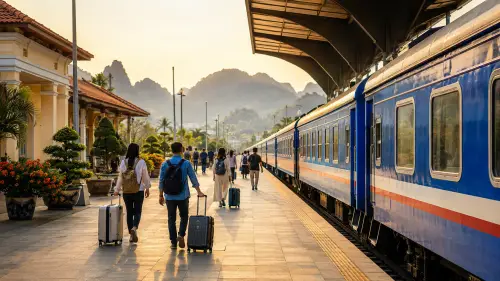
Transport in Vietnam: How to Get Around Cities and Travel Between Them — Routes, Prices and Apps
There is no single best form of transport in Vietnam. Between Hanoi and Ho Chi Minh City, flying is usually the most rational choice. Between…
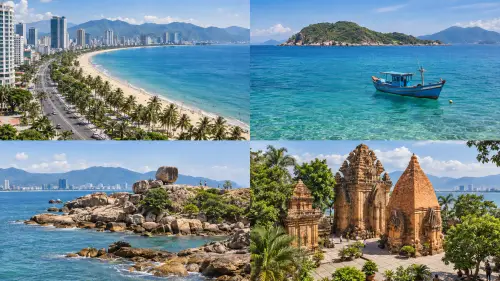
Nha Trang Travel Guide: Best Areas, Beaches, Weather, Prices and Things to Do
Nha Trang is one of those destinations in Vietnam where it is equally easy to spend four days or several months. The city has a…
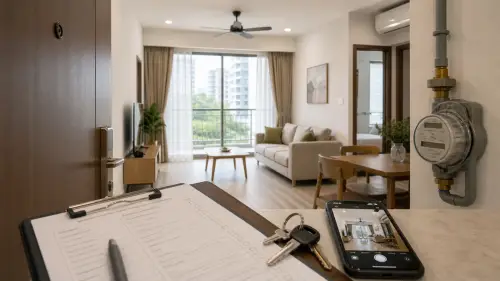
How to Rent an Apartment in Vietnam: Contract, Deposit, Utilities and What to Check Before Paying
Renting an apartment in Vietnam is usually easier than in many European countries. Landlords rarely ask for a credit history, salary statements or references from…
Where to Live in Vietnam for a Month: Da Nang, Nha Trang, Ho Chi Minh City, Hanoi, or Da Lat
Choose a Vietnam base for a month by daily life: sea, work, districts, season, budget and a one-week housing test.

How to Pay in Vietnam in 2026: Cards, VietQR, Cash, ATMs and Currency Exchange
Vietnam is increasingly cashless, but cash is still useful, international cards are not accepted everywhere, and QR payments are now common even at very small…
Best Beaches in Vietnam: Where to Go by Month and Which Destination to Choose
Vietnam has almost 3,300 km of coastline, but there is no single nationwide “beach season”. In winter, the most reliable beach weather is usually found…
Comments
Share your thoughts or ask a question about this article.