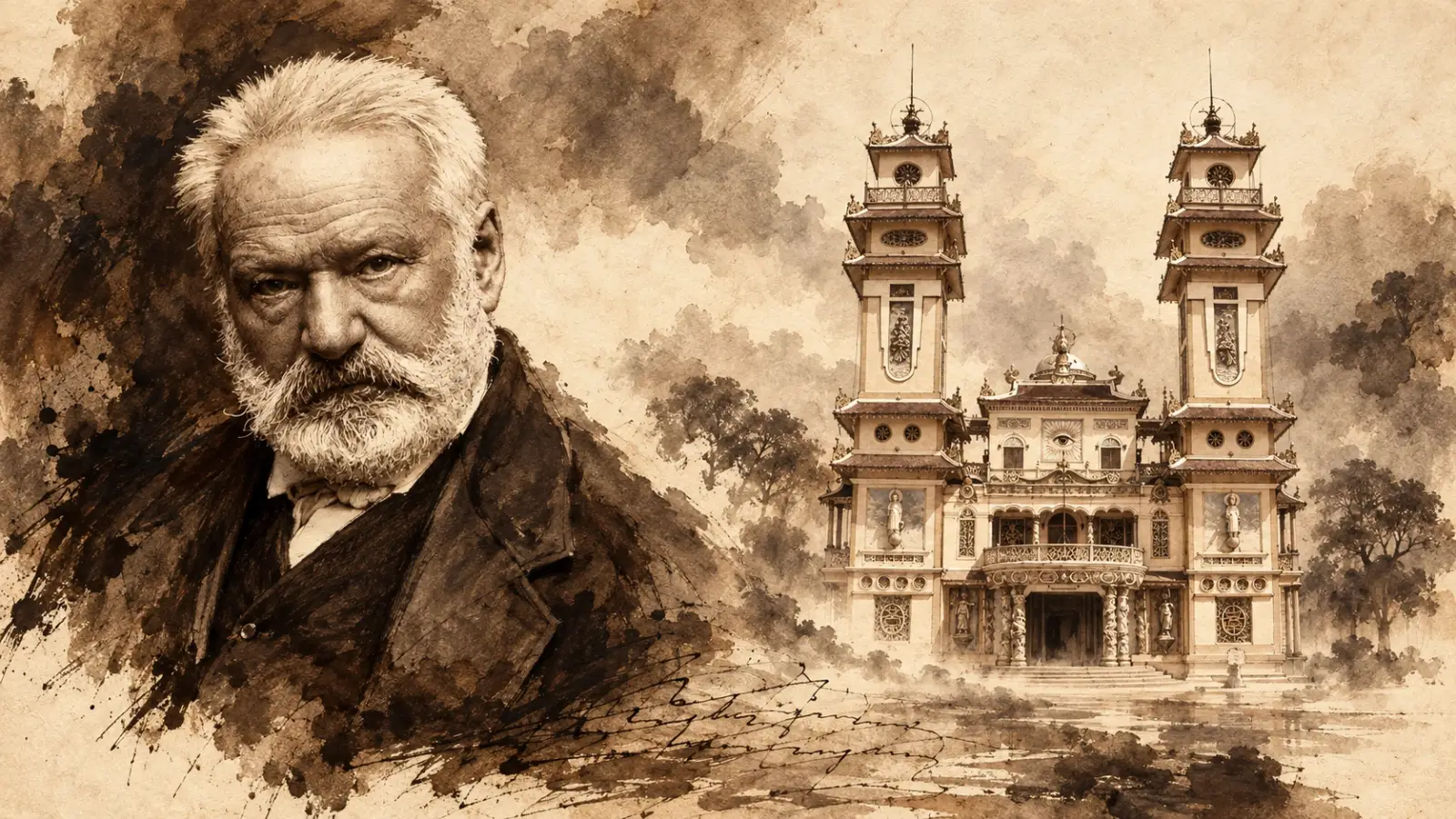
Cao Dai: how Victor Hugo became one of its saints
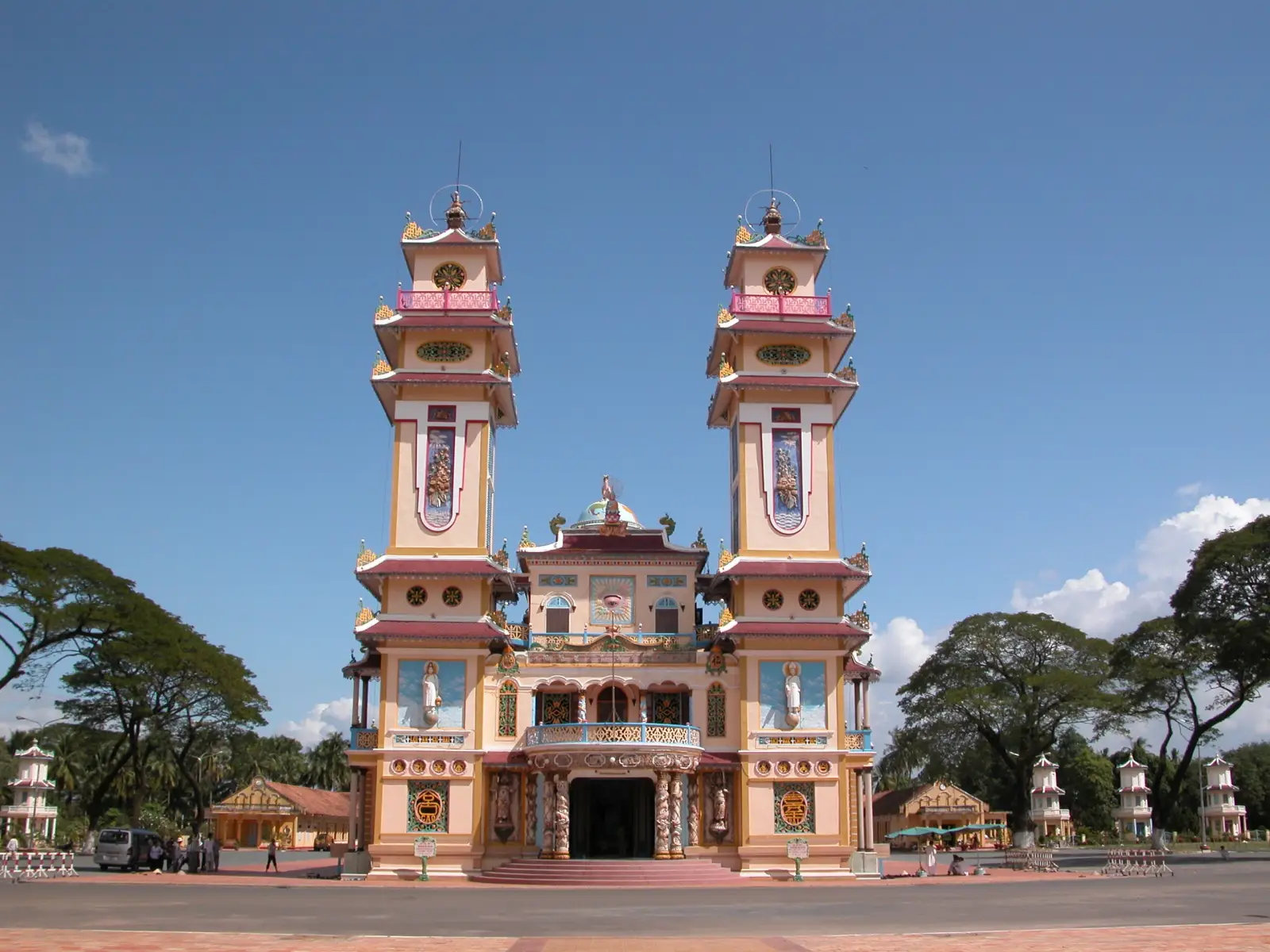
In southern Vietnam, about a hundred kilometres northwest of Ho Chi Minh City, stands the Tay Ninh temple. Dragons coil around its columns, while two towers resembling the bell towers of a European cathedral rise above the entrance. This is where followers of Cao Dai gather, a religion that emerged in Vietnam in 1926. They believe in one God and hold that the teachers of different religions passed on his guidance to humanity.
Near the temple entrance is a mural showing three men. One is Victor Hugo, the French writer who wrote Les Misérables and The Hunchback of Notre-Dame. Beside him stand a Chinese revolutionary and a Vietnamese poet. Cao Dai followers honour all three as saints. How did a French writer find himself in this company?
How Cao Dai emerged in Vietnam
The name Cao Đài consists of two words: cao means “high” and đài means “tower”. Together, they mean “high tower”. For believers, this evokes God's heavenly palace. They also use the name for God himself, and the religion takes its name from him.
In the early twentieth century, Vietnam was under French rule. Many educated Vietnamese learned French, read European books and worked in the French administration. At the same time, they retained an interest in their country's beliefs, where Buddhism, Taoism and Confucianism had long existed side by side. Within a single family, ancestor worship could coexist with Buddhist prayers and the moral teachings of Confucius.
Among the future followers of Cao Dai was a civil servant named Ngô Văn Chiêu. According to religious tradition, in 1921, while serving on Phu Quoc Island, he saw an eye in the sky and understood it as a sign of God's presence. An image of a single eye later became the new religion's main symbol. It is called the Divine Eye: for believers, it means that God sees people's actions and knows their thoughts.
In Saigon, today's Ho Chi Minh City, people were also gathering at this time to try to communicate with spirits. Among them was the customs officer Phạm Công Tắc. Those attending asked questions and wrote down answers that they regarded as messages from another world. They believed that certain people could receive these messages and pass them on to others. Such people are called mediums.
Gradually, a new teaching grew out of these meetings. The messages explained how to pray, what an altar should look like and how people should live. In 1926, the followers informed the French authorities that they were founding a religion, and that autumn they held a large ceremony at Gò Kén Pagoda near Tay Ninh.
Hugo and the talking tables of Jersey
In September 1853, a visitor arrived at Victor Hugo's home on the island of Jersey with an unusual proposal. The writer Delphine de Girardin insisted that it was possible to speak with the dead. All that was needed was a table.
Jersey lies in the English Channel, close to the French coast. Hugo was living there in exile with his family. He had opposed Louis-Napoléon Bonaparte's coup and had been forced to leave France.
Ten years before Delphine's visit, the family had suffered a devastating loss. In February 1843, Hugo's eldest daughter, Léopoldine, married Charles Vacquerie, and in September the couple drowned in the Seine. Léopoldine was nineteen. The family kept her wedding belongings; her father dedicated poems to her.
Delphine came to Jersey already a committed believer in “talking tables”. Such experiments were fascinating European salons at the time: people gathered around a table, placed their hands on it and waited for a sign from an unseen presence. If the table tilted or tapped a leg against the floor, they took it as a spirit's reply.
The first attempts at Hugo's house failed. Delphine decided that the table's square shape was to blame and went to a toy shop to buy another: a small, round table with three legs. But at first, the new table remained still too.
The answers had to be deciphered using an agreed code. One tap meant “yes”, two meant “no”. For longer messages, they counted letters of the alphabet: one tap for the first letter, two for the second, and so on. Even a short sentence had to be assembled little by little.
On the evening of 11 September, relatives and friends gathered around the table again. Among them was Auguste Vacquerie, the brother of Léopoldine's late husband. He later described this séance in detail in his memoirs. Vacquerie himself was initially sceptical, even explaining the table's first movements as the involuntary pressure of tired hands. During the conversation, however, those present came to believe that Léopoldine was speaking to them.
Hugo asked whether she was happy and received an affirmative answer. When he asked where she was, the table tapped out the word “light”. The writer then asked what he must do to join her. The answer was a single word: “love”.
According to Vacquerie's account, those gathered were crying. They were convinced that Léopoldine was beside them and answering their questions. The conversation continued: Hugo asked whether she saw her loved ones' suffering, whether she stayed near them and whether she would return.
After that evening, séances became a regular part of the family's life. The writer's son, Charles Hugo, played an important role: he was considered the main medium. Victor took part in the conversations and recorded messages, although he was not present at every meeting.
In time, the participants began addressing other figures too. They believed that Dante, Shakespeare, Plato and Jesus were answering them. Alongside questions to departed loved ones, the records began to include conversations about God, immortality and literature.
The séances continued until the autumn of 1855, leaving detailed records of questions, answers and participants' names. Hugo died in 1885, and some of these materials were published in 1923. Four years later, messages in his name began to be received in Phnom Penh.
How Hugo became a spiritual guide for Cao Dai followers
Phnom Penh is the capital of Cambodia, Vietnam's neighbour. In 1927, Cambodia still had a monarchy, but France exerted considerable influence over its government. Together with the territories of present-day Vietnam and Laos, Cambodia formed part of French Indochina. The French administration could therefore transfer an employee from Saigon to Phnom Penh. Such a transfer was given to Phạm Công Tắc, the customs officer who had helped found Cao Dai.
The authorities wanted to distance him from the growing religious movement. In Cambodia, however, Tắc continued meeting followers and holding séances. According to believers' accounts, the spirit of Victor Hugo began communicating with them in 1927.
Messages were received in French and Vietnamese. The participants knew the writer's works, and his own attempts to communicate with the dead echoed what they themselves were doing.
Cao Dai followers came to regard Hugo as a spiritual guide to those spreading the religion beyond Vietnam. His messages were intended to help them in this work. Within their faith, the writer acquired another name: Nguyệt Tâm Chơn Nhơn, which can be approximately translated as “spiritual teacher with a lunar heart”.
Cao Dai followers distinguish between the one God and spirits who help people. Hugo took his place among these guides. He was also linked to Nguyễn Du, the author of the celebrated Vietnamese poem The Tale of Kiều. According to one religious explanation, parts of a single spirit can be embodied in different people. This was how the connection between the two poets was explained.
Cao Dai followers also associate Hugo's name with prayers. Texts for weddings, prayers for the dying and the dead, and words for funeral rites are attributed to him. Believers hold that they received them from him during séances.
Three Saints and a covenant with God
We can now return to the mural near the entrance of the Tay Ninh temple. On the left is Sun Yat-sen, the Chinese politician who fought imperial rule. Hugo stands in the centre, and on the right is Nguyễn Bỉnh Khiêm, a sixteenth-century Vietnamese scholar and poet. He was also credited with the ability to predict the future.
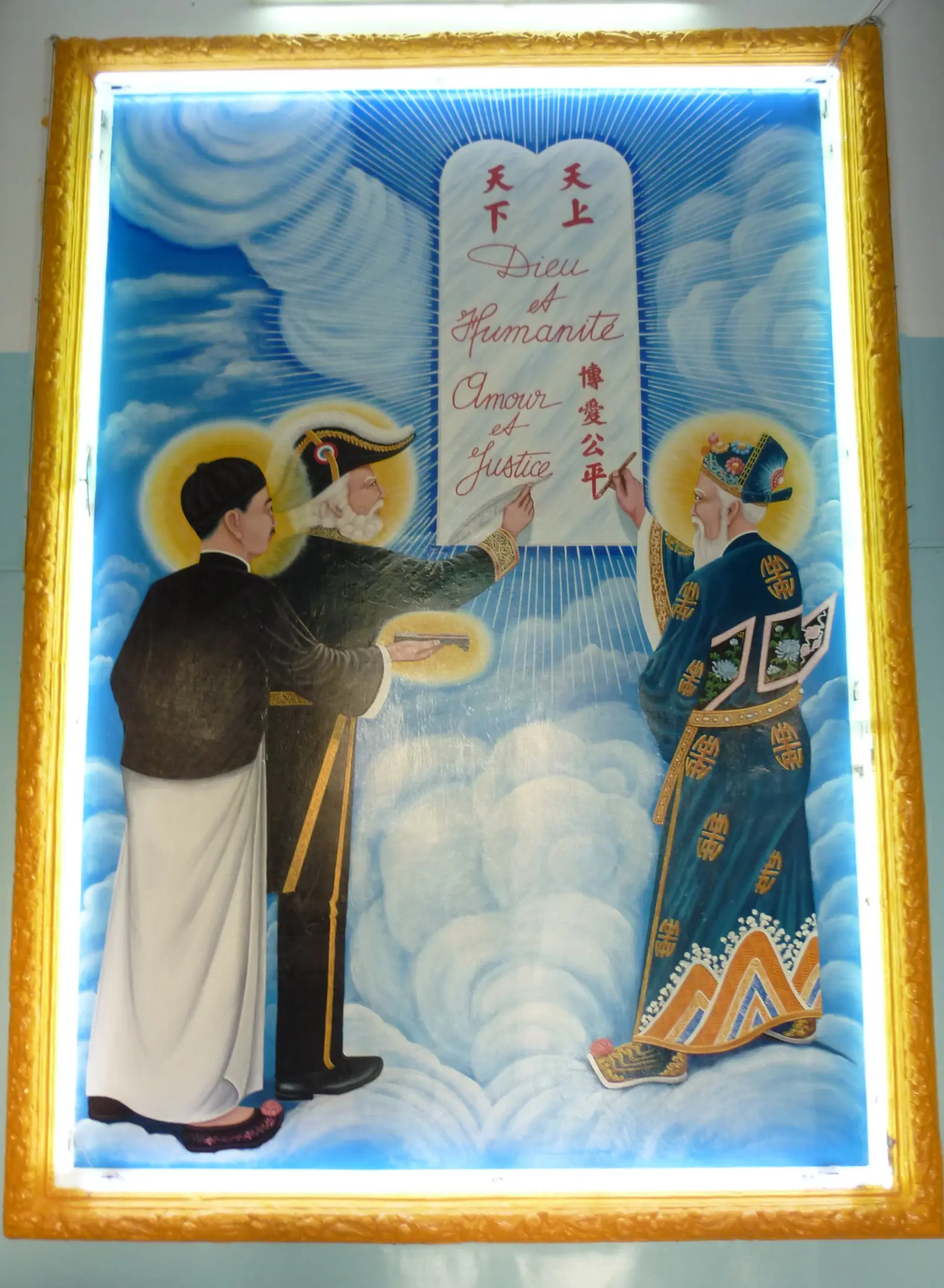
Sun Yat-sen holds an ink pot while his companions write: Hugo uses a quill to write in French, and Nguyễn Bỉnh Khiêm uses a brush to write Chinese characters. The mural is called Three Saints. Cao Dai followers understand it as a scene depicting a covenant between God and humanity, with these three men representing humankind.
The French inscription reads: “God and Humanity. Love and Justice.” A Frenchman, a Chinese man and a Vietnamese man are engaged in a shared task. For believers, this is a sign that people from different countries can overcome hostility.
This mural is especially important to the Tay Ninh branch of Cao Dai, one of several currents within the religion.
There was also an understandable earthly history behind Cao Dai followers' affection for Hugo. Future believers encountered his books at school and read about compassion, injustice and human dignity. At the opening of the Phnom Penh temple in 1937, speakers spoke of their love for the writer they had known since their schooldays.
His works were translated and adapted in Vietnam. In one local adaptation of Les Misérables, the story was moved to Vietnam, and the priest who helps the protagonist was replaced by a Buddhist monk.
The Divine Eye and the colours of the Tay Ninh temple
Construction of the temple with Hugo's image at its entrance began in 1933, just a few years after Cao Dai emerged. Its ceremonial opening took place in 1955. Its design brings together towers resembling European bell towers, Asian dragons and symbols of the new Vietnamese faith.
Beyond the mural of the Three Saints lies the main hall. At its far end is a large sphere covered in stars and the image of a single eye. The sphere represents the universe, while the eye recalls the tradition of Ngô Văn Chiêu's first encounter with the new teaching. This symbol greets visitors on the façade and then appears before them again at the altar. Cao Dai followers depict God's left eye specifically, linking it with the east and the rising sun.
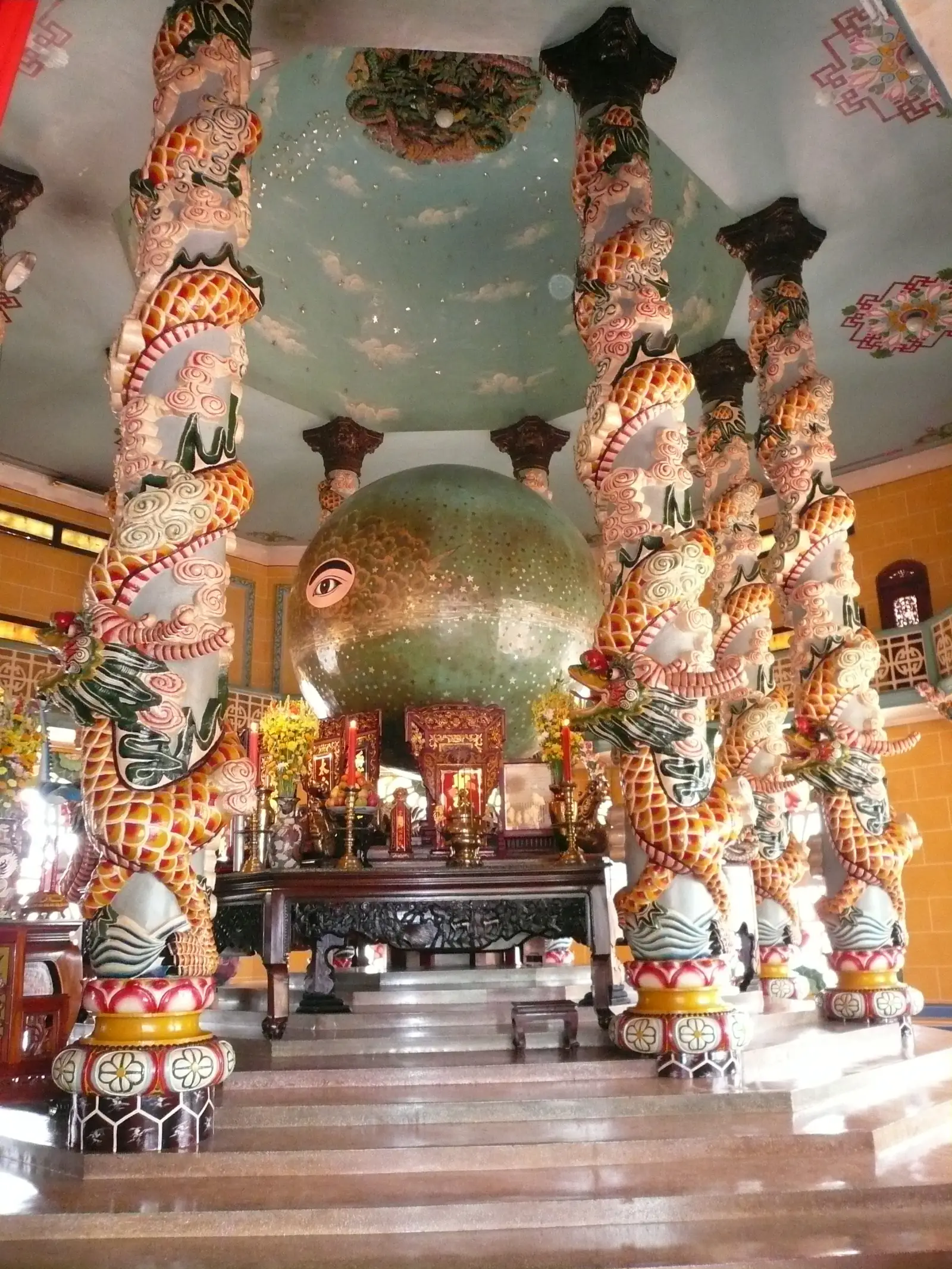
When religious officials gather for prayer, each takes an assigned place. The hall's floor rises gradually through nine levels. These correspond to nine ranks in the religious community, so people's positions during worship depend on their standing within it.
The same order is visible in their clothing. Yellow, blue and red robes stand out among the white ones. These three colours are worn by male clergy: yellow represents Buddhism, blue Taoism and red Confucianism. In this way, the idea of bringing different teachings together, with which Cao Dai began, becomes visible during communal prayer.
White is worn by many believers and female religious officials. Cao Dai followers associate this colour with purity and consider it to unite all the other colours. For them, it is another way to express the unity of people who have come to pray to one God.
Prayer, vegetarianism and everyday rules
A follower of Cao Dai can live with a family and work while observing religious rules in everyday life. Some of these rules concern food. On certain days of the month, believers abstain from meat, while those who take on stricter commitments remain vegetarian all the time. Thus, the same religion can encompass habits and ways of life that vary in strictness.
Other requirements are equally important for everyone. They are set out in Tân Luật, the Cao Dai code of rules. They include prohibitions on killing, stealing, lying and drunkenness. Particular attention is paid to how people treat one another. Slander, stirring up quarrels and breaking promises are also considered wrongs. Even a promise made to someone becomes part of a person's religious responsibility.
During communal prayer, these everyday concerns come together with beliefs about God and humanity. Flowers, wine and tea are brought to the altar. For a believer, each of these offerings stands for a part of their own life.
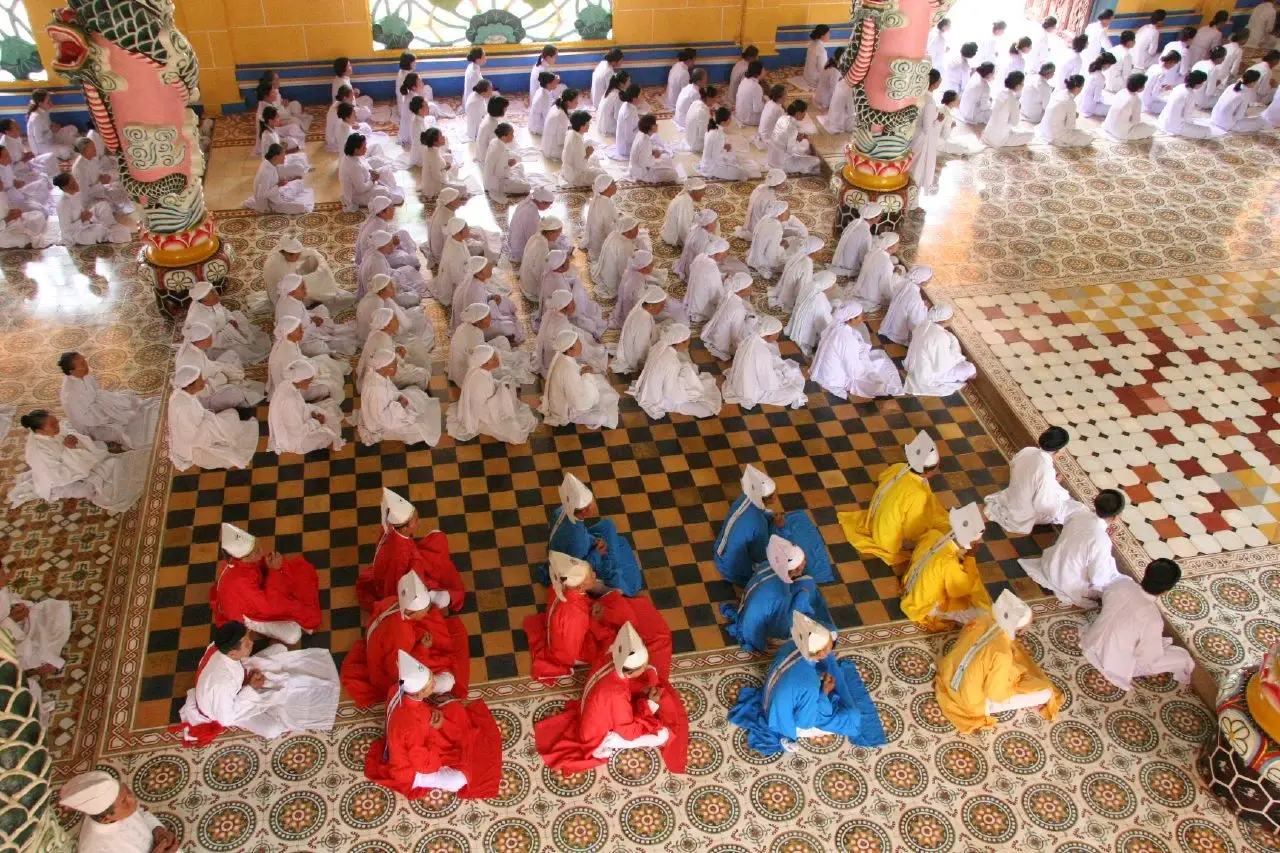
Flowers represent the body: everything in a person that belongs to the material world. Wine is associated with vital energy, and tea with the spirit. By offering them, a Cao Dai follower therefore dedicates their whole self to God: their body, strength and spiritual life.
Comments
Read also
All articles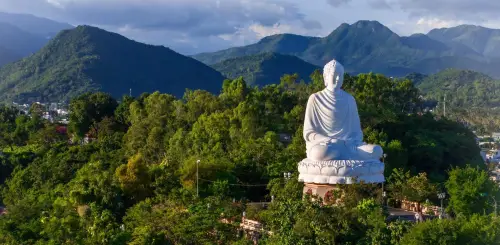
Long Son Pagoda and the White Buddha in Nha Trang: what to see and how to get there
From a small thatched temple to a giant Buddha on the hilltop.
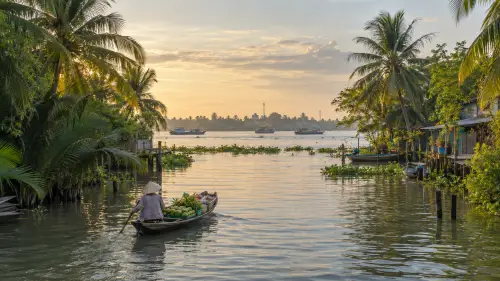
Mekong Delta: How to Plan Your Trip and What Is Actually Worth Seeing
The Mekong Delta is not a single attraction near Ho Chi Minh City. It is a huge region of rivers, canals, rice fields, orchards and…
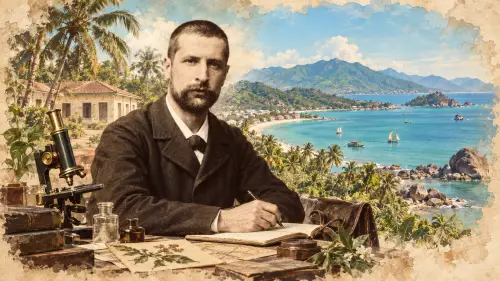
From Paris to Nha Trang: How Alexandre Yersin Became a Legend in Vietnam
He arrived from Europe with a microscope, identified the bacterium behind plague, and could have returned to Paris. Instead, he chose Nha Trang. Why do…
Hue, Da Nang and Hoi An in 5–7 Days: A Practical Central Vietnam Itinerary
Hue, Da Nang and Hoi An are close enough to combine in one trip, but they should not be treated as three similar stops. Hue…
A hotel of fantasies: how a Vietnamese revolutionary’s daughter built Crazy House
Concrete trees, family keepsakes and a building project that became a life’s work.
Operation Babylift: what became of Vietnamese children taken from home
New families overseas and parents left in Vietnam. What was the price of being saved?