Long Son Pagoda and the White Buddha in Nha Trang: what to see and how to get there
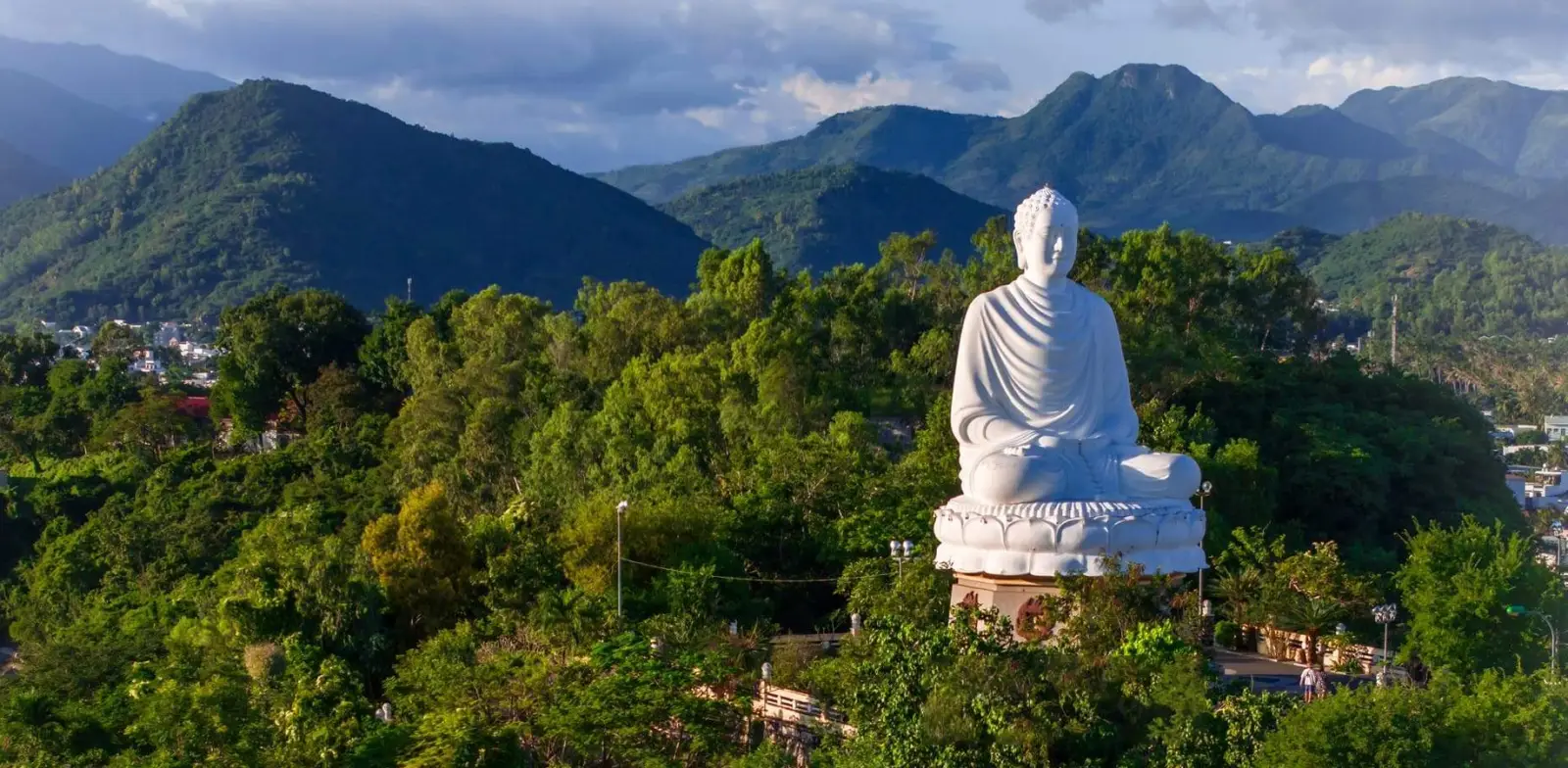
Nha Trang has its own White Buddha. He sits on an enormous lotus on a hilltop, towering above Long Son Pagoda. A staircase leads up from the temple — almost two hundred steps, which make themselves particularly noticeable in the midday heat.
When the monk Thich Ngo Chi founded a temple here in 1886, the enormous Buddha did not yet exist. A small thatched-roof building stood on top of the hill, roughly where the statue sits today.
The temple that moved down the hill
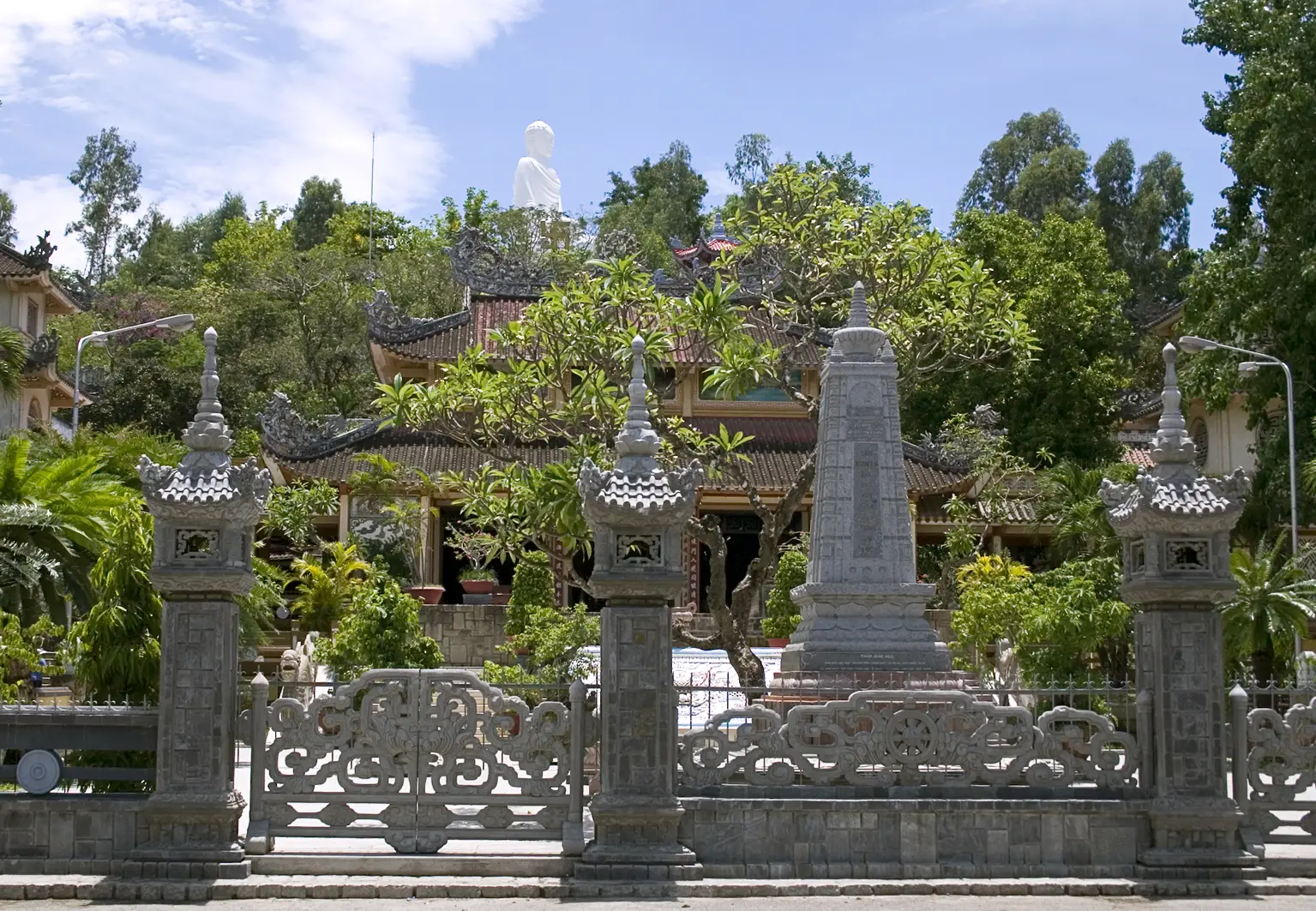
The pagoda was originally called Dang Long. It stood on the summit for fourteen years, until a powerful storm struck Nha Trang in 1900. The building was destroyed, and its founder decided to move the temple to the foot of the hill. At its new location, it was given the name Long Son.
The pagoda was subsequently rebuilt and enlarged several times. From a small thatched-roof building, it grew into a temple complex that became one of the centers of Buddhist life in Khanh Hoa, the province to which Nha Trang belongs.
Buddhist organizations established their offices here in the twentieth century, and a school for training monks opened in 1982. People came to Long Son to study, pray and make pilgrimages.
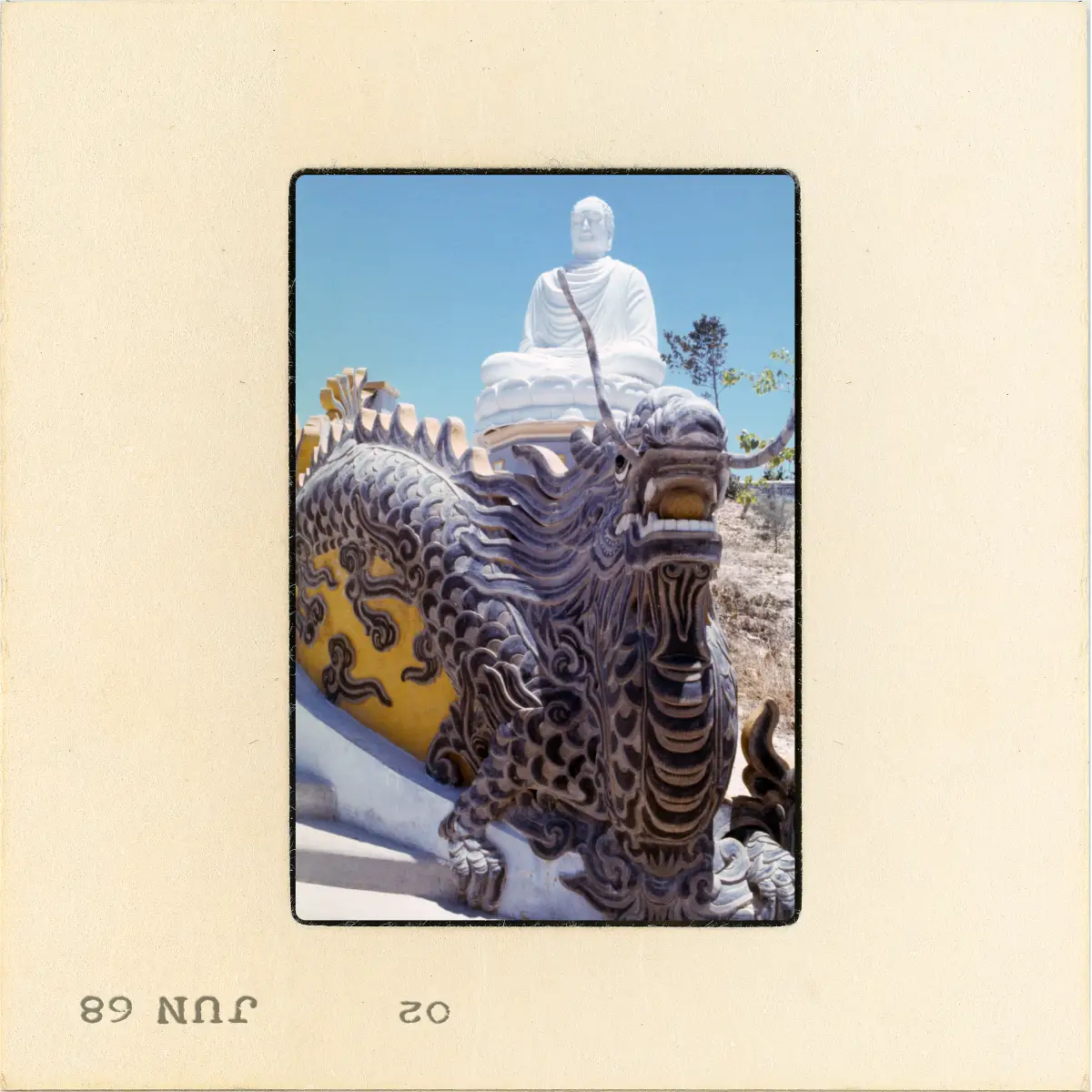
The pagoda took on its present appearance gradually: buildings were restored, and new statues and monuments were added to the grounds. The enormous White Buddha only took his place on the summit in the 1960s, almost eighty years after the temple was founded.
The pagoda at the foot of the hill
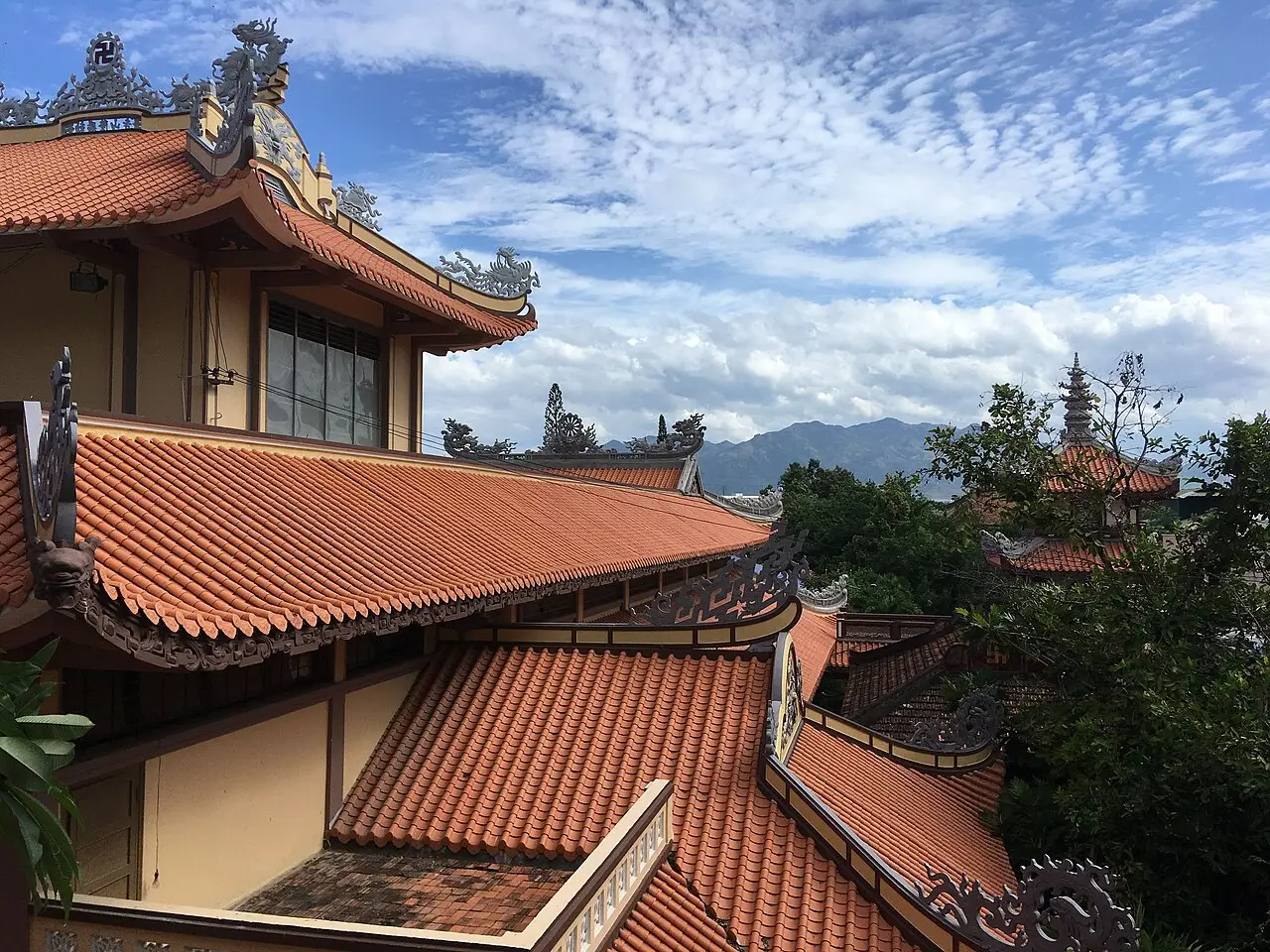
Stone dragons stand beside the steps leading to the main hall. The edges of the temple roofs curve upward, and reliefs decorate the facade. Trees grow around the buildings, with the hill and its staircase to the White Buddha rising behind them.
Inside the main hall is a bronze Buddha depicted teaching. The statue is about 1.6 meters tall and weighs approximately 700 kilograms.
A pair of enormous ceremonial candles also stands here, each 3.4 meters tall and weighing around 900 kilograms. They were made at An Phu Pagoda in Ho Chi Minh City and presented to Long Son in 2008.
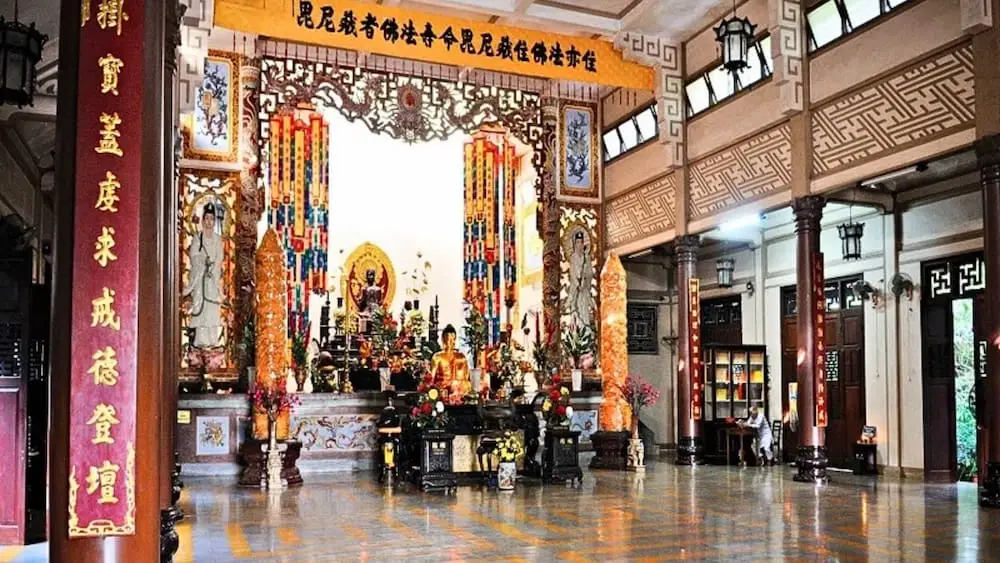
Long Son remains an active temple: people come here to pray, and religious ceremonies take place. If the main hall is open to visitors, you can enter after leaving your shoes at the entrance. During prayers, avoid walking between worshippers and the altar or approaching people at prayer to take photographs. Participation in rituals is optional.
The Reclining Buddha and the bell tower
A staircase of 193 steps leads from the temple to the summit. Along the way are the Reclining Buddha and the bell tower, where you can stop and rest during the climb.
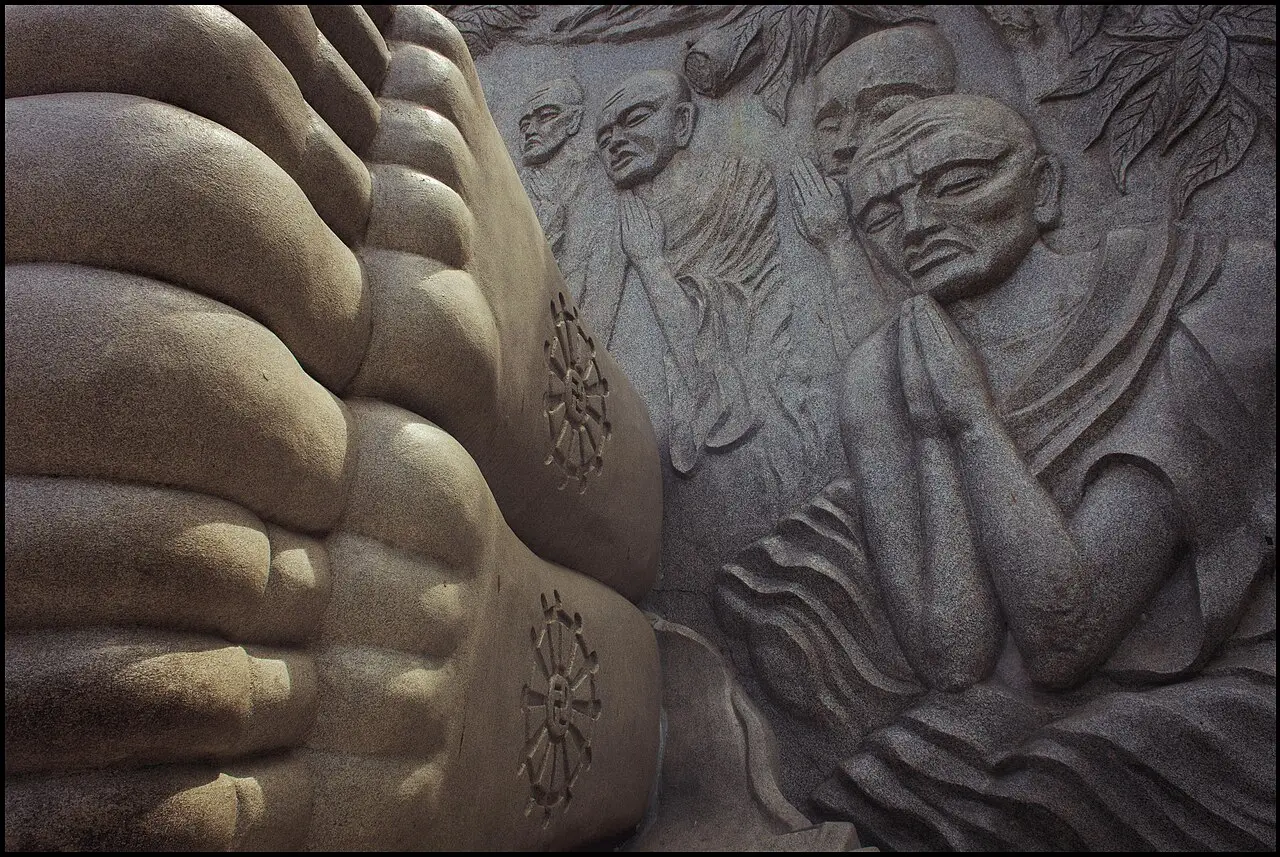
The Reclining Buddha was added to Long Son in 2003. He is depicted lying on his right side, with his head supported by his hand. Behind him is a relief showing disciples gathered around their teacher.
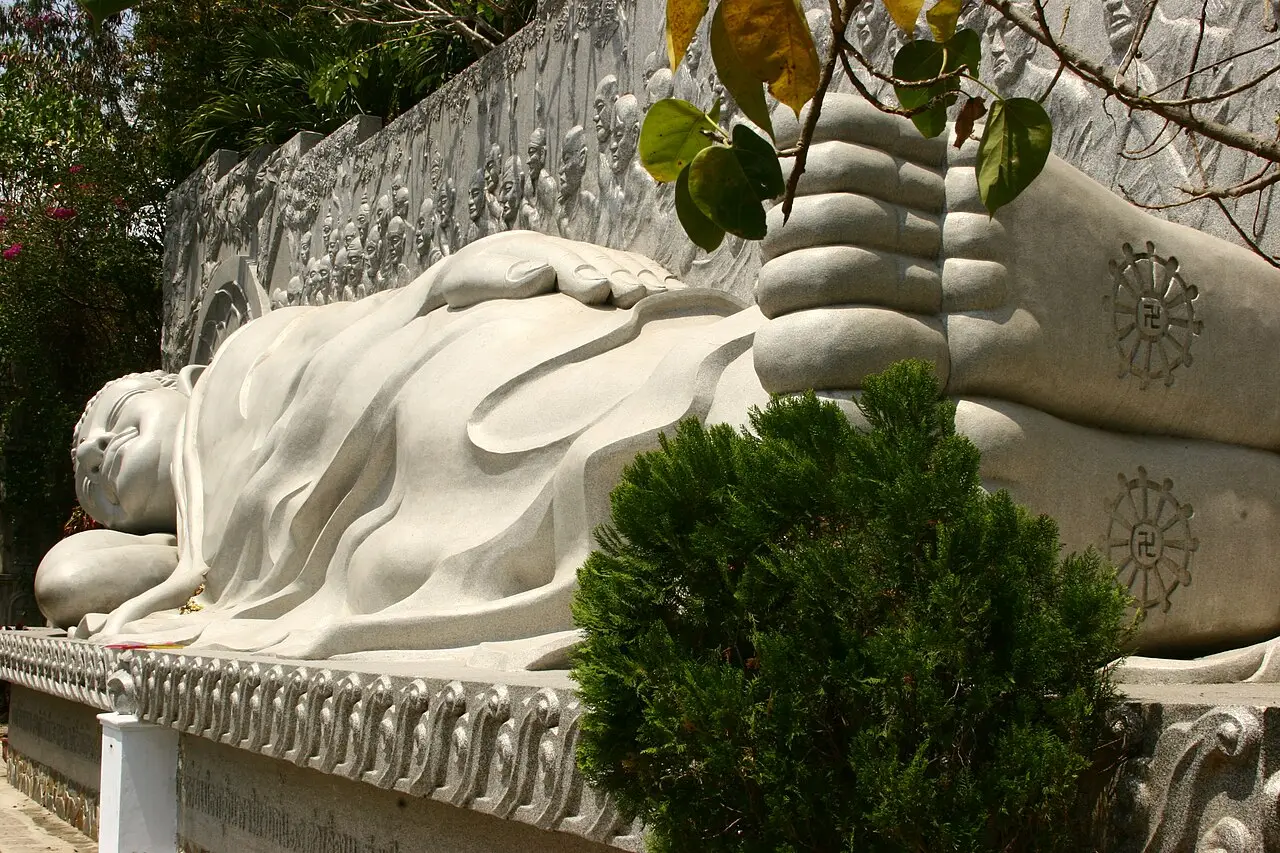
This pose appears in many Buddhist temples across Asia. It is associated with the end of the Buddha's earthly life and his entry into parinirvana. In Buddhist tradition, this means final liberation from the cycle of birth and death. The disciples depicted behind him belong to the same episode.
Farther up stands the bell tower, housing the large Dai Hong Chung bell. Buddhists from Hue donated it to the temple in 2002. The bell is about 2.2 meters tall and weighs approximately one and a half tonnes.
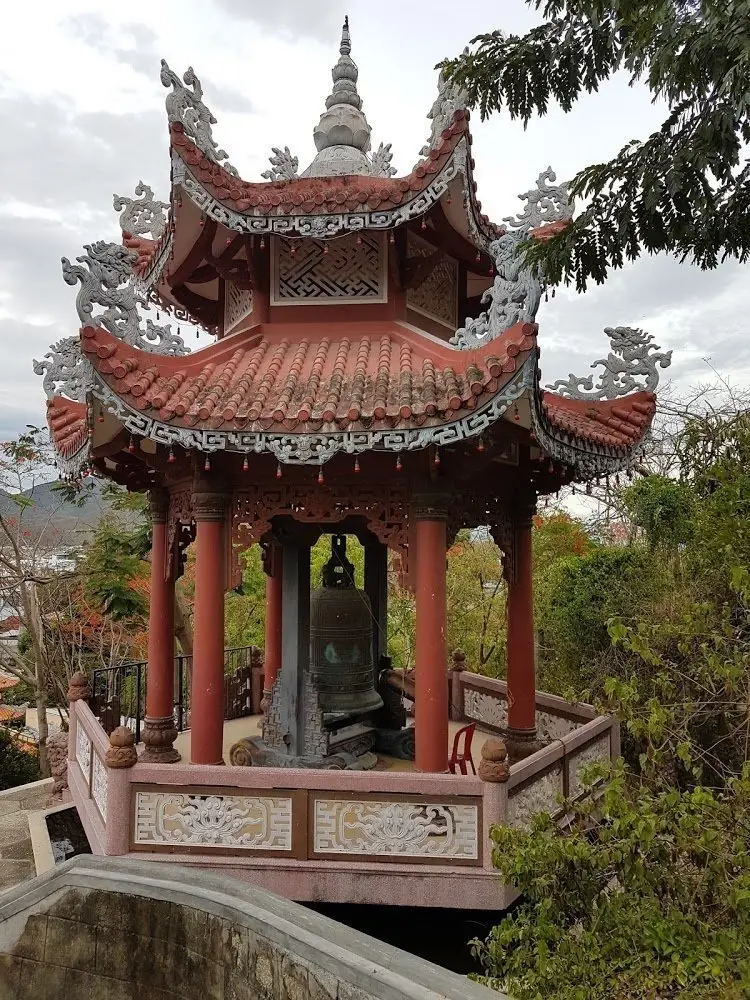
Ring it only with permission from the temple attendants. If someone nearby offers a paid service or participation in a ritual, first clarify exactly what is being offered and how much it costs.
The White Buddha and his head from Saigon
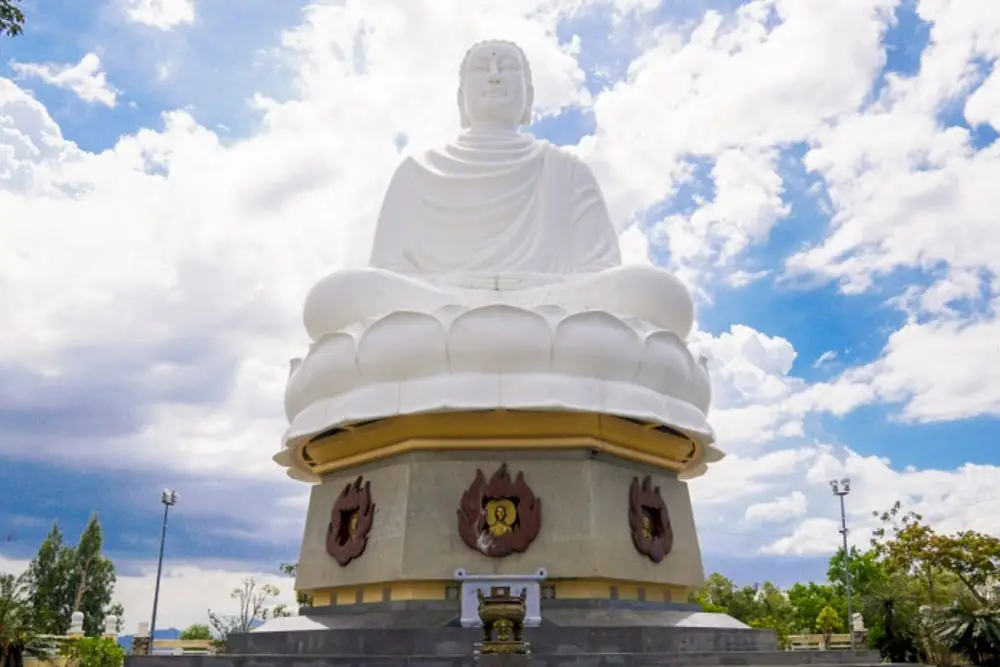
Buddha Shakyamuni, the historical Buddha whose teachings gave rise to Buddhism, sits on the summit. Beneath him is a large lotus pedestal.
The statue was made in sections. Its body was constructed on the hill itself, while the sculptor Phuc Dien made the head in Cholon, a district of Saigon, now Ho Chi Minh City. Buddhist temple researcher Vo Van Tuong dates this work to 1964–1965.
Guidebooks give different measurements for the White Buddha: 14, 21 and 24 meters. They refer to different levels of the structure. The figure is about 14 meters tall, while the entire monument rises approximately 24 meters from the platform. The seated Buddha alone is roughly as tall as a five-story building.
The statue can be seen from different parts of Nha Trang, including road and railway routes. The platform beside it overlooks the city's neighborhoods.
Portraits of the monks
Around the lotus pedestal are portraits of seven Buddhist monks who self-immolated in protest against religious persecution in South Vietnam in 1963.
The well-known photograph of the monk Thich Quang Duc self-immolating on a Saigon street dates from the same period. The photograph is held in the collection of the United States Library of Congress.
The persecution of Buddhists and the monks' protests formed part of the political and religious crisis in South Vietnam. At Long Son, these events are commemorated in the portraits at the base of the White Buddha.
Planning your visit
Allow an hour to an hour and a half for Long Son: enough to see the lower temple, climb with stops and spend some time beside the statue. You may need longer with children or frequent breaks.
Morning or later in the afternoon is preferable. At midday, the heat makes the climb harder, particularly on exposed sections. Bring water and a hat, and wear shoes that fit securely and have a good grip. Take particular care on the steps after rain.
With a child, you can first walk to the Reclining Buddha, rest and decide whether to continue. The staircase route is inconvenient for a stroller. Wheelchair access to the summit needs to be discussed with the temple in advance; do not assume that a step-free route is available. If the climb is unsuitable, you can limit your visit to the lower part of the complex.
Location and getting there
Long Son's address is 22, 23 Thang 10 Street, Nha Trang. The street's name means “23 October” and is sometimes written as 23/10. Search for Chùa Long Sơn in your navigation app. Russian-language maps may spell the name “Лонгшон,” “Лонг Шон” or “Лонг Сон.”
By taxi or ride-hailing app, the most convenient destination is the main entrance at the foot of the hill. Check the fare from your hotel: it depends on distance, time and the vehicle you choose.
If arriving by motorbike, confirm the parking location and price before leaving your vehicle.
Check a walking route on the map beforehand. Add the staircase within the grounds and the return journey to the walk from your hotel. If the distance is long, taking transport is more convenient.
Admission and opening hours
Admission is free. Parking, purchases and any services you choose are paid for separately. A guided tour and incense are not required to visit, and donations are voluntary.
Sources give different visiting hours: some describe access throughout the day, while others list morning and afternoon sessions with a break between them. It is best to arrive during daylight with time to spare. If you want to enter the main hall, check its availability on the day of your trip: the grounds and individual rooms may open at different times.
More worshippers visit on the first and fifteenth days of the lunar month and on religious holidays. Choose an ordinary weekday if you prefer a less crowded visit.
Clothing, photography and purchases
Wear clothing that covers your shoulders and knees. Long trousers or a long skirt and a top with sleeves are suitable. Remove your shoes before entering the main hall, and follow any additional instructions on site.
Speak quietly, silence your phone and do not touch offerings or temple objects. If sitting on the floor in the hall, do not point your feet toward the altar.
Keep passageways clear while taking photographs. Inside the temple, first check whether photography is allowed. Ask permission before taking a close-up portrait of a monk or someone praying.
Persistent selling has been a problem around Long Son: in August 2026, local authorities again took action against vendors following tourists.
If offered a souvenir, incense or guiding services, first establish the price and decide whether you want it. Do not accept items “just to hold” if you do not intend to buy them. Place donations in the designated box inside the temple.
After Long Son, you can continue your city itinerary to Nha Trang's Stone Cathedral or the Po Nagar Towers. Leave time for travel and rest between stops, especially on a hot day.
Comments
Read also
All articles
Mekong Delta: How to Plan Your Trip and What Is Actually Worth Seeing
The Mekong Delta is not a single attraction near Ho Chi Minh City. It is a huge region of rivers, canals, rice fields, orchards and…
Everyday Vietnam: How to Communicate at Markets, Cafés and in Vietnamese Homes
Travellers in Vietnam rarely need a deep understanding of local etiquette. Mispronouncing a word, choosing the wrong form of address or not knowing where to…
Tram Huong Tower in Nha Trang: why it is not a lotus and what is inside
Why the tower changed colour, what was displayed inside and how to visit.
No Sex, Music or Weapons: Life in the Coconut Kingdom During the War
A French education, a religion of his own and an island in the middle of the Mekong: the story of Nguyễn Thành Nam and the…
From Paris to Nha Trang: How Alexandre Yersin Became a Legend in Vietnam
He arrived from Europe with a microscope, identified the bacterium behind plague, and could have returned to Paris. Instead, he chose Nha Trang. Why do…
The “Long-Haired Army”: the story of Vietnam’s first female general
Women in southern Vietnam arrived at government offices with their entire families and spent weeks demanding the withdrawal of troops. One of the movement’s organisers…