Mekong Delta: How to Plan Your Trip and What Is Actually Worth Seeing
The Mekong Delta is not a single attraction near Ho Chi Minh City. It is a huge region of rivers, canals, rice fields, orchards and towns stretching across hundreds of kilometres. That is why the standard request to “visit the Mekong in one day” can be misleading: in one day you can only see a small part of the delta, usually around My Tho or Ben Tre. To reach Can Tho, see Cai Rang Floating Market at the right time, or continue to Chau Doc and Tra Su Forest, you need a separate multi-day trip.
Here, the number of days matters more than the number of attractions on your list. With one day, it makes sense to stay relatively close to Ho Chi Minh City. With two nights, Can Tho becomes practical. With three or four days, the delta starts to feel like a destination in its own right rather than just an excursion from the city.
The short answer
| Time available | What I would choose |
|---|---|
| 1 day | Ben Tre |
| 2 days / 1 night | Can Tho with Cai Rang, or Ben Tre + Can Tho |
| 3 days / 2 nights | Ben Tre + Can Tho + Cai Rang |
| 4 days / 3 nights | Ben Tre + Can Tho + Chau Doc / Tra Su |
| 5+ days | A slower route through several towns, villages and the western delta |
| Continuing to Cambodia | Finish in Chau Doc and travel up the Mekong to Phnom Penh |
If this is your first trip and time is limited, I would not try to “see the whole delta”. One good day in Ben Tre or two nights around Can Tho will usually be more rewarding than a long bus itinerary touching five different place names.
Why a one-day tour from Ho Chi Minh City often disappoints
Most cheap day tours are sold under the broad name Mekong Delta Tour, but in practice they usually visit the My Tho and Ben Tre area. That makes sense logistically: My Tho is roughly 1.5 hours from Ho Chi Minh City and Ben Tre about two hours away, so travellers can be collected in the morning and returned to the city the same evening.
Current bus prices to Ben Tre are roughly in the 80,000–150,000 VND range, with journey times of around 2–3 hours depending on departure point and stops.
The problem is not Ben Tre itself. The area is worth seeing. The problem is the format of many mass-market tours, where the entire day becomes a sequence of prepared tourist stops: honey, fruit, folk music, coconut candy, a short boat ride, a souvenir shop and lunch.
You can technically say that you have visited the Mekong Delta, while spending very little time actually observing daily life in the delta.
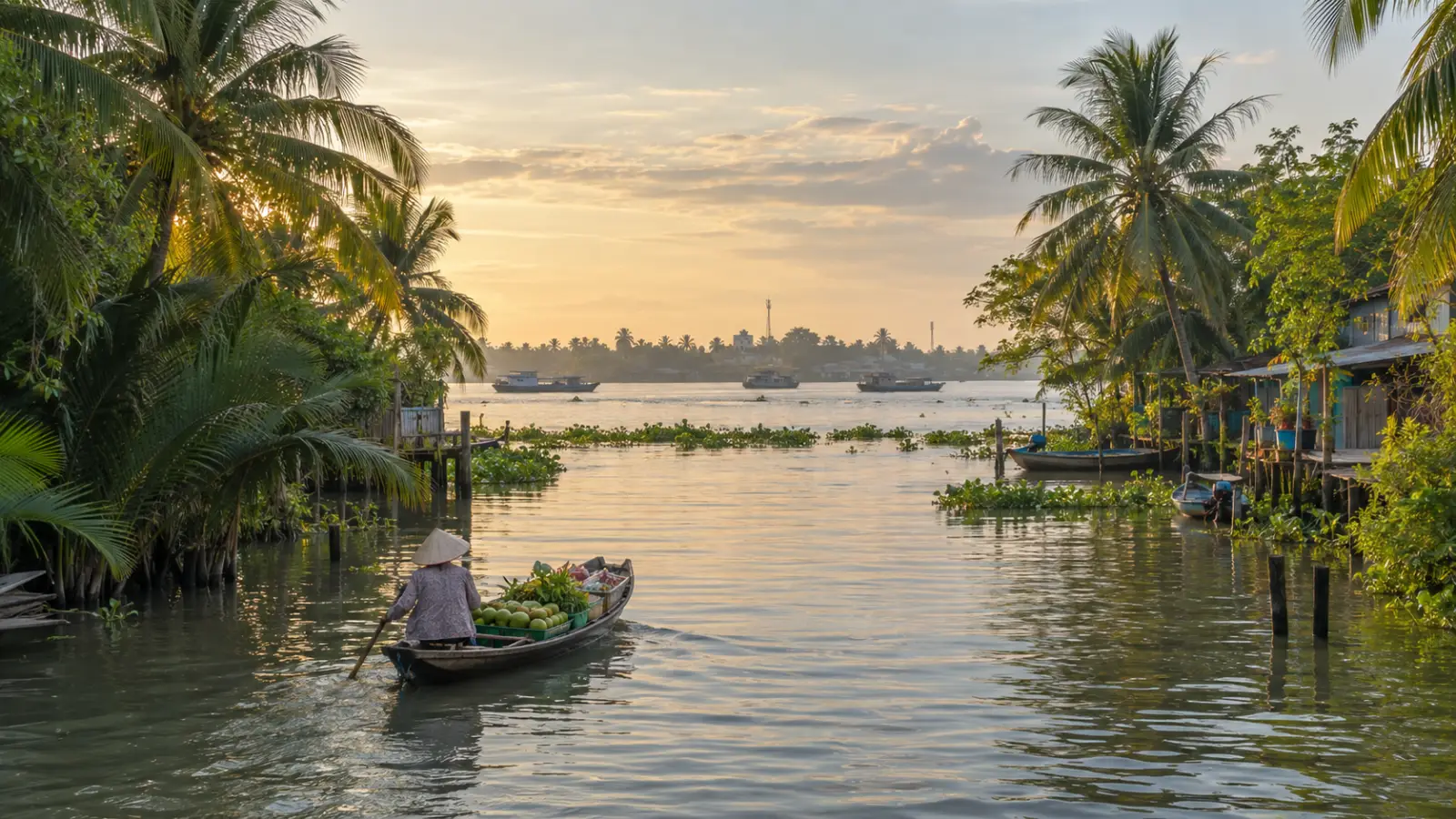
If possible, I would choose a small group, a private guide or an independent trip with an overnight stay. In Ben Tre especially, the real attraction is not a single “sight”, but the landscape itself: narrow canals, coconut palms, bicycles between villages, small boats and life organised around the water.
My Tho or Ben Tre?
These two names often appear together because they sit close to one another on opposite sides of the river system.
My Tho is easier logistically, which is why so many mass-market tours from Ho Chi Minh City use it. If you simply want a first look at the Mekong in one day without planning anything yourself, it works.
But if I had to choose one place for the atmosphere of the delta itself, I would prefer Ben Tre.
Ben Tre is strongly associated with coconut plantations. The region’s tourism promotion focuses heavily on agritourism, coconut gardens, local crafts and small homestays.
A typical Ben Tre visit may include a motorboat on a larger river, a transfer to a small rowing boat in a narrow canal, cycling or walking between orchards, and some exposure to coconut processing. Around the Ham Luong River and the canals near the city, the experience becomes much more pleasant if you do not try to visit five workshops in two hours.
Is Ben Tre worth an overnight stay?
If you only have one day, not necessarily.
But one night in a countryside homestay is worthwhile if you want to experience the delta after the tour buses have gone. In the evening and early morning, the canals, villages and small roads between orchards feel completely different.
I would not, however, build a three-day first trip entirely around Ben Tre. A more balanced route is to continue to Can Tho.
Can Tho: the best base for a first independent trip
If Ben Tre shows you the small canals and rural delta, Can Tho is the region’s main large city.
It is also home to the best-known active floating market in the delta: Cai Rang.
By road, Ho Chi Minh City to Can Tho usually takes around 3–4 hours. Typical current bus fares are roughly 150,000–200,000 VND, although limousine and more comfortable services can cost more.
That distance is precisely why Can Tho is not ideal as a standard day trip from Ho Chi Minh City if your main goal is the floating market.
Cai Rang: why you need to stay overnight
The most important rule about Cai Rang is simple:
It is a morning market, not a tourist attraction with normal opening hours.
Trading begins before sunrise. The most interesting time for visitors is roughly 5:30–7:00 AM. After 8:00, the number of boats drops noticeably, and by around 9:00 most of the main trading activity is over.
Boats from central Can Tho usually leave the Ninh Kieu waterfront at around 5:00–5:30 AM. The trip to the market takes about half an hour.
That is why the idea of leaving Ho Chi Minh City in the morning and seeing the real Cai Rang Floating Market does not really work. By the time a normal bus reaches Can Tho, the market is already finishing.
If a one-day tour from Ho Chi Minh City advertises a “floating market” in the middle of the day, check carefully which market it actually means.
Cai Rang is smaller than it was twenty years ago — and that is normal
Old photos show huge numbers of cargo boats almost filling the river. Today, the market is smaller.
The reason is straightforward: roads, bridges and trucks have made land transport much more efficient. Wholesale river trade has gradually declined, while tourism has become more important.
That does not mean the market is “fake”. Cai Rang still operates as a real wholesale market, but expecting a scene from a 1990s documentary will lead to disappointment.
Large boats sell fruit and vegetables in bulk, while smaller boats move around selling coffee, soup, bánh mì and breakfast.
One characteristic feature is the long pole known as cây bẹo, where traders hang a sample of what they are selling. From another boat, you can immediately see whether it carries pineapples, watermelons, sweet potatoes or another product.
Do you need a long floating-market tour?
If you only care about Cai Rang, two hours is enough.
Longer boat trips often add a rice-noodle workshop, fruit orchards or another smaller market.
That can be interesting, but again there is a risk of turning the morning into a conveyor belt of tourist stops. Before booking, I would ask the operator to list the stops precisely.
A good rhythm is to reach the market at around 5:45, spend some unhurried time among the trading boats, buy coffee or breakfast on the river, and only then continue into a smaller canal or visit a workshop.
What about the other floating markets?
Older guidebooks can create the impression that the delta is full of enormous floating markets. That is no longer true.
Cai Rang remains the most obvious choice for a first visit.
Phong Dien, near Can Tho, is smaller and more local. It is sometimes combined with Cai Rang on an early-morning route.
Cai Be was once one of the delta’s most famous floating markets, but much of the trading has moved onto land. The surrounding area is still interesting for orchards, riverside scenery and small producers, but I would not travel there specifically expecting a large floating market.
This is important when booking tours: the phrase `floating market` by itself tells you very little.
What else is there to do in Can Tho?
The city itself deserves at least the second half of a day.
After an early Cai Rang trip, you can return to the centre, rest or have breakfast, and then continue at a slower pace.
Places worth considering include the Con Son, Con Son, local markets and the city’s food scene. You can also visit Con Son, a small river island with orchards and family-run farms.
I would not turn Can Tho into a sightseeing marathon. The main reason to stay here is to experience the river before the tour groups wake up.
Chau Doc: a different side of the delta
If you have three or four days, I would continue west to Chau Doc.
It is about 145 km from Can Tho. Modern buses generally take around 3–3.5 hours, with regular services and current fares often starting around the equivalent of $6–11 depending on platform and date.
The landscape begins to change here. Low hills appear, floodplain environments become more visible, and the cultural mix of Vietnamese, Khmer and Cham communities is stronger.
Chau Doc itself is not a city with a huge list of must-see monuments. It works best as a base for Sam Mountain, religious sites, riverside villages and Tra Su Forest.
Tra Su Forest: one of the best natural experiences in the delta
Tra Su Cajuput Forest is a seasonally flooded melaleuca forest near Chau Doc.
The classic experience is travelling by small boat along narrow green waterways beneath the trees and through floating vegetation. The protected area covers roughly 850 hectares and also includes a long bamboo bridge and viewpoints.
It is a particularly good choice if, after Ben Tre and Cai Rang, you want something more than another boat ride past villages. Tra Su gives you a proper wetland landscape.
The forest is usually most photogenic during higher-water periods. It can still be visited in the dry season, but conditions may look quite different from promotional images showing channels completely covered in bright green aquatic plants.
Who should add Chau Doc?
I would not add it to every itinerary.
If your Vietnam trip is short and you need to return to Ho Chi Minh City after the delta, two nights around Can Tho may be enough.
Chau Doc becomes especially useful in two situations.
The first is when you have at least 3–4 days and want to see more than the central, most tourist-friendly part of the delta.
The second is when your route continues into Cambodia.
Passenger speedboats run from Chau Doc to Phnom Penh. In 2026, Hang Chau lists a departure at 1,640,000 VND, with a journey of about 6–6.5 hours including border formalities and a one-way fare of 1,640,000 VND. The return service leaves Phnom Penh at 12:30.
That route is much more logical than returning from Chau Doc all the way to Ho Chi Minh City and then travelling separately to Cambodia.
Is Tra Vinh worth adding?
If you have more than four days and are more interested in culture than famous checklist attractions, the former Tra Vinh area is worth considering.
Khmer influence is much more visible here: temples, architecture and local communities give a different perspective on the delta compared with Ben Tre’s coconut workshops or urban Can Tho.
For a short first trip, though, I would not add Tra Vinh simply to put another place on the map. It works better on a slower route where you have time for small towns and villages.
Why some province names now look different
This can create confusion when searching for hotels or transport.
Since July 1, 2025, Vietnam has operated under a new provincial administrative structure, reducing the number of province-level units from 63 to 34.
In the Mekong Delta, the changes are particularly visible. Former Ben Tre and Tra Vinh are now part of an expanded An Giang; former Tien Giang, including My Tho, is part of An Giang; Kien Giang merged with An Giang under the name An Giang; and Can Tho expanded to incorporate former Hau Giang and Soc Trang.
For travellers, this is mostly a bureaucratic detail. Drivers, hotels and tourism websites still commonly use the familiar names Ben Tre, My Tho, Tra Vinh and Chau Doc.
So do not be surprised if an old guidebook and a new official address show different province names for the same place.
A good one-day route
If you have only one free day from Ho Chi Minh City, I would choose:
Ho Chi Minh City → Ben Tre → Ho Chi Minh City.
Leave early.
On site, focus on the river, a smaller canal, cycling or walking along rural roads, coconut gardens and a proper lunch.
I would not try to add Can Tho. It only increases the time spent in vehicles.
And when choosing a tour, pay attention to group size. In the Mekong Delta, the difference between 30 people on a bus and a small group of 6–8 is enormous.
The best two-day route
If Cai Rang is the priority, I would plan it like this.
Day 1: Ho Chi Minh City → Can Tho
Leave in the morning or after breakfast and arrive around lunchtime. Check in, explore the city and waterfront, visit a market, have dinner and go to bed early.
Day 2: Cai Rang → Ho Chi Minh City
Leave by boat at around 5:00–5:30 AM, reach the market during the most active period and return to the city for breakfast.
After that, you can add Binh Thuy or Con Son before returning to Ho Chi Minh City in the afternoon.
This is much better than leaving Ho Chi Minh City in the middle of the night just to reach the market.
The best three-day route
For a first proper Mekong Delta trip, I would choose:
Ho Chi Minh City → Ben Tre → Can Tho → Ho Chi Minh City.
Day 1: Ben Tre
Leave Ho Chi Minh City in the morning and spend the day exploring canals and coconut gardens.
You have two options: stay overnight in Ben Tre, or continue to Can Tho in the evening.
For a slower experience, stay in a countryside homestay.
Day 2: Ben Tre → Can Tho
Spend a little more time in the countryside in the morning, then transfer to Can Tho and spend the evening there.
Day 3: Cai Rang → Ho Chi Minh City
Visit the floating market at dawn, have breakfast, add one short stop in Can Tho and return to Ho Chi Minh City.
This route gives you two different versions of the delta: the narrow canals of Ben Tre and the larger river trade around Can Tho.
A four-day route
If you want to go deeper into the region:
Ho Chi Minh City → Ben Tre → Can Tho → Chau Doc → Ho Chi Minh City / Phnom Penh.
Day 1
Ben Tre.
Day 2
Transfer to Can Tho, explore the city and spend the evening around Ninh Kieu.
Day 3
Cai Rang at sunrise, breakfast, then bus to Chau Doc. The current journey from Can Tho typically takes around three hours.
Day 4
Visit Tra Su in the morning or explore the Sam Mountain area, then return to Ho Chi Minh City.
If continuing to Cambodia, add another night and take the morning boat to Phnom Penh the next day.
Is a private car worth it?
For two people, buses and limousine services are usually simpler and cheaper.
For a family or group of 3–4 people, a private car becomes more attractive, especially on a route through Ben Tre, Can Tho and Chau Doc with several stops.
The main advantage is not speed, but flexibility: you can stop in smaller places between the main towns.
Inside the canals and at the floating market, of course, a car is useless. Boats remain essential.
Should you rent a motorbike?
The delta is almost entirely flat, which makes cycling excellent in Ben Tre and rural areas.
A motorbike gives you more freedom, but riding all the way from Ho Chi Minh City on major roads is not particularly enjoyable and requires the proper legal licence for the relevant category.
I would not rent a motorbike just to ride from Ho Chi Minh City to Can Tho.
It is usually more pleasant to take a bus between cities and rent a bicycle or scooter locally for smaller rural roads.
Best time to visit
The delta is in southern Vietnam, so it makes more sense to think in terms of dry and rainy seasons rather than four distinct seasons.
Roughly December to April is the easiest period for travel. There is less rain, roads are more predictable and early mornings on the river are more comfortable. It is also the busier tourist season.
May to October is wetter, but that does not mean you should avoid the delta. Southern Vietnam often gets bright or cloudy mornings followed by stronger showers later in the day. Early trips to Cai Rang therefore still work well during the rainy season.
Higher water levels later in the wet season create a different landscape, with more flooded fields and wetlands. This can be especially interesting in the western delta and around Tra Su.
For a straightforward first visit with minimal weather complications, I would choose December–March.
What about fruit season?
The delta is productive year-round, but the mix of fruit changes through the seasons.
Late spring and summer bring an especially wide range of tropical fruit, including mangoes, rambutans, longans and durians. During this period, orchard visits and local markets can be more interesting than in winter.
However, do not choose a tour just because the description says `fruit garden`. On some mass-market tours, that may simply mean a small garden where visitors are given a plate of fruit.
If fruit is genuinely important to you, ask which orchard you are visiting, what is currently in season and whether you will actually walk through the farm, rather than just have a tasting.
Mosquitoes, heat and rain
There is water everywhere, but that does not mean you will spend the whole trip surrounded by mosquitoes.
Repellent is most useful in the evening, around orchards and in Tra Su Forest. During the day on an open boat, mosquitoes are usually less of a problem.
The heat is more noticeable. After 10–11 AM, direct sun on a small boat without much shade can be intense, so bring water, a hat and proper sun protection.
During the rainy season, a lightweight rain jacket and a dry bag or waterproof phone case are usually more useful than a large umbrella.
Where to stay
In Can Tho, the Ninh Kieu area is the most convenient if you are planning an early departure for Cai Rang. It saves time in the morning.
In Ben Tre, I would do the opposite and avoid prioritising the city centre. The point of staying overnight is to choose a homestay or small lodge among gardens and canals.
In Chau Doc, staying near the riverside centre is convenient if you plan to take the boat to Cambodia the next morning. The current Hang Chau service to Phnom Penh departs at 07:00 from the area near Victoria Chau Doc Hotel.
How much money should you budget?
The Mekong Delta itself is not an expensive region.
The main costs are transport and boats. Intercity buses often cost only around 100,000–300,000 VND depending on distance and vehicle class.
There is no entrance ticket to Cai Rang as such: you pay for the boat. Prices vary considerably depending on whether it is private or shared and how long the route lasts. If travelling with several people, ask for the total boat price, not only the price per person.
A private Ben Tre tour or a car with driver can make the trip much more expensive, although the cost becomes more reasonable when divided between 3–4 passengers.
How to avoid a bad tour
A useful tour description should contain specific places, not just phrases such as `Mekong experience`, `local village` and `floating market`.
Before paying, find out:
- How many people will be in the group.
- Which exact floating market is included.
- What time you will actually reach the market.
- How much time you will spend on boats.
- Which workshops or producers are included.
- Whether there are compulsory shopping stops.
- How much of the route is on a small rowing boat.
- Whether boats, lunch and admission fees are included in the total price.
If a tour promises Cai Rang but leaves Ho Chi Minh City at 7 AM, something in the itinerary does not add up.
Independent travel or a tour?
For one day in Ben Tre, a good small-group tour may be easier than organising everything independently, because the challenge is not reaching the town but arranging the right boats and rural route.
For Can Tho, independent travel is extremely straightforward: bus, hotel, early boat.
For Chau Doc and Tra Su, both approaches work. Independent travel is cheaper and more flexible, while a car with driver or local tour makes remote sights much easier to combine in one day.
So I would not choose between “tour only” and “independent only”. The delta works very well with a mixed approach: travel between cities on your own, then book local boats or excursions where they are actually useful.
My recommendation for a first trip
If you have one day, go to Ben Tre.
If you have two nights, spend them around Can Tho and make sure you see Cai Rang before 7 AM.
If you have three days, combine Ben Tre and Can Tho.
If you have four or five days, add Chau Doc and Tra Su.
And if your trip continues from Vietnam into Cambodia, do not return to Ho Chi Minh City at all. Cross the delta from east to west and finish with the morning Chau Doc → Phnom Penh boat.
The most important point when planning is simple:
The Mekong Delta becomes much more interesting once you stop treating it as a single excursion from Ho Chi Minh City.
The region makes sense through different scales of water: a narrow canal under coconut palms in Ben Tre, the broad river and trading boats of Cai Rang, and the flooded forest near Chau Doc.
You cannot experience all of that in one day. But even two or three days are enough to turn a generic “Mekong tour” into a proper journey through one of the most distinctive regions of southern Vietnam.
Updated: September 2026.
Main sources: official Ben Tre and Vietnam tourism resources; current information on Cai Rang Floating Market; current bus platforms and transport operators; Hang Chau Tourist; current information on Tra Su and Vietnam’s 2025 administrative reform; recent traveller information and route reports from the Mekong Delta.
Read also
All articles
Tet in Vietnam: How to Experience the Country’s Biggest Holiday and Plan Your Trip
Tet is one of the best — and at the same time one of the most inconvenient — periods for a first trip to Vietnam.…

Where to Live in Vietnam for a Month: Da Nang, Nha Trang, Ho Chi Minh City, Hanoi, or Da Lat
Choose a Vietnam base for a month by daily life: sea, work, districts, season, budget and a one-week housing test.
What to eat in Vietnam beyond phở: a regional food guide
Regional Vietnamese dishes, ingredients, serving, ordering and phrases for dietary questions.

Hue, Da Nang and Hoi An in 5–7 Days: A Practical Central Vietnam Itinerary
Hue, Da Nang and Hoi An are close enough to combine in one trip, but they should not be treated as three similar stops. Hue…

Hanoi: What to See in 3–4 Days, Where to Stay, What to Eat and How to Get Around
A practical Hanoi guide for 3–4 days: where to stay, what to see, what to eat and how to move around the city.

Vietnam in 14 days: three routes without racing across the country
Three workable two-week routes through north, central and south Vietnam: nights, transfers, weather buffer and booking order.

Comments
Share your thoughts or ask a question about this article.