Vietnam with Children: Where to Go, How to Get Around and What to Know
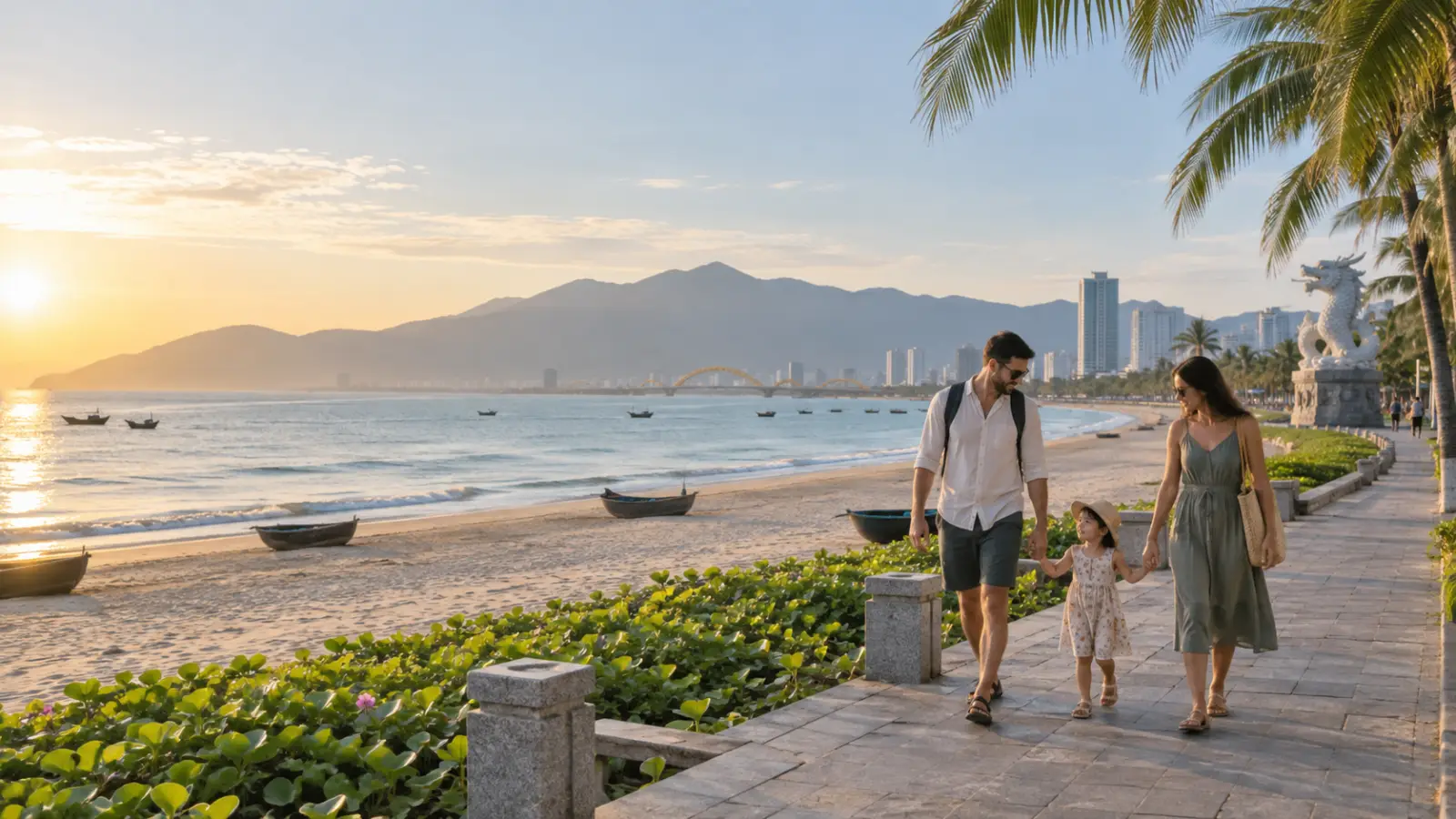
Vietnam can be a very good destination for families, but how easy the trip feels depends heavily on the itinerary. A hotel near a calm beach in Da Nang or Nha Trang, short Grab rides and relaxed evening walks can be easier than many family holidays in Europe. A route built around night buses, mountain roads, boats and five cities in ten days is a completely different experience.
The main difference is that infrastructure in Vietnam is not always designed around families with small children. Pavements may be occupied by parked motorbikes, child seats are not something you can automatically expect in a taxi, ramps are inconsistent, and midday heat can destroy an otherwise perfect sightseeing plan.
With children, it usually makes sense to travel through Vietnam less intensively than an adult backpacker would. A good family itinerary is built around a small number of bases, short transfers and the ability to spend the hottest part of the day in the hotel, pool or an air-conditioned space.
Vietnam’s official tourism portal also highlights Da Nang, Hoi An, Nha Trang and Phu Quoc among the country’s stronger family destinations.
The short answer
| Situation | What I would choose |
|---|---|
| First Vietnam trip with a child aged 1–5 | Da Nang + Hoi An |
| Beach is the main priority | Nha Trang, Da Nang or Phu Quoc depending on season |
| Children want pools, parks and attractions | Nha Trang or Phu Quoc |
| You want both city and beach | Da Nang + Hoi An |
| You want to add culture | Hanoi + Ninh Binh or Hoi An |
| 10–14 days | 2–3 bases, not 5–6 cities |
| Travelling with a baby | One resort destination + at most one additional base |
With a small child, I would reduce the number of transfers before cutting activities within one destination.
Da Nang and Hoi An: the most versatile combination
If I had to choose one region for a first family trip to Vietnam, I would usually start with Da Nang and Hoi An.
Da Nang has an international airport, long urban beaches, a wide choice of apartments and hotels, supermarkets, restaurants, hospitals and normal city services. Hoi An is only around 40–60 minutes away by road.
Vietnam’s official tourism guidance also treats Da Nang as one of the country’s main family beach destinations.
In Da Nang itself, the rhythm can be very simple: beach in the morning, pool or hotel during the hottest part of the day, then dinner and a walk in the evening.
Hoi An adds what modern Da Nang lacks: an old town, lanterns, narrow streets, boats, rice fields and workshops. Family-oriented recommendations from Vietnam Tourism also include cycling through the countryside, cooking classes and An Bang Beach.
With very young children, I would not necessarily move hotels between Da Nang and Hoi An. It is perfectly reasonable to stay in one place and visit the other for half a day.
Nha Trang: easy if you want a classic beach holiday
Nha Trang works particularly well for families looking for a city beach resort rather than an isolated hotel complex.
It is easy to find apartments with kitchens, restaurants across different price levels, shopping centres, pools, parks and family entertainment. Cam Ranh Airport is connected to the city by road, so arrival does not require complicated transport.
Vietnam Tourism also lists Nha Trang as a major family destination and mentions boat trips, the Oceanographic Museum, mud baths and family attractions.
The main thing is to choose the right neighbourhood and season.
If the child is young and you expect to go to the sea every day, do not look only at the hotel rating. Check the specific beach section in front of the property, whether there is a large road between the hotel and the sea, whether there is a pool and shade, and how far the nearest supermarket is.
Phu Quoc: family resort travel
Phu Quoc works well for families who want less city and more hotel, beach and entertainment in one place.
The island has many large resorts with pools, kids’ clubs, family rooms and their own infrastructure. Vietnam’s official tourism portal also recommends Phu Quoc for families and highlights the wide range of accommodation and activities.
This can be particularly convenient with preschool children because you can spend several days without building any complicated programme at all.
There are two important limitations.
The first is seasonality. Phu Quoc is generally easiest from around November to April. During the rainy period, sea conditions and weather can be much less predictable.
The second is distance. The island is large, so a cheap hotel far from the beach, restaurant or attraction you actually want can turn into daily taxi rides.
With children, paying more for the right location can be better value than losing an hour every day to transport.
Hanoi with children: interesting, but not as the main resort base
Hanoi can work very well as a 2–4 day part of a family trip.
For school-age children, the Old Quarter, Hoan Kiem Lake, temples, street food and the famous water puppet theatre can be more memorable than another beach day.
But Hanoi is not the easiest city for a stroller. Pavements are often used for parked motorbikes, tables and street commerce, so you may still end up walking partly along the edge of the road.
With a baby, I would not make the Old Quarter the centre of a two-week trip. With a school-age child, a few days in Hanoi can be one of the most interesting parts of the journey.
A good extension is Ninh Binh. It is much closer than Sapa or Ha Giang and gives you boat rides, limestone scenery and countryside without several exhausting travel days.
Ho Chi Minh City: usually better as a short stop
Ho Chi Minh City can be interesting for older children, but with a toddler it can become tiring quickly because of the heat, traffic, large distances and intense street movement.
For a family itinerary, I would usually keep it to 2–3 days unless the city itself is an important part of the trip.
Choose accommodation based on how easily you can reach the places you care about with short GrabCar rides, rather than simply choosing the cheapest hotel.
If you want nature after Ho Chi Minh City, the Mekong Delta is an option. But with small children, I would prefer one night in a good homestay or Can Tho over a 12-hour mass-market bus tour with multiple mandatory stops.
Sapa and Ha Giang: not for every family
With a school-age child, Sapa can be an excellent addition: the Fansipan cable car, mountains, villages and short treks all work well.
With a two-year-old, the advantages are less obvious. You need around 5–6 hours on the road from Hanoi, the weather can be cold or foggy, and many attractions involve stairs or uneven paths.
Ha Giang is more demanding still.
A classic Ha Giang Loop means several days on mountain roads. I would not build a trip there around a motorbike with a small child at all. Even in a car, the days can be long and winding.
With older teenagers who enjoy mountains and road travel, it is a very different proposition.
How many cities are reasonable with children?
For a 10–14 day trip, I would usually limit the itinerary to two or three bases.
For example:
Da Nang — 6 nights → Hoi An — 2 nights → Hanoi — 3 nights
or even:
Da Nang — 8 nights → Hanoi — 3 nights.
Another option:
Ho Chi Minh City — 2 nights → Nha Trang — 7 nights → Hanoi — 3 nights.
If relaxation is the main goal:
Phu Quoc — 8–10 nights → Ho Chi Minh City — 2 nights.
For an adult, six cities may feel exciting. For a family, it often means packing six times, six check-ins, six new rooms and too many days when the child is simply sitting in transport.
Plane, train or bus?
Domestic flights in Vietnam can eliminate very long transfers. With children, that can matter more than saving a few dozen dollars.
Trains can make sense on shorter daytime sections. Children can move around, look out of the window and avoid spending the entire journey strapped into a road vehicle.
Sleeper buses are the first thing I would remove from an itinerary with small children.
Even a good cabin bus is still a bus: braking, winding roads, overnight stops, sometimes loud music, and the expectation that everyone will sleep while the vehicle is moving.
For an adult, a night bus may save the cost of a hotel. For a family, it may simply ruin the following day.
Grab and taxis: the key question is child seats
Vietnam introduced new child-restraint rules in 2026.
For a child under 10 years old and also shorter than 1.35 m, an appropriate child-restraint system is required in a normal private car. Such children should also not sit in the same row as the driver, except in vehicles with only one row of seats.
However, there is an important exception: the child-restraint requirement does not apply in the same way to vehicles operating as passenger transport.
For tourists, this creates an unusual situation. A taxi may legally arrive without a child seat, but that does not make the journey physically safer.
With a baby or toddler, I would therefore not assume that a standard GrabCar or ordinary taxi will have a suitable seat.
For airport transfers and long road journeys, book a vehicle with a child seat in advance and ask for confirmation of the actual seat type or age/weight category, rather than accepting a vague `yes, baby seat`.
If the child is very young and you expect to take many car journeys, bringing your own compact travel seat may be easier than trying to source one repeatedly.
Do not use motorbikes as family taxis
In Vietnam, it is completely normal to see a family with a child on one motorbike.
That does not mean a visiting family should copy the habit.
Road injuries remain a serious issue, particularly for children and young people. The World Health Organization in Vietnam continues to emphasise properly fitted, quality helmets and child road safety.
With a small child, I would exclude GrabBike entirely.
Even for short distances, GrabCar or a normal taxi is the more sensible choice.
Using a stroller in Vietnam
A stroller is useful, but not everywhere.
It works best in airports, shopping centres, resorts, waterfront promenades, newer parts of Da Nang and large tourist complexes.
It works worst on old pavements in Hanoi and Ho Chi Minh City, temple stairs, markets and rural paths.
For a child who still sleeps during the day, the best combination is often a lightweight folding stroller plus a baby carrier.
A large heavy stroller with huge wheels can be comfortable inside a resort, but quickly becomes annoying when repeatedly loading it into Grab cars or taking domestic flights.
Choose accommodation differently when travelling with children
A good family hotel does not necessarily mean a five-star resort.
Sometimes a two-room apartment with a washing machine, refrigerator and basic kitchen is much more useful than an expensive hotel room.
I would check:
- Is there a lift if the room is above the ground floor?
- Is the refrigerator large enough to be useful?
- Can the hotel provide a baby cot?
- Is there a quiet room away from a bar or busy road?
- Is there a pool and a shallow section?
- How far is the beach in practice?
- Do you need to cross a busy road to reach it?
- Is there a supermarket, pharmacy and normal restaurant nearby?
- Can a car stop directly at the entrance?
With a baby, ask specifically about a baby cot rather than assuming one will be available.
Food for children
Vietnamese food is actually quite easy for many children.
Not everything is spicy. Simple foods are easy to find: rice, noodles, eggs, chicken, soups, bánh mì and fruit.
A useful phrase is:
Không cay — not spicy.
For picky eaters, tourist destinations almost always have pizza, pasta, potatoes, bakeries, yoghurt and familiar international foods.
Larger supermarkets sell imported food, baby purées, nappies and infant formula. But if your child depends on a specific formula or specialised food, bring enough with you because the exact brand may not be available.
Water and stomach problems
For drinking, the simplest option is bottled or reliably purified water.
The CDC notes that young children can become dehydrated from diarrhoea faster than adults and recommends access to oral rehydration solution.
For that reason, carrying ORS in a small medical kit — or at least knowing what to ask for at a Vietnamese pharmacy — is sensible.
There is no need to forbid local food completely. It is more useful to choose busy places with good food turnover, freshly prepared dishes and reasonably clear hygiene.
I would be especially cautious with food that has been sitting unrefrigerated for a long time and with raw products.
Heat is often a bigger practical problem than exotic diseases
One of the most common planning mistakes is assuming a child will happily walk around Hue, Hoi An or Ho Chi Minh City at 1 PM.
In hot periods, it is better to adopt the local rhythm:
morning — sightseeing and outdoor activities;
11 AM–3 PM — pool, nap, food, museum or hotel;
after 4 PM — outside again.
The CDC recommends limiting physical exertion during strong heat, drinking regularly and seeking shade, particularly around the hottest part of the day.
For babies under six months, protection relies mainly on shade and clothing that covers the skin. Older children also need sunscreen, hats and regular fluids.
Mosquitoes: dengue matters more than many visitors expect
Dengue is a year-round risk in Vietnam, with outbreaks periodically becoming more intense.
This is not a reason to avoid the country, but mosquito repellent should be part of an ordinary family travel kit rather than something you only take into the jungle.
The mosquitoes that can transmit dengue also bite during the daytime.
Protection is especially worth paying attention to in gardens, around standing water, in the Mekong Delta and in greener areas.
Do not let children play with monkeys or stray animals
At tourist sites, you may encounter monkeys, dogs and cats.
A child sees a “cute monkey”, but from a safety perspective any unfamiliar animal should be treated as a possible source of bites or scratches.
The CDC advises discussing rabies vaccination before travel when activities may involve higher animal-contact risk or when rapid medical care could be difficult to access.
Do not feed monkeys by hand or encourage children to pet stray dogs.
If a child is bitten or scratched, this is not a “wait until tomorrow” situation. Wash the wound thoroughly and seek medical care promptly.
Sea and swimming pools
Even a beach that looks calm can have currents and strong waves.
Follow beach flags and lifeguard instructions where available. The CDC also recommends swimming in designated areas and using life jackets on boats.
For island excursions, ask specifically whether the operator has a child-size life jacket that actually fits your child.
`Life jackets included` does not automatically mean the boat has a suitable one for a three-year-old.
At resort pools, do not assume the presence of a lifeguard means constant individual supervision.
Swimming in rivers and lakes is different from swimming in the sea
The Mekong, lakes and attractive rural waterways should not be treated like natural swimming pools.
The CDC recommends avoiding swimming in untreated freshwater in areas where sanitation may be limited, including because of risks such as leptospirosis.
A boat trip on a river is fine.
Letting a child swim in a random Mekong canal is not something I would recommend.
Vaccinations and preparation before the trip
A few weeks before travelling, check the child’s normal vaccination schedule and discuss the trip with a doctor.
The CDC recommends that international travellers be up to date on routine vaccinations, including measles, and suggests speaking with a healthcare professional roughly a month before travel about vaccinations or medication relevant to the itinerary.
The exact recommendations depend on the child’s age, country of residence, length of trip and whether you will spend two weeks in Da Nang or a month moving through rural areas.
For that reason, a universal list such as “every child needs these five vaccines before Vietnam” would be misleading.
Travel insurance matters more with children
I would not travel with a child without proper medical travel insurance.
Do not look only at the headline coverage limit. Check how it works in practice:
- Does it cover outpatient treatment, not only hospital admission?
- Is there a deductible?
- Does the clinic bill the insurer directly, or do you pay first?
- Are infectious diseases covered?
- Does it include medical transport to another city or country if necessary?
- Is the assistance line available 24/7?
Medical infrastructure is much stronger in Hanoi, Ho Chi Minh City, Da Nang, Nha Trang and Phu Quoc than in remote islands or mountain regions.
That is another reason not to build a complicated infant itinerary around very isolated places.
What to put in a family medical kit
There is no reason to bring a suitcase full of medicine. Pharmacies are widespread in Vietnam.
But some things are useful to have immediately:
- Regular medicines the child already takes.
- A familiar children’s fever/pain medicine in the correct formulation.
- ORS for rehydration.
- A thermometer.
- Age-appropriate mosquito repellent.
- Sunscreen.
- Antiseptic and basic wound dressings.
- Any motion-sickness medication the child normally uses, if recommended by a doctor.
- A small reserve of familiar baby food or formula.
Do not self-prescribe antibiotics “just in case”.
Nappies and baby supplies
In large cities, basic baby products are easy to find.
Nappies, wet wipes, bottles, baby food and common formulas are sold in supermarkets, shopping centres and through delivery services.
The problem is more likely to be finding the exact brand or model.
If the child only tolerates one specific type of nappy or formula, bring enough from home.
Before travelling to islands, mountain regions or small villages, stock up in a larger city.
Family entertainment does not have to mean children’s parks every day
Vietnam works well because ordinary travel experiences can be mixed with a few child-specific activities.
In Hoi An, add a cooking class or boat ride.
In Nha Trang, consider the Oceanographic Museum, islands, pools and amusement parks.
On Phu Quoc, there are beaches, cable cars and large entertainment complexes.
In Hanoi, the water puppet theatre.
In Ninh Binh, a boat ride and cycling.
In the Mekong Delta, a small boat through the canals.
You do not need a `kids attraction` every day. For many children, a boat trip, train journey, night market, unusual fruit or feeding fish can be more memorable than an expensive theme park.
How to plan a day with a small child
Instead of five scheduled activities, I would plan one main activity in the morning and one easy activity in the evening.
For example:
morning — boat trip or museum;
midday — nap and pool;
evening — beach and dinner.
This matters especially during the first few days after a long flight and a major time-zone change.
If the child handles the schedule well, it is always easy to add something locally. Cancelling an already-paid eight-hour excursion is much less pleasant.
An example of a relaxed two-week itinerary
For a first trip with a preschool-age child, I might consider:
Da Nang — 6 nights
Beach, pool, short city trips, and one optional day at Ba Na Hills.
Hoi An — 3 nights
Old town in the morning and evening, An Bang, countryside or a cooking class.
Hanoi — 3 nights
City, water puppets, the lake and gentle sightseeing.
Ninh Binh — 2 nights
Boat rides, nature and minimal long touring days.
This already gives you sea, a modern city, an old town, the capital and countryside without constant overnight transfers.
With a baby, I would simplify even further and keep only Da Nang/Hoi An + Hanoi, or simply stay at one good beach destination.
When travelling Vietnam with children may be a bad idea
The problem is usually not Vietnam itself, but the itinerary.
I would rethink the plan if it contains several night buses in a row, changing hotels every day, doing the Ha Giang Loop with a small child on a motorbike, arriving after an overnight flight and immediately taking an eight-hour excursion, or planning a beach holiday in a destination during its least suitable season.
Vietnam does not require families to spend two weeks inside a single resort. It is absolutely possible to travel actively with children here.
But the trip usually becomes much better if you move more slowly than you would without a child.
The most valuable family resource in Vietnam is not the number of attractions completed. It is the ability to return to a cool room at the right time, let the child sleep, keep an evening free and avoid turning every transfer into an obligation.
With that approach, Vietnam combines things that are difficult to get in one holiday: warm seas, major cities, unusual food, boats, mountains, old quarters and countless simple everyday experiences that children often remember better than attractions designed specifically for them.
Updated: September 2026.
Main sources: Vietnam National Authority of Tourism; Government of Vietnam and Road Traffic Police information on child-restraint rules; World Health Organization Vietnam on child road safety; CDC Travelers’ Health for current medical guidance for travel to Vietnam.
Read also
All articles
What to eat in Vietnam beyond phở: a regional food guide
Regional Vietnamese dishes, ingredients, serving, ordering and phrases for dietary questions.

Ho Chi Minh City: What to See in 3–4 Days, Where to Stay, What to Eat and How to Get Around
A practical Ho Chi Minh City guide for 3–4 days: where to stay, what to see, what to eat and how to navigate the city.

Hue, Da Nang and Hoi An in 5–7 Days: A Practical Central Vietnam Itinerary
Hue, Da Nang and Hoi An are close enough to combine in one trip, but they should not be treated as three similar stops. Hue…

Where to Live in Vietnam for a Month: Da Nang, Nha Trang, Ho Chi Minh City, Hanoi, or Da Lat
Choose a Vietnam base for a month by daily life: sea, work, districts, season, budget and a one-week housing test.

Best Beaches in Vietnam: Where to Go by Month and Which Destination to Choose
Vietnam has almost 3,300 km of coastline, but there is no single nationwide “beach season”. In winter, the most reliable beach weather is usually found…

Hanoi: What to See in 3–4 Days, Where to Stay, What to Eat and How to Get Around
A practical Hanoi guide for 3–4 days: where to stay, what to see, what to eat and how to move around the city.

Comments
Share your thoughts or ask a question about this article.