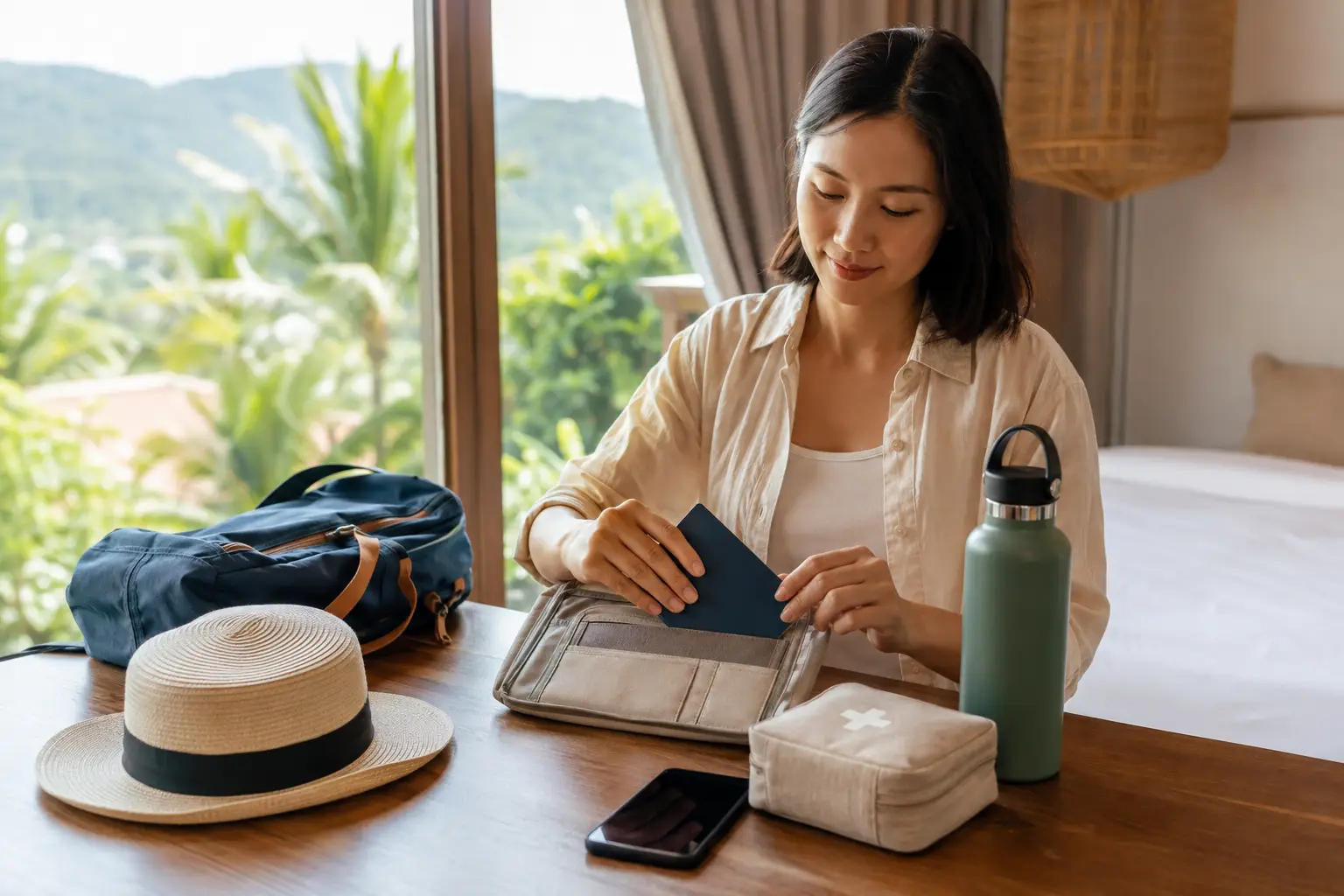
Health in Vietnam: Insurance, Hospitals, Pharmacies and Emergency Care
Healthcare in Vietnam varies greatly depending on where you are.
In Hanoi and Ho Chi Minh City, there are large international hospitals with English-speaking staff, direct relationships with international insurers, CT and MRI facilities, surgery and intensive care. Da Nang, Nha Trang and Phu Quoc also have good private hospitals. In smaller cities, mountain areas and islands, however, the choice may be limited to a local hospital, and a serious case may require transfer to a larger medical centre.
For most travellers, the five things that matter most are simple: who to call in an emergency, which hospital to choose in your city, how travel insurance actually works, what to do after an animal bite or high fever, and whether you may have to pay a deposit before the insurer confirms coverage.
This guide is updated for September 2026.
Emergency numbers: 115 and 112
Vietnam’s main medical emergency number is:
115 — ambulance / cấp cứu
Police: 113
Fire: 114
Since August 2025, Vietnam has also operated a nationwide emergency number:
112
It is available 24/7 for accidents, disasters and other emergencies requiring urgent assistance. When necessary, the operator can route the case to police, fire or ambulance services.
There is one practical limitation for foreign travellers: public emergency operators primarily work in Vietnamese.
If you do not speak Vietnamese, it may be quicker to ask hotel staff, your landlord, security staff or a local person nearby to call and explain the exact location.
For severe trauma, loss of consciousness, major breathing difficulty, heavy bleeding, possible stroke or suspected heart attack, do not spend half an hour trying to negotiate with your insurer first.
Get medical help immediately. Insurance can be contacted in parallel or once the patient is stable.
Private ambulance services for foreigners
Large private healthcare providers also operate their own emergency services.
Family Medical Practice has 24-hour emergency contacts and medical transport:
| City | Emergency number |
|---|---|
| Ho Chi Minh City | +84 28 3744 9000 |
| Hanoi | +84 944 431 919 |
| Da Nang | +84 913 917 303 |
Its main Hanoi and Ho Chi Minh City clinics operate 24/7.
Phu Quoc also has a dedicated emergency medical service. Emergency calls can be made through:
115
or
1800 1500
This is particularly useful on an island where travel time from northern or southern resorts to a hospital can be significant.
Where to go in Hanoi
For foreigners, two of the easiest options are Family Medical Practice and Hanoi French Hospital.
Family Medical Practice Hanoi
Address: 298i Kim Ma, Ngoc Ha, Hanoi
Clinic: +84 24 3843 0748
24-hour emergency: +84 944 431 919
The clinic provides general medicine, paediatrics, laboratory testing, diagnostics and emergency care, with international and English-speaking staff.
For fever, stomach problems, infections, minor injuries or a general doctor consultation, this is often more convenient than going directly to a large hospital.
Hanoi French Hospital
Address: 1 Phuong Mai Street, Hanoi
Emergency: +84 24 3574 1111
General enquiries and appointments: +84 24 3577 1100
This is a full international hospital with 24-hour emergency care, surgery, intensive care, cardiology, neurology, paediatrics, obstetrics and diagnostic services.
For serious injury, hospital admission or more complex investigations, it is usually the more appropriate choice.
Vinmec Times City
Another large private option is:
Vinmec Times City International Hospital
Address: 458 Minh Khai, Hanoi
Phone: 024 3974 3556
Where to go in Ho Chi Minh City
Ho Chi Minh City has the widest choice of international and private healthcare in Vietnam.
Family Medical Practice — Diamond Plaza
Address: 34 Le Duan Street
Clinic: +84 28 3822 7848
Emergency and ambulance: +84 28 3744 9000
The clinic operates 24/7 and is one of the easiest options for foreigners needing outpatient or urgent care.
Family Medical Practice also has clinics in Thao Dien and Phu My Hung.
FV Hospital
For more serious conditions, FV Hospital is one of the major international hospitals in the city.
Address: 6 Nguyen Luong Bang Street
General line: 028 3511 3333
24-hour Emergency: 028 3511 3500
FV provides emergency medicine, surgery, imaging, specialist care, intensive care and inpatient treatment.
It also works with many international insurance companies and has a dedicated insurance department.
Vinmec Central Park
Another large private hospital:
Address: 720A Dien Bien Phu
Phone: 028 3622 1166
Vinmec Central Park has emergency medicine, intensive care and a wide range of specialist departments.
If the problem is potentially serious — major road accident, neurological symptoms, chest pain or possible surgery — it is usually better to go directly to a large hospital rather than a small tourist clinic.
Da Nang and Hoi An
Da Nang has a good selection of both international and local private hospitals.
Family Medical Practice Da Nang
Address: 96–98 Nguyen Van Linh, Hai Chau
24-hour emergency: +84 913 917 303
The clinic offers English-speaking doctors, laboratory services, diagnostics, vaccination and outpatient care.
Vinmec Da Nang
Address: 30 Thang 4 Street
Phone: 0236 3711 111
The emergency department operates 24 hours a day.
Hoan My Da Nang
Address: 291 Nguyen Van Linh
General line: 0236 3650 676
Emergency: 0236 3650 950
Hoan My is open 24/7 and is generally less expensive than international hospitals.
Hoi An has local clinics and hospitals, but for a serious injury, CT or MRI imaging, surgery or complicated hospital care, Da Nang usually offers much stronger facilities.
Because the cities are relatively close, transfer to Da Nang often makes more sense than trying to manage a serious condition locally.
Nha Trang
For foreigners, one of the most predictable options is:
Vinmec Nha Trang
Address: Tran Phu Street, Nha Trang
Phone: 0258 3900 168
Emergency and intensive care operate 24 hours a day.
Vinmec Nha Trang also provides emergency transport from hotels and resorts over a wider area, including the Cam Ranh resort zone.
This matters because many visitors who say they are staying in “Nha Trang” are actually based around Bai Dai or Cam Ranh, sometimes quite far from the city centre.
There are many smaller private clinics in Nha Trang for simple outpatient problems, but for CT scans, hospitalisation, surgery or serious trauma, a large hospital is a safer choice.
Phu Quoc
Medical options on Phu Quoc are more limited than in Ho Chi Minh City, but the island has:
Vinmec Phu Quoc
Area: Bai Dai
General line: 0297 3985 588
Emergency: 0297 3985 511
The emergency department operates 24/7.
The island also has a dedicated emergency medical service through:
115
and
1800 1500
For a truly serious case, medical evacuation to Ho Chi Minh City may be required.
This is one reason why insurance that covers medical transport and evacuation matters more on islands and in remote areas than in large cities.
How much does healthcare cost?
Vietnam has inexpensive public hospitals, good local private clinics and expensive international hospitals.
The price difference can be several times over.
As a rough example, Hanoi French Hospital currently lists:
around 1.5 million VND for a general doctor consultation;
around 2.1 million VND for a specialist;
over 3 million VND for an emergency consultation.
An inpatient room can cost roughly 10–15 million VND per day, before adding imaging, laboratory tests, medication and procedures.
At Vinmec Da Nang, some consultations start at roughly 690,000 VND, while certain 24-hour services cost around 1.1 million VND.
These are not national fixed prices.
The practical point is that a simple doctor visit may cost tens of dollars, while surgery, intensive care or several days in hospital can easily reach thousands.
That is the real reason travel insurance matters.
How travel insurance actually works in Vietnam
Having insurance does not automatically mean you simply show a PDF at reception and walk away without paying.
There are two main models.
Direct billing / Guarantee of Payment
The insurer or assistance company sends the hospital a Guarantee of Payment — GOP.
If the hospital accepts direct billing for that insurer and your specific policy, you normally pay only the deductible and services not covered by insurance.
Pay first, claim later
The hospital asks you to pay yourself.
You then submit documents to the insurer for reimbursement.
FV Hospital, for example, explicitly states that even in an emergency admission, the patient may be asked to leave a deposit until the hospital receives a valid GOP.
If the guarantee has not arrived by discharge, the patient may have to pay the full bill and claim reimbursement later.
FV has direct-billing arrangements with insurers and assistance companies including Allianz, Cigna, Bupa Global, International SOS and others.
But acceptance depends on both the insurer and your exact policy.
That is why even with good insurance it is sensible to have a working credit or debit card with a meaningful available limit.
What kind of insurance is worth buying?
The cheapest policy is not necessarily useless, but in Vietnam the most important features are usually:
hospitalisation
and
medical evacuation
A seriously ill patient may need transport from Phu Quoc, a mountain province or another remote area to Ho Chi Minh City.
In rare severe cases, evacuation to Bangkok, Singapore or the traveller’s home country may be necessary.
That can cost much more than an ordinary hospital visit.
If you plan to ride a motorbike, dive, surf, trek, paraglide or do other activities, check the policy wording carefully.
Insurers may exclude claims when:
- the traveller was driving without the legally required licence;
- a helmet was not used;
- alcohol or drugs were involved;
- the activity itself was excluded from the policy.
Save your policy number, assistance phone number and emergency instructions somewhere other than only your phone.
If you are travelling as a family, additional practical details are covered in our guide to Vietnam with children.
What to do if you are sick but it is not an emergency
If your condition is stable, contact the insurance assistance service first.
They may direct you to a specific clinic and arrange a Guarantee of Payment in advance.
If you simply walk into an expensive international hospital and inform the insurer afterwards, direct billing may not be available even if the treatment is covered.
Bring:
- passport;
- insurance policy;
- list of regular medication;
- information about allergies.
If you pay yourself, keep more than just the card receipt.
Insurers commonly require:
- detailed itemised invoice;
- medical report or discharge summary;
- prescriptions;
- test results;
- imaging reports;
- proof of payment.
Do not leave the hospital without collecting these documents.
Dengue is more relevant than malaria for most tourists
One common mistake is worrying extensively about malaria while barely thinking about dengue.
Dengue is a real, recurring health risk in Vietnam.
The mosquitoes that spread dengue — Aedes mosquitoes — also bite during the day, so sleeping under a mosquito net at night is not enough.
A practical prevention routine is to use repellent containing ingredients such as:
DEET
picaridin / icaridin
or
IR3535
especially in humid, green and mosquito-heavy areas.
What if you develop a high fever?
High fever, strong body aches, headache and rash while in Vietnam should not automatically be treated as “just a cold”.
Dengue is one possible cause.
If dengue is suspected, WHO advises avoiding aspirin and ibuprofen because they may increase the risk of bleeding.
Paracetamol / acetaminophen is generally the preferred fever reducer until a doctor evaluates the patient.
Seek urgent medical care if there is:
- severe abdominal pain;
- repeated vomiting;
- bleeding;
- extreme weakness;
- worsening condition after the fever begins to fall.
What about malaria?
For a normal trip to Hanoi, Ho Chi Minh City, Da Nang or Nha Trang, malaria tablets are usually not the main concern.
CDC does not identify known malaria transmission in those major cities.
Risk is more relevant in certain rural, forested and mountainous areas, including parts of the Central Highlands.
If your itinerary involves extended stays in remote areas of provinces such as Dak Lak, Dak Nong, Gia Lai or Lam Dong, discuss malaria prevention with a travel doctor based on the exact route.
Buying random antimalarial medication after arrival is not a good substitute for proper advice.
Dog, cat or monkey bite: do not wait for symptoms
Rabies remains a real risk in Vietnam.
If a mammal bites or scratches you:
wash the wound immediately and thoroughly with soap and running water
and
seek medical assessment as soon as possible.
Post-exposure treatment may include rabies vaccination and, for previously unvaccinated people in certain cases, rabies immunoglobulin.
Do not simply wait to see whether a stray dog “looks sick”.
The same applies to monkey bites and scratches at tourist attractions.
Rabies is preventable after exposure when treatment is given correctly, but once symptoms appear it is almost invariably fatal.
Which vaccinations are worth discussing?
There is no single compulsory “Vietnam vaccine package” for every traveller.
The first step is to ensure routine vaccinations are up to date.
For unvaccinated travellers, travel-health guidance commonly recommends considering:
Hepatitis A
Hepatitis B
Typhoid
depending on itinerary and individual circumstances.
Japanese encephalitis
Japanese encephalitis is a more specialised consideration.
Vaccination is particularly worth discussing when:
- staying in Vietnam for about a month or longer;
- spending significant time in rural areas;
- hiking, camping or staying outdoors extensively;
- sleeping in places with poor mosquito protection.
For a short city-based holiday, it is not usually a routine requirement.
Pharmacies: where to buy medicine
Pharmacies are extremely common in Vietnam and many ordinary medicines are inexpensive.
For travellers, large chains are usually the simplest option because it is easier to obtain receipts, identify the active ingredient and reduce the risk of buying products from questionable sources.
Two major chains are:
FPT Long Châu
and
Pharmacity
Long Châu has more than two thousand branches nationwide. Many locations operate from early morning until late evening, although exact hours vary.
Vietnam’s Ministry of Health has also intensified enforcement against counterfeit medicines and medical products.
For important medication, buying from a recognised pharmacy is more sensible than purchasing from a market stall, an unknown Facebook seller or another informal source simply to save a small amount.
If you rely on essential prescription medication, bring enough from home when possible, in original packaging and with a prescription or medical letter.
Controlled, narcotic and psychotropic medicines may be subject to additional import rules and should be checked separately before travel.
Food poisoning and stomach problems
Most stomach problems in Vietnam are unpleasant rather than dangerous, but there are situations where a clinic is appropriate.
Seek medical advice if there is:
- high fever;
- blood in stool;
- severe or localised abdominal pain;
- repeated vomiting;
- inability to keep fluids down;
- signs of significant dehydration;
- no improvement over time.
Do not start antibiotics simply because a pharmacy is willing to sell them.
Diarrhoea may be viral, bacterial, parasitic or non-infectious, and inappropriate antibiotics can make the situation worse.
Tap water in Vietnam should not generally be treated as ordinary drinking water by travellers.
Use bottled or properly filtered water.
Ice in normal restaurants and cafés is often commercially produced from treated water. The hygiene standard of the establishment matters more than the simple fact that a drink contains ice.
Motorbikes are one of the biggest real risks
For many tourists, a road accident is a more realistic serious risk than a rare tropical disease.
Vietnamese traffic can be unfamiliar even to experienced drivers.
Motorbike use combines several risks:
- dense traffic;
- wet roads;
- poor lighting in some areas;
- buses and trucks on major roads;
- unfamiliar traffic behaviour.
Insurance matters here.
The fact that a rental shop gives you a motorbike does not automatically mean you are legally allowed to drive it or that your insurer will cover an accident.
Before renting, check:
- whether your driving licence is legally valid in Vietnam;
- whether you need an International Driving Permit;
- engine-size restrictions;
- helmet requirements;
- your insurance exclusions.
After a serious accident, medical treatment comes first.
For the insurance claim, preserve medical documents, invoices and, where applicable, police records.
Sea, waterfalls and the rainy season
In Nha Trang, Da Nang, Phu Quoc and other coastal destinations, the sea can look calm from shore while currents are still dangerous.
Strong surf and rip currents are real risks.
If lifeguards close the beach or warning flags are displayed, treat them as actual safety warnings rather than decoration.
Central Vietnam also has a seasonal risk of heavy rain, flooding and landslides, particularly during the wetter months.
Mountain streams and waterfalls can become dangerous very quickly after rainfall.
A waterfall that is safe on a dry morning may be a very different place after several hours of heavy rain.
If you live in Vietnam for several months
For a short holiday, knowing the nearest international hospital is usually enough.
For longer stays, it is useful to have a two-level healthcare plan.
For routine problems, use a good local private clinic or doctor, where prices can be much lower than at international hospitals.
For major diagnostics, surgery or hospital admission, decide in advance which large hospital you would use — for example:
- Vinmec;
- FV Hospital;
- Hanoi French Hospital;
- another major private hospital in your city.
Also check in advance whether your insurer has a direct-billing relationship with that hospital.
It is much easier to learn this on a normal afternoon than after a road accident at 2 a.m. while reception is asking for a deposit.
Practical minimum before travelling
You do not need an enormous first-aid kit or dozens of medical instructions.
For a normal trip, the useful minimum is:
- insurance with a reasonable medical limit and evacuation cover;
- the emergency number 115 saved;
- the nearest serious hospital saved in your phone;
- access to money or a payment card for a possible deposit;
- enough regular prescription medicine;
- mosquito repellent.
If an animal bites you, wash the wound and seek medical care immediately.
If you develop a high fever in Vietnam, remember dengue is possible and avoid random self-treatment.
If you have severe trauma or dangerous symptoms, get medical care first and deal with insurance paperwork afterwards.
Vietnam’s major cities can handle most ordinary and many serious medical problems very well.
For foreigners, the bigger practical challenges are usually not a complete lack of medical care, but choosing the right facility, dealing with language barriers and understanding how payment and insurance work.
Updated: September 2026.
Main sources: Vietnam Ministry of Health; Government of Vietnam; CDC Travelers’ Health and CDC Yellow Book 2026; WHO; Family Medical Practice Vietnam; Vinmec Healthcare System; FV Hospital; Hanoi French Hospital; Hoan My Da Nang.
Comments
Read also
All articles
From Paris to Nha Trang: How Alexandre Yersin Became a Legend in Vietnam
He arrived from Europe with a microscope, identified the bacterium behind plague, and could have returned to Paris. Instead, he chose Nha Trang. Why do…

From Mivina to Vinpearl: How a Billionaire from Kharkiv Changed Vietnam
Can instant noodles make you enough money to build your own Disneyland on a tropical island? Pham Nhat Vuong went from trading in Moscow and…
How to Rent an Apartment in Vietnam: Contract, Deposit, Utilities and What to Check Before Paying
Renting an apartment in Vietnam is usually easier than in many European countries. Landlords rarely ask for a credit history, salary statements or references from…

Why Vietnam has two Women’s Days: the women who fought for rights and independence
A women’s newspaper, underground organizations, negotiations in Paris and letters from France: the history remembered in Vietnam on October 20.
Nha Trang Travel Guide: How Many Days, Where to Stay and What to Do
How long should you stay in Nha Trang? Three days covers the city, beach and one outing; five to seven days gives you time for…

Where to Post an Ad in Vietnam: How to Sell an Item, Offer a Service, or Find Clients
Life in Vietnam constantly creates situations where you need to offer something to other people. Before moving, you might sell a monitor, bicycle, furniture or…