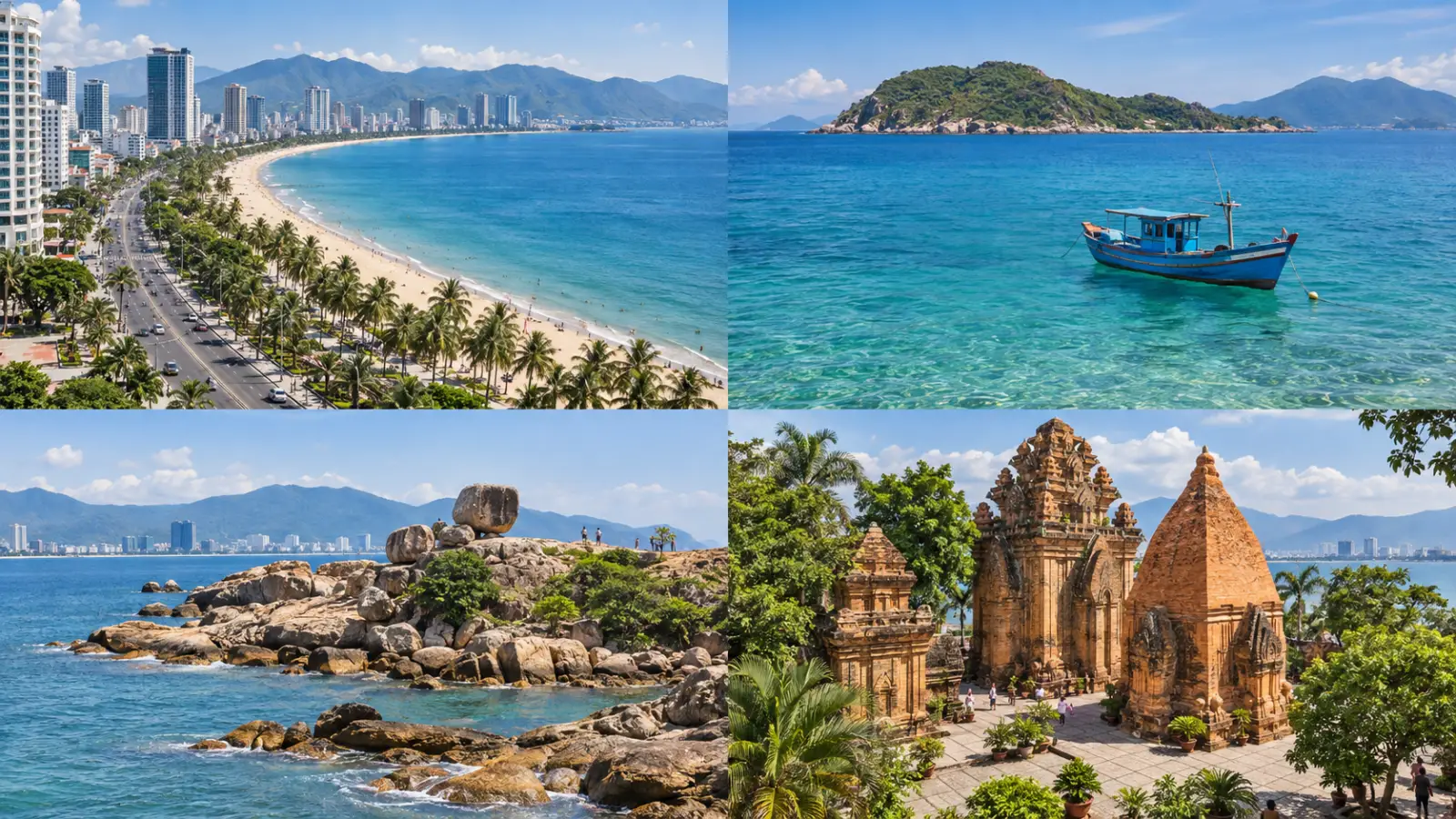
Nha Trang Travel Guide: Best Areas, Beaches, Weather, Prices and Things to Do
Nha Trang is one of those destinations in Vietnam where it is equally easy to spend four days or several months. The city has a long urban beach, good everyday infrastructure, islands, diving, inexpensive local restaurants, modern apartments, markets, shopping centres and a wide range of entertainment. At the same time, Nha Trang is not simply a resort town built around a few hotels: it continues to function as a normal Vietnamese city regardless of tourism.
Nha Trang is also much more varied than photos of the central seafront might suggest. The southern part of the city, the tourist centre, the north and the residential neighbourhoods inland can feel surprisingly different. You can spend a week surrounded by hotels and international restaurants near Trần Phú, or stay farther north and experience a quieter rhythm with local cafés and apartments aimed at long-term residents.
This guide explains the main areas of Nha Trang, how to understand the city map, which beaches to choose, the best time to visit, typical prices in 2026 and which attractions are actually worth including in your trip.
Nha Trang after the administrative reform
There is one recent change that many older travel guides do not yet reflect.
Since July 1, 2025, the former city of Nha Trang has been reorganised as part of Vietnam’s transition to a new two-tier local government system. The former city territory is now divided among four large wards: Nha Trang, Bắc Nha Trang, Tây Nha Trang and Nam Nha Trang.
The central Nha Trang ward incorporated several former areas including Lộc Thọ, Vạn Thạnh, Vĩnh Nguyên, Tân Tiến and Phước Hòa.
For travellers, very little has changed in practice.
Nha Trang is still universally used as the name of the city and resort, while older neighbourhood names such as Vĩnh Hải, Vĩnh Phước and Lộc Thọ continue to appear in accommodation listings, Google Maps, local conversations and older addresses.
So if a new official address says `phường Bắc Nha Trang` while an older review refers to `Vĩnh Hải`, they may be describing exactly the same area.
Understanding the Nha Trang map
Look at a map of Nha Trang and the basic geography is immediately clear: the city stretches along the coastline from north to south.
For travellers, it is more useful to divide Nha Trang into practical areas rather than official administrative units:
- the central tourist district around Trần Phú;
- northern Nha Trang around Hòn Chồng, Vĩnh Phước and Vĩnh Hải;
- the south around Vĩnh Trường, the old harbour area and transport to Hòn Tre;
- residential neighbourhoods inland from the beachfront;
- beaches and destinations outside the city such as Bãi Dài, Dốc Lết and the islands.
This division is far more useful when choosing accommodation than the formal administrative address.
Central Nha Trang: where to stay for a first visit
For most visitors, central Nha Trang means the area around Trần Phú Beach and the streets Nguyễn Thiện Thuật, Hùng Vương, Biệt Thự, Nguyễn Thị Minh Khai and the surrounding blocks.
This is the easiest area for a short first trip.
It has the highest concentration of restaurants, bars, coffee shops, massage salons, tour agencies, supermarkets and hotels. The beach is usually within walking distance, Grab cars are easy to find, and there is little need to plan where to eat in the evening.
The main disadvantage is that this is also the most tourist-oriented part of Nha Trang. The closer you are to the first line along Trần Phú, the more businesses cater primarily to visitors and the higher prices tend to be.
Walk just one or two blocks inland, however, and ordinary Vietnamese eateries begin to appear. Breakfast can already cost considerably less than on the beachfront.
Who should stay in the centre?
Central Nha Trang is the easiest choice if this is your first visit, you are staying for 3–7 days, you do not want to rent a motorbike and you plan to combine the beach with restaurants and excursions.
If you are staying for a month or longer and want fewer tourists, northern Nha Trang or residential areas farther inland may be more comfortable.
Northern Nha Trang: quieter and often better for longer stays
The northern part of the city begins roughly beyond the bridge across the Cái River and continues along Phạm Văn Đồng.
Short-term visitors usually know this area because of Hòn Chồng, while long-term residents are more familiar with neighbourhoods such as Vĩnh Phước and Vĩnh Hải.
There is less of a resort-centre atmosphere here, with more apartment buildings, local cafés and long-term rentals. Some beach sections are narrower than the central beach, but traffic and the waterfront can feel calmer.
The north is particularly popular with people staying for a month or several months.
The main advantages are a slower pace, often better rental value and plenty of inexpensive local food.
The disadvantage is that if nightlife and central restaurants matter every evening, you will use Grab more frequently.
Southern Nha Trang: harbour, islands and newer residential areas
Southern Nha Trang is less obvious as a place to stay, but this is where you will find the old harbour area, the Institute of Oceanography, departure points for many island trips and transport towards Hòn Tre.
Farther inland, newer residential complexes and neighbourhoods have also appeared.
For a first short visit, this is usually less convenient than the centre unless you have chosen a particular resort or apartment complex.
It can, however, be convenient for island excursions and VinWonders.
Inland Nha Trang: where the everyday city begins
It is worth walking just a few blocks away from Trần Phú at least once.
This is where everyday Nha Trang becomes much more visible: local markets, small coffee shops, bánh căn stalls, bún cá restaurants, family-run eateries, workshops and shops without tourist signs in several languages.
For long-term living, these neighbourhoods can be more practical than the beachfront.
For someone staying only four days, however, the savings on accommodation may not justify travelling to the beach every day.
Trần Phú: Nha Trang’s main city beach
The main beach stretches for roughly 7 km along central Nha Trang.
Its greatest advantage is obvious: it is right inside the city.
You can leave your hotel, cross the road and be on the beach. Behind you are cafés, shops, parks and restaurants, so a beach day requires almost no planning.
Early morning is one of the best times to experience it.
From around 5:00–6:00 AM, the promenade fills with local residents swimming, jogging, exercising or simply sitting by the sea. By 10:00–11:00, the sun is considerably stronger.
The beach becomes lively again in the evening.
The downsides of the central beach
This is an urban beach, so do not expect an isolated tropical bay.
It can be busy, while water conditions and the amount of debris along the shore vary after bad weather. During periods of stronger waves, the sea can look very different from the calm water shown in promotional photographs.
There is also a busy road separating hotels from the beach along most of Trần Phú.
For most adults this is a minor issue. With small children, it becomes more important when choosing a hotel.
The northern beach
The beaches along Phạm Văn Đồng north of Hòn Chồng have a different character.
Tourist density is lower, some stretches of beach are narrower, and the surrounding area is more residential. Many long-term visitors prefer this side of the city.
It is a good choice if you want to live near the sea without being in the main tourist district every evening.
However, the northern coastline is not uniform. The condition of the exact section in front of your accommodation matters more than the general label “north beach”.
Check recent photos of the specific beachfront before booking.
Bãi Dài: the beach towards the airport
Bãi Dài lies south of Nha Trang on the road towards Cam Ranh.
This is a completely different environment: a long coastline, resorts, individual beach venues and much less urban development.
If you want to spend several days primarily by the sea, Bãi Dài can be more pleasant than staying on Nha Trang’s central waterfront.
But staying there and commuting into central Nha Trang every day is rarely a good idea. The distance quickly removes the advantages of having a more attractive beach.
It works better either as a separate resort stay or as a day trip.
Dốc Lết: is it worth the journey?
Dốc Lết is considerably farther north of Nha Trang and is known for lighter-coloured sand and shallow water.
It can be a good option for families with children or anyone looking for a calmer beach day.
The journey, however, takes a significant part of the day, so there is little reason to travel there simply to photograph another beach.
If the central beach is calm and clean on the day of your visit, the difference may not justify the transport. If you specifically want a quieter resort-style beach away from the city, it makes more sense.
The islands: the main reason to leave the city beach
Nha Trang Bay contains numerous islands, and a boat trip is one of the most obvious excursions to add.
Hòn Mun is particularly known for coral and marine life and remains one of the main areas around Nha Trang for snorkelling and diving.
Hòn Tằm is more focused on resort-style beach time and water activities.
Hòn Miễu is closer to the mainland and appears on many standard island tours.
Hòn Tre is closely associated with Vinpearl and VinWonders.
Do not automatically book the cheapest `3 islands tour`. Some involve large groups, very short stops and several commercial attractions.
Before paying, check which islands are actually included, how long you spend at each stop, the group size, the type of boat and whether admission fees are included.
When is the best time to visit Nha Trang?
Nha Trang’s climate is easiest to understand as a relatively dry part of the year followed by a wetter period.
From January through August, conditions are generally sunnier with relatively little prolonged rain. From September, cloud cover and rainfall become more frequent.
For a conventional beach holiday, February through June is the most predictable period.
January is normally already quite good, although the sea can remain cooler and rougher following the end of the rainy season.
July and August are generally sunny but hotter.
From September, the probability of rain gradually increases.
October and November are the riskiest months if your priority is calm seas every day and regular island excursions. Heavy rainfall, rough sea conditions and cancellations of marine activities are more likely.
Is Nha Trang good in winter?
Yes, but do not assume that the climate is identical to Phu Quoc in southern Vietnam.
December can still be changeable, particularly in the first half of the month. January is generally better, while from February the chances of stable beach weather improve considerably.
That is why the simple statement that “winter is high season in Vietnam” is not very useful. Different parts of the country have different weather patterns.
What to see in Nha Trang itself
Po Nagar Cham Towers
Po Nagar Cham Towers is one of the few major sights in Nha Trang that genuinely explains the region’s history rather than simply entertaining visitors.
The complex was developed by the Cham between approximately the 7th and 12th centuries and remains an active religious site.
Around an hour is enough for most visits.
Go in the morning before it becomes too hot, wear respectful clothing and follow the rules when entering the sacred interiors.
Hòn Chồng
Hòn Chồng is a rocky promontory in northern Nha Trang with views across the bay, city and islands.
It is not somewhere that requires half a day, but it combines conveniently with Po Nagar and a visit to northern Nha Trang.
Morning or late afternoon is generally the best time.
Long Sơn Pagoda
Long Sơn Pagoda is slightly inland from the beach area and is best known for the large white Buddha statue above the complex.
Unlike many of Nha Trang’s modern attractions, it is worth visiting as part of understanding the ordinary city and its religious life.
Dress appropriately and remember that some visitors are there to pray rather than sightsee.
National Oceanographic Museum of Vietnam
In southern Nha Trang, the National Oceanographic Museum of Vietnam operates within the Institute of Oceanography complex.
Its collections include thousands of marine specimens, aquariums and a large whale skeleton. The institute itself dates back to 1922.
It is a particularly useful choice with children or on a rainy day.
Do not expect a modern aquarium on the scale of Singapore. Parts of the exhibition feel old-fashioned, but the scientific and historical collections are the real reason to visit.
Mud baths
Mineral and mud bathing is one of Nha Trang’s characteristic leisure activities.
The best-known complexes include Hòn Tằm Mud Bath, Hòn Tằm Mud Bath and Hòn Tằm Mud Bath.
A typical visit combines mineral or mud baths with pools and relaxation areas. It is not a must-see attraction, but it works particularly well after several active sightseeing days or during cloudy weather.
The complexes vary considerably in atmosphere and price, so decide whether you want a simple local spa experience or a full resort-style day.
VinWonders Nha Trang
VinWonders is located on Hòn Tre and connected with the mainland by cable car.
It is effectively a full-day destination, with a water park, rides, gardens, shows and family areas.
In 2026, the standard official ticket including the return cable car costs 800,000 VND for visitors between 100 and 140 cm and people over 60 and 800,000 VND for visitors between 100 and 140 cm and people over 60. Children under 100 cm enter free. Discounted evening tickets are available after 4 PM.
If the rides and attractions are important to you, arrive in the morning rather than trying to add VinWonders after sightseeing in the city.
Đầm Market
Chợ Đầm is one of Nha Trang’s best-known markets.
For visitors it is interesting for fruit, dried seafood, spices, coffee and ordinary local trading.
It is also firmly on the tourist map, so comparing prices is sensible.
If your priority is seeing a more everyday market and eating local food, explore smaller markets and neighbourhoods farther inland as well.
What to eat in Nha Trang
If you limit yourself to phở and bánh mì, you will miss much of the city’s food identity.
Some of the main local dishes include:
- bún cá / bún chả cá — noodle soup with fish and fish cakes;
- bún sứa — noodles with jellyfish;
- nem nướng Ninh Hòa — grilled pork sausages served with herbs, rice paper and dipping sauce;
- bánh căn — small rice-flour cakes often topped with egg, shrimp or squid;
- seafood, which deserves an entire category of its own.
In 2026, breakfast or a simple meal in a local restaurant commonly costs around 150,000–300,000 VND per person. A straightforward seafood dinner may start around 150,000–300,000 VND per person and increase significantly depending on the seafood ordered. Similar food on the Trần Phú beachfront often costs noticeably more.
With seafood, always check whether the listed price is per portion, per 100 grams or per kilogram.
How expensive is Nha Trang in 2026?
Nha Trang remains a relatively affordable resort destination, but the difference between a local lifestyle and a tourist-oriented one can be large.
Typical everyday prices:
| Expense | Approximate price |
|---|---|
| Local breakfast | 30,000–60,000 VND |
| Coffee | 15,000–40,000 VND |
| Simple local restaurant | 40,000–100,000 VND per person |
| Tourist-oriented café or restaurant | 130,000–250,000 VND per person |
| Seafood restaurant | around 200,000–500,000+ VND per person |
| Airport bus to Nha Trang | around 50,000 VND |
| Taxi from airport to centre | around 300,000–400,000 VND |
| VinWonders adult ticket | 1,050,000 VND |
Giving one average hotel price is less useful because accommodation varies heavily by season, weekends, public holidays and how early you book.
When comparing hotels, look beyond the star rating. The exact room, renovation date, noise, swimming pool, walking distance to the beach and recent reviews often matter far more.
Getting from Cam Ranh Airport to Nha Trang
Cam Ranh International Airport is not located inside Nha Trang.
The journey to the centre usually takes around 45–60 minutes depending on traffic and where you are staying.
Airport buses cost around 300,000–400,000 VND. Official taxis and services such as Xanh SM generally cost approximately 300,000–400,000 VND to central Nha Trang, while a pre-booked private transfer may cost somewhat more.
The VinBus 16-2 electric bus also operates between the airport and Nha Trang, passing through southern parts of the city and along Trần Phú.
For two or three travellers, the price difference between public transport and a private car becomes much less significant.
Getting around Nha Trang
Most visitors use Grab or regular taxis.
The central area is compact enough to cover many journeys on foot, although distances feel very different in the midday heat.
For trips of a few kilometres, GrabCar is often easier than negotiating with a driver on the street.
A motorbike gives much more freedom, especially for longer stays and trips north of the city or into the surrounding area. However, visitors should first check whether they are legally entitled to ride the relevant category of motorcycle in Vietnam. The fact that a rental shop is willing to hand over the keys does not establish that.
Is there public transport?
Yes.
Bus services operate within the city and the wider region, including newer electric routes. The airport connection is particularly useful for travellers.
For a short holiday, however, there is usually little reason to organise the whole trip around local buses. Nha Trang is stretched along the coast, while Grab remains relatively affordable.
For someone staying several months and regularly travelling along the same routes, buses become much more useful.
How many days do you need in Nha Trang?
3 days is the minimum for the city, beach and either an island trip or VinWonders.
5–7 days is a comfortable first visit, allowing time for the sea, islands, city and a few days without scheduled excursions.
10–14 days works very well for a beach holiday where you do not need an activity every day.
A month or longer changes Nha Trang from a resort into a practical base for everyday life, remote work and exploring Khánh Hòa.
A five-day Nha Trang itinerary
Day 1: city and beach
There is no need to book an excursion immediately after arrival.
Walk along Trần Phú, see the central beach, have a meal in a local restaurant and spend the evening on the waterfront.
Day 2: Po Nagar, Hòn Chồng and the north
Visit Po Nagar in the morning, continue to Hòn Chồng and have lunch in northern Nha Trang.
Spend the rest of the day on the northern beach.
Day 3: the islands
Choose a specific itinerary rather than simply booking “three islands”.
If snorkelling or diving matters, look for trips that include Hòn Mun and check how much actual time is spent in the water.
Day 4: VinWonders or a spa day
For families, VinWonders is an obvious choice.
If amusement parks are not your thing, spend the day at the mud baths, on the beach and around the city instead.
Day 5: everyday Nha Trang
Visit a market, have a local breakfast, explore the residential streets, stop at Long Sơn and finish with another afternoon by the sea.
This gives a much better picture of Nha Trang than booking five consecutive group excursions.
Nha Trang reviews: why travellers disagree so much
Reviews of Nha Trang can sound as if people visited completely different cities.
One traveller describes inexpensive food, beautiful sea and an extremely convenient resort. Another complains about noise, crowds, waves and an overly commercial tourist centre.
Often, both experiences are real.
One person may have stayed in northern Nha Trang in February, eaten mostly in local restaurants and spent time on the islands. Another may have booked the busiest part of the beachfront in November while expecting a quiet tropical island.
Nha Trang depends heavily on where you stay, when you visit and what you expect.
It is not the Maldives, a tiny fishing village or an isolated resort zone.
It is a living Vietnamese coastal city with a good beach directly in the centre, an enormous range of accommodation and food, mature tourism infrastructure and the ability to move from a dense city environment to the sea and islands in a short time.
Who is Nha Trang particularly good for?
Nha Trang is an excellent choice if you want to combine the beach with city life rather than stay inside a resort.
It works well for families, long-stay winter visitors, digital nomads, travellers without a car and anyone who wants restaurants, shops, healthcare and normal urban infrastructure close by.
It is particularly strong for longer stays because normal everyday life does not depend on using hotel facilities.
Who may prefer somewhere else?
If your ideal holiday means an empty white-sand beach with no road, high-rise buildings or city behind it, central Nha Trang probably will not provide that.
You can choose a resort outside the city or another destination entirely.
For historic streets and architecture, Hoi An or Hue is more interesting.
For a major metropolis, choose Ho Chi Minh City.
For an isolated island-resort experience, Phu Quoc or one of the resorts elsewhere in Khánh Hòa may make more sense.
Is Nha Trang worth visiting?
Nha Trang works best when it is not treated as a destination built around one major attraction.
Its main strength is everyday convenience.
You can swim in the sea in the morning, drink coffee in a normal local café ten minutes later, work from an apartment in the afternoon, eat seafood in the evening and take a boat to an island the following day.
That is why some travellers visit for a week while others remain for several months.
For a first trip, 5–7 days is a good amount of time. Stay either around central Trần Phú for maximum convenience or farther north if a quieter atmosphere matters more.
For beach weather, February through June is the most reliable period, although January through August is generally the drier and sunnier part of the year.
When choosing accommodation, start by looking at the Nha Trang map, check the distance to the exact beach section you intend to use, and only then compare hotel ratings.
The area and the season will usually influence your experience of Nha Trang much more than the number of stars beside the hotel name.
Updated: September 2026.
Main sources: Vietnam National Authority of Tourism; official Khánh Hòa provincial information; official transport information from Cam Ranh International Airport and Khánh Hòa Digital Tourism; VinWonders Nha Trang; current 2026 tourism and price information.
Read also
All articles
Health in Vietnam: Insurance, Hospitals, Pharmacies and Emergency Care
A practical health guide for Vietnam: emergency numbers, hospitals, pharmacies, travel insurance, animal bites, fever and upfront payments.

Ho Chi Minh City: What to See in 3–4 Days, Where to Stay, What to Eat and How to Get Around
A practical Ho Chi Minh City guide for 3–4 days: where to stay, what to see, what to eat and how to navigate the city.

Ninh Binh, the Bays or the Mountains: What to Add to a Trip to Hanoi
Hanoi is rarely the only destination on a first trip to northern Vietnam. Within a few hours of the capital, you can reach dramatically different…

Everyday Vietnam: How to Communicate at Markets, Cafés and in Vietnamese Homes
Travellers in Vietnam rarely need a deep understanding of local etiquette. Mispronouncing a word, choosing the wrong form of address or not knowing where to…

How Much Does a Trip to Vietnam Cost, and What Does One Month of Living There Cost? A Realistic 2026 Budget
Ready VND budgets for a week and a month in Da Nang, Hanoi and Ho Chi Minh City: accommodation, food, transport, deposit and reserve.
Mekong Delta: How to Plan Your Trip and What Is Actually Worth Seeing
The Mekong Delta is not a single attraction near Ho Chi Minh City. It is a huge region of rivers, canals, rice fields, orchards and…
Comments
Share your thoughts or ask a question about this article.