Ho Chi Minh City: What to See in 3–4 Days, Where to Stay, What to Eat and How to Get Around
Ho Chi Minh City is not a place best understood through a simple “top 10 attractions” list. There is the Independence Palace, the War Remnants Museum, the old Central Post Office and Cholon, but much of the city’s character comes from elsewhere: morning cơm tấm with pork grilling over charcoal, cafés hidden inside old apartment buildings, endless motorbike traffic, the new metro, high-rises across the Saigon River and neighbourhoods that feel completely different at night than they do in the morning.
For a first visit, three full days are enough to see several sides of the city without rushing. A fourth day can be used for the Cu Chi Tunnels, the Mekong Delta or simply another slower day in the city itself. The main thing to remember is scale. The historic centre is relatively compact, but Cholon, Thao Dien, the airport and the eastern side of the city are in very different directions. Heat and traffic also make distances feel much longer than they look on a map.
Ho Chi Minh City or Saigon?
The official name is Thành phố Hồ Chí Minh / Ho Chi Minh City. But Sài Gòn / Saigon is still used everywhere by locals, restaurants, hotels, brands and city institutions. Both names are completely normal in everyday conversation.
There is another detail worth knowing in 2026. After the 2025 administrative reform, the city’s official geography changed substantially. Former districts such as District 1, District 3 and District 5 are no longer current administrative units, and central areas are now divided into new wards such as Sài Gòn, Bến Thành, Tân Định, Xuân Hòa and Chợ Lớn. For travellers, however, the old district names are still useful. Booking sites, Google Maps, older guides and local residents continue to use “District 1” or “District 5” as practical geographic references. So this guide uses both: the current place names and the familiar tourist geography.
Where to stay
For a first trip, I would not choose accommodation by price alone. In Ho Chi Minh City, an extra 15–20 minutes through dense traffic quickly becomes a noticeable part of every day.
| Area | Best for | What to know |
|---|---|---|
| Bến Thành / Nguyễn Huệ / Đồng Khởi | First trip for 2–4 days | Best access to the centre, Metro Line 1 and major sights; accommodation is usually more expensive |
| Phạm Ngũ Lão / Bùi Viện | Budget hotels, hostels and nightlife | Very noisy, especially directly around Bùi Viện |
| Tân Định / former District 3 area | Staying close to the centre but in a calmer neighbourhood | Usually requires a short Grab ride to Nguyễn Huệ or Bến Thành |
| Thảo Điền | Cafés, restaurants, longer stays and remote work | Too far from most historical sights for a short first visit, though the metro now makes it much easier |
| Chợ Lớn | Chinese-Vietnamese heritage and more local urban life | Not the most convenient base for classic first-time sightseeing |
For a first three-day visit, I would stay somewhere roughly between Bến Thành, Nguyễn Huệ and Đồng Khởi. From there, much of the first day can be done on foot, Metro stations Bến Thành and Opera House are nearby, and the river is easy to reach in the evening. If you want cheaper accommodation, the Phạm Ngũ Lão area is practical, but I would not book directly on Bùi Viện Walking Street unless nightlife matters more than sleep.
Tân Sơn Nhất Airport: your terminal now matters
Tân Sơn Nhất currently has three passenger terminals: T2 — international flights. T3 — most domestic flights. T1 — domestic VietJet Air flights.
By late 2025 and into 2026, Vietnam Airlines, Pacific Airlines, Vasco, Bamboo Airways, Vietravel Airlines and Sun PhuQuoc Airways had moved domestic operations to T3, while VietJet continued operating from T1. This is especially important for international-to-domestic connections because T2 and your domestic terminal may be separate buildings. A free airport shuttle connects T1, T2 and T3.
For a connection, always follow current airport signs rather than relying on an old travel guide.
Getting from the airport to the city
The easiest option is usually a car booked through a major ride-hailing app or an official taxi. Licensed operators include familiar taxi companies such as Vinasun and Mai Linh, as well as ride-hailing services including Grab and Xanh SM. App-based cars use designated pickup zones, so do not rely only on where the vehicle appears on the map. Follow the airport signs to the correct pickup area.
Fares are dynamic and depend heavily on time of day. The main problem is not the distance but the traffic. The airport is geographically quite close to the city centre, yet a short route on the map can take much longer during rush hour.
For the return journey before an international flight, leave a generous time buffer.
How many days do you need?
1 day — enough for the historical centre, but very superficial. 2 days — enough for the centre plus Cholon or another separate neighbourhood. 3 days — ideal for a first visit.
4 days — enough to add Cu Chi, a Mekong Delta trip or another slower city day. The Cu Chi Tunnels and the Mekong Delta should not be treated as “two more Ho Chi Minh City attractions”. They are separate excursions.
Day 1: historic central Saigon
The first day works best around a group of sights relatively close to each other: Independence Palace → War Remnants Museum → Notre-Dame / Central Post Office → Đồng Khởi → Nguyễn Huệ → Saigon River.
Independence Palace
Start with Dinh Độc Lập — Independence Palace / Reunification Palace. This is more than an attractive modernist building. It is one of the key sites for understanding South Vietnam and the end of the war in 1975. Inside are ceremonial halls, presidential rooms, communications facilities, underground spaces and much of the period interior.
As of September 2026, it is open daily: 07:00–18:00
The full adult ticket is: 80,000 VND
Allow roughly 1.5 hours rather than just stopping for a photo outside.
War Remnants Museum
From the palace, it is easy to continue to the War Remnants Museum. It is one of the city’s strongest museums, but the material is difficult: photographs, documents, military equipment and exhibitions dealing with civilian suffering and Agent Orange. The museum presents the war primarily through a Vietnamese historical and state perspective.
That is worth understanding in advance, but it also makes the museum especially interesting as a place to see how the war is officially remembered and interpreted in Vietnam.
As of September 2026: 07:30–17:30 daily last admission at 17:00 adult ticket:
40,000 VND
I would allow at least 1.5–2 hours and avoid scheduling several more museums afterwards.
Notre-Dame: an important 2026 limitation
After the museum, walk towards Saigon Notre-Dame Cathedral Basilica and the Central Post Office. Many older travel guides are now misleading here. The cathedral is still undergoing major restoration work. Tourist visits to the interior remain closed during the renovation.
Religious services continue, but for a normal visitor in 2026, the cathedral should be treated mainly as an exterior architectural stop, not a full interior visit. In March 2026, new gilded crosses were returned to the towers, but restoration work was still ongoing.
Saigon Central Post Office
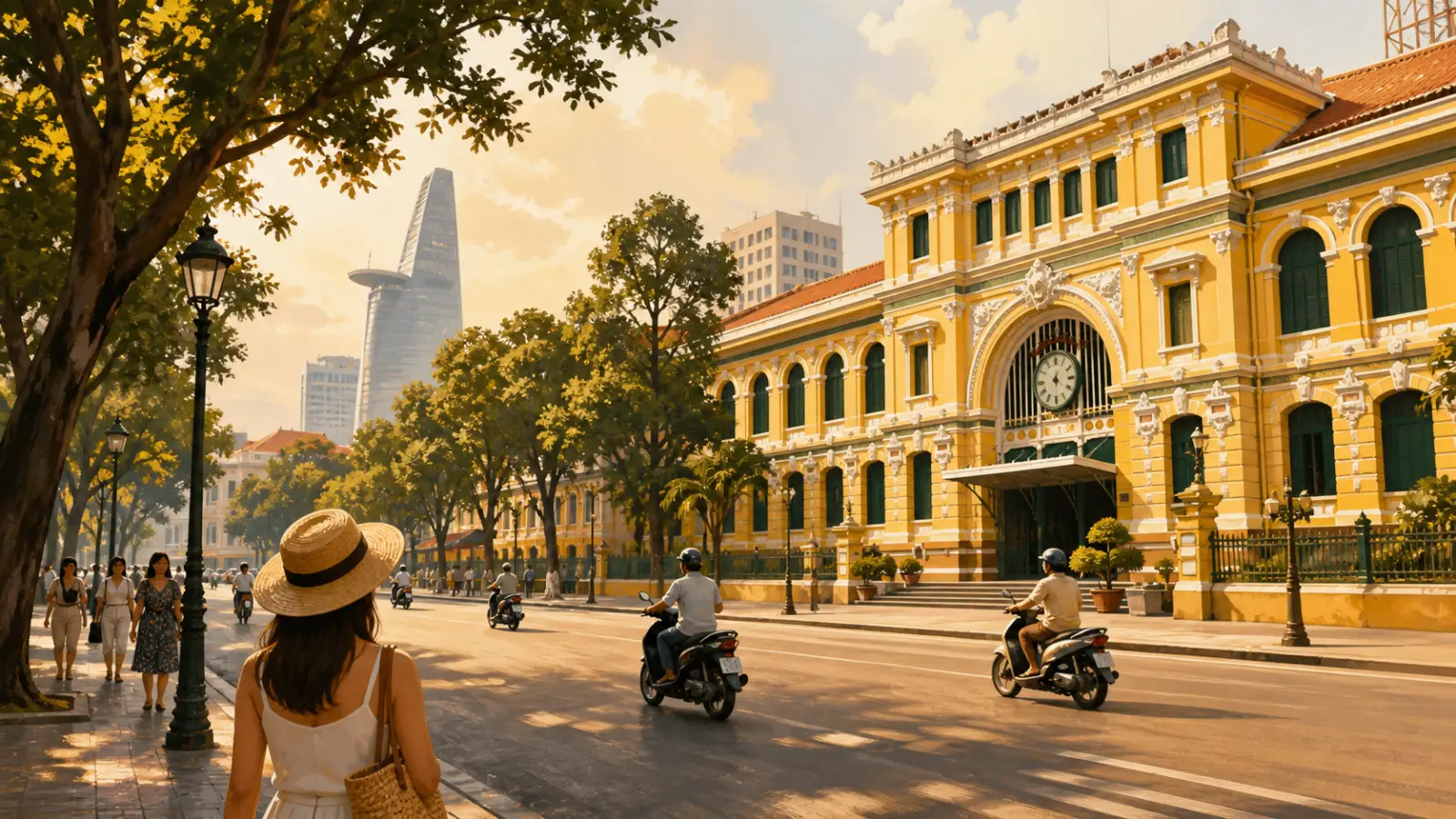
Right next to the cathedral is the Saigon Central Post Office. It is interesting because it remains a functioning public building rather than a preserved shell. You do not need half a day for this area.
The cathedral, post office and surrounding streets fit naturally into roughly an hour of relaxed walking.
Đồng Khởi and Nguyễn Huệ
Continue along Đồng Khởi.
Along this axis you will find: Saigon Opera House; historic hotels; shops; older administrative buildings; and the route towards Nguyễn Huệ and the river.
Nguyễn Huệ is better in the evening
Nguyễn Huệ Walking Street can feel like a large, exposed paved space during the day. In the evening, it becomes much more interesting. There are more people, the lighting comes on, cafés get busier, and the walk towards the river works much better.
You can also visit the old building at 42 Nguyễn Huệ, where several floors have been converted into cafés and small businesses. Repurposed old buildings like this are an important part of the modern central Saigon experience. End the day around the Bạch Đằng riverfront.
Day 2: Bến Thành and Cholon
The second day should show you a very different side of the city.
Is Bến Thành Market worth visiting?
Bến Thành is one of the city’s best-known symbols and a useful orientation point. It is worth entering. But I would not build half a day around it.
The market is heavily oriented towards tourists, with souvenirs, clothing, food and general merchandise. Prices are not always fixed, so if there is no visible price tag, ask before buying. Its biggest practical advantage today is its central location and direct connection to the Bến Thành Metro station.
For most visitors, 30–60 minutes is enough unless you genuinely want to shop.
Then go to Chợ Lớn
Chợ Lớn is Ho Chi Minh City’s historic Chinese-Vietnamese district. It deserves its own part of the day rather than being squeezed between the palace and Nguyễn Huệ.
Two of the best places to start are: Bình Tây Market and
Thiên Hậu Pagoda
Bình Tây Market
Bình Tây is more interesting than Bến Thành if you want to see a major traditional trading environment rather than a tourist market. It is primarily a wholesale market.
Expect: bulk goods; suppliers; food products; spices; household items; and the real commercial rhythm of the area.
You do not have to buy anything. The scale and atmosphere are the point.
Thiên Hậu Pagoda
After the market, continue to Thiên Hậu Pagoda on Nguyễn Trãi. It is an active temple closely connected with the city’s Chinese community.
The atmosphere matters more than ticking off architectural details: incense; offerings; worshippers; inner courtyards.
Treat it as a religious site rather than as a photo set.
Do not turn Cholon into a checklist
The area is huge. Trying to see every market, temple and old street in two hours is not useful.
A better plan is: Bình Tây; one temple; lunch; a little walking; then back to the centre.
That makes the contrast between central business Saigon and Cholon much clearer.
Day 3: metro, modern Ho Chi Minh City and the river
On the third day, I would not repeat the historical centre. Ho Chi Minh City finally has a genuinely useful tool for exploring the eastern side of the city: Metro Line 1.
Metro Line 1
The Bến Thành – Suối Tiên line has been in commercial operation since December 2024.
It has 14 stations, including three underground stations in the centre: Bến Thành
Opera House
Ba Son
Then it continues above ground through: Văn Thánh; Tân Cảng; Thảo Điền; An Phú; and farther east towards Suối Tiên.
Single fares are roughly: 6,000–20,000 VND depending on distance and payment method.
There are also: 1-day pass — 40,000 VND
3-day pass — 90,000 VND
with unlimited rides during the validity period. For a normal tourist itinerary, a day pass is not always necessary. If you simply go from the centre to Thảo Điền and back, individual rides may be cheaper.
Useful stops for visitors
The most useful stations are: Opera House — historical centre; Ba Son — riverside development; Tân Cảng — Landmark 81 area; Thảo Điền — cafés, restaurants and a more modern international neighbourhood.
There is little reason to ride all the way to Suối Tiên simply to say you travelled the entire line.
Thảo Điền
Thảo Điền used to be an area visitors reached mostly by car through heavy traffic. The metro changed that significantly.
The neighbourhood has many: cafés; restaurants; bars; shops; modern residential complexes.
But it is not a “must-see attraction”. It makes sense if you want to see another side of contemporary Ho Chi Minh City, especially if you are considering the city for a longer stay. After the 2025 administrative reform, the former Thảo Điền area became part of the new An Khánh ward, although “Thảo Điền” remains the normal geographic name people use.
Saigon Waterbus: transport or sightseeing?
Another good way to see the city is the Saigon Waterbus. The route starts at Bạch Đằng and continues up the river.
Typical journey times include approximately: Bạch Đằng → Thủ Thiêm — 5 minutes
Bạch Đằng → Ba Son — 10 minutes
Bạch Đằng → Thảo Điền — 20 minutes
Bạch Đằng → Thanh Đa — 32 minutes
Bạch Đằng → Linh Đông — 52 minutes
The Waterbus operates daily.
Current published hours are roughly: 07:00–21:00 Monday to Friday
07:00–23:00 on weekends and public holidays
I would not use it mainly as the fastest transport. It is better as an inexpensive way to see Ho Chi Minh City from the river. A good combination is: city centre → Waterbus to Thảo Điền → café or dinner → Metro back.
That is much more interesting than spending the third day walking through another series of central shopping malls.
If you have a fourth day
Then it makes sense to leave the city.
Option 1: Cu Chi Tunnels
The Cu Chi Tunnels are associated with wartime guerrilla infrastructure and are far from central Ho Chi Minh City. This is at least a half-day trip, and it is better to think of it as almost a full-day excursion. There are road-based and combined river-tour options.
If military history genuinely interests you, Cu Chi connects well thematically with the War Remnants Museum and Independence Palace. If not, there is no need to go simply because every “must-see” list includes it.
Option 2: Mekong Delta
There are countless one-day Mekong Delta tours from Ho Chi Minh City. In a single day, you will see only a small and highly tourist-oriented part of an enormous region. That is fine if you treat it as an introduction.
If the Mekong itself is important to you, it is much better to spend at least one night around Cần Thơ or another delta city.
Whether you have one day or several shapes the whole itinerary; our guide to planning a trip to the Mekong Delta explains the options in more detail.
Do not combine Cu Chi and the Mekong in one day
Those tours exist. Technically, it is possible. In practice, the result is usually a long bus marathon where both major topics receive very little time.
I would choose one.
What to do in the evening
Ho Chi Minh City does not have one universal nightlife district. It depends on what you want. Nguyễn Huệ and Bạch Đằng — walking, city atmosphere and river views.
Bùi Viện — bars, loud music and tourist nightlife. Thảo Điền — restaurants, bars and a calmer modern scene. Chợ Lớn — a completely different evening rhythm, but not really a bar-hopping district.
For a first evening, I would choose Nguyễn Huệ and the river. Bùi Viện is worth seeing only if that kind of nightlife actually interests you. It is not an essential Ho Chi Minh City experience.
How to get around
Ho Chi Minh City is easier to navigate than it was a few years ago, but no single form of transport solves everything.
The best combination is: walking in the centre
Metro Line 1
Grab / Xanh SM or taxi for cross-city routes
Waterbus for the river and selected destinations
Walking
The central area around: Independence Palace; Notre-Dame; Central Post Office; Đồng Khởi; Nguyễn Huệ; Bạch Đằng can genuinely be explored on foot.
But the old claim that “you can walk everywhere in District 1” is too optimistic. Midday heat changes your opinion of a two-kilometre walk very quickly.
Motorbike taxis
Riding as a passenger on a motorbike can be much faster than travelling by car. It only makes sense if you are comfortable in that traffic and use a proper helmet. If this is your first time seeing Ho Chi Minh City traffic and you already feel nervous standing on the pavement, a car is the more sensible option.
Should you rent your own motorbike?
For a first three-day trip, usually not. The advantage is small. Short taxi and motorbike-taxi rides are inexpensive, you do not have to deal with parking, and legal driving-document and insurance requirements still apply.
The fact that a rental shop is willing to give you a motorbike does not automatically mean you are legally entitled to ride it or that your insurer will cover an accident.
How to cross the street
Ho Chi Minh City traffic looks chaotic, but the advice “just walk and everyone will go around you” is too simplistic. At major roads, use traffic lights and marked crossings.
At uncontrolled crossings: watch the flow; move steadily; be predictable; do not suddenly run; do not suddenly step backwards.
Pay particular attention to buses and cars because they cannot change direction as easily as motorbikes. When standing near the road, keep your phone on the side away from traffic.
What to eat in Ho Chi Minh City
One of the city’s strengths is that you can find food from almost every region of Vietnam. But there are dishes particularly worth trying here.
Cơm tấm
If I had to choose one everyday dish strongly associated with Saigon, it would be cơm tấm. It is usually broken rice served with grilled pork, egg, chả, pickled vegetables and fish sauce. The smell of pork grilling over charcoal in the morning is one of the characteristic details of residential streets in the city.
Hủ tiếu
Another important southern dish is hủ tiếu. It comes as soup or as a dry noodle dish with broth on the side. There are many versions with pork, shrimp, offal and other toppings.
Bánh xèo
Ho Chi Minh City is also an easy place to try a large southern-style bánh xèo — a crisp pancake filled with shrimp, pork and bean sprouts. Pieces are wrapped in leaves and herbs and dipped into sauce.
Bánh mì
Bánh mì is available across Vietnam, but Saigon is one of the best places to compare different styles.
Common fillings include: thịt; xíu mại; chả cá; thịt quay; chicken; different pâtés and sauces.
Ốc
For a more local evening meal, look for ốc.
The term covers snails, shellfish and other seafood prepared in many different ways: grilled; with garlic; with tamarind; with coconut; with chilli; and with a wide range of sauces.
This is more of a social evening format than a single signature dish.
How much does food cost?
A practical budget is roughly: 40,000–80,000 VND — a simple local meal; 25,000–60,000 VND — a normal coffee; 100,000–250,000 VND per person — a more comfortable café or restaurant; modern restaurants, rooftop bars and fine dining can cost much more.
There is no reason to cross the entire city because someone online declared one particular place “the best bánh mì in Saigon”. There is too much good food in Ho Chi Minh City to spend an hour in traffic for one sandwich.
Coffee is a separate part of the city
Ho Chi Minh City has everything from plastic-stool cà phê sữa đá for a few tens of thousands of dong to specialty coffee, design-focused cafés and international chains. Old buildings converted into small commercial spaces are especially interesting. Buildings such as 42 Nguyễn Huệ and 22 Lý Tự Trọng contain cafés and small shops spread across former residential units.
On a hot day, an hour in an air-conditioned café is not wasted holiday time. It is a normal part of experiencing the city.
When is the best time to visit?
Ho Chi Minh City is warm throughout the year. The main seasonal distinction is not summer versus winter, but dry versus wet.
Typically: December–April — drier
May–November — wetter
The strongest heat often comes around April–May. For a first visit, the easiest period is usually December–February. But the rainy season does not make Ho Chi Minh City a bad destination.
A typical tropical downpour may start in the afternoon and end relatively quickly. Sometimes rain lasts much longer, so wet-season itineraries simply need to be more flexible.
A useful rhythm is: morning — outdoors; middle of the day — museum, shopping centre or café; evening — back outside.
Common planning mistakes
Assuming the whole centre is comfortable to walk. Parts are compact, but heat and wide roads make longer walks tiring. Going to Notre-Dame expecting to see the interior. In 2026, tourist access inside remains closed because of restoration. Spending too much time at Bến Thành. For most visitors, an hour is enough.
Staying directly on Bùi Viện despite having no interest in nightlife. That is a deliberate exchange of sleep for location and noise. Failing to check the terminal for a domestic flight. Domestic airlines are now split between T1 and T3. Ignoring the metro because older guides were written before it opened. Line 1 is already useful for Bến Thành, Opera House, Ba Son, Tân Cảng and Thảo Điền.
Trying to combine Cu Chi and the Mekong in one day. It can be done, but choosing one is almost always better. Crossing the entire city for the “one correct” food place. It is more interesting to choose a neighbourhood and eat well there.
A practical three-day itinerary
If you simply want a ready-made route: Day 1: Independence Palace → War Remnants Museum → Notre-Dame from outside → Central Post Office → Đồng Khởi → Nguyễn Huệ → Bạch Đằng in the evening. Day 2: Bến Thành → Chợ Lớn → Bình Tây Market → Thiên Hậu Pagoda → dinner → return to the centre. Day 3: Metro from Bến Thành → Tân Cảng or Thảo Điền → modern eastern Ho Chi Minh City → Waterbus back towards Bạch Đằng → final evening in the centre.
If you have a fourth day, choose one: Cu Chi or the Mekong Delta. This route shows more than the colonial centre and wartime history.
It gives you several different versions of Ho Chi Minh City: historic Saigon; Chinese-Vietnamese Cholon; the modern city developing along the metro and river.
For a first visit, that is enough. Updated: September 2026.
Main sources: Vietnam National Authority of Tourism; War Remnants Museum; Independence Palace Historical Site; Saigon Notre-Dame Cathedral; Ho Chi Minh City Metro Line 1; Saigon Waterbus; Tân Sơn Nhất International Airport; official Ho Chi Minh City administrative reform documents.
Comments
Read also
All articles
How Much Does One Month in Vietnam Cost? 2026 Travel and Living Budget
How much does one month in Vietnam cost? Plan 18–25 million VND for a simple monthly lifestyle, or 28–40 million for more comfort. Compare housing,…
Ho Chi Minh City Events
Nguyen Hue festivals, river celebrations, symphony concerts, ballet and A O Show. Browse Ho Chi Minh City events or announce your own event for free.
10 Beach Clubs in Vietnam: Pools, Sunsets, Music and Water Sports
Ten beach clubs in Phu Quoc, the Hoi An area, Nha Trang, Cam Ranh, Mui Ne and Phan Rang, with real photographs, each venue’s character…
Nha Trang in the rain: three days out without the beach
Choose a museum, a film or a show, with routes that keep outdoor walks short.

Entering Vietnam in 2026: Visa-Free Travel, e-Visa and Entry Requirements
Vietnam entry rules for 2026: who can travel visa-free, when to apply for an e-Visa, and which documents to check before departure.
Nha Trang's Museum of Oceanography: what adults and children can see
A whale beneath a rice field, stray seals and fish with transparent bodies.