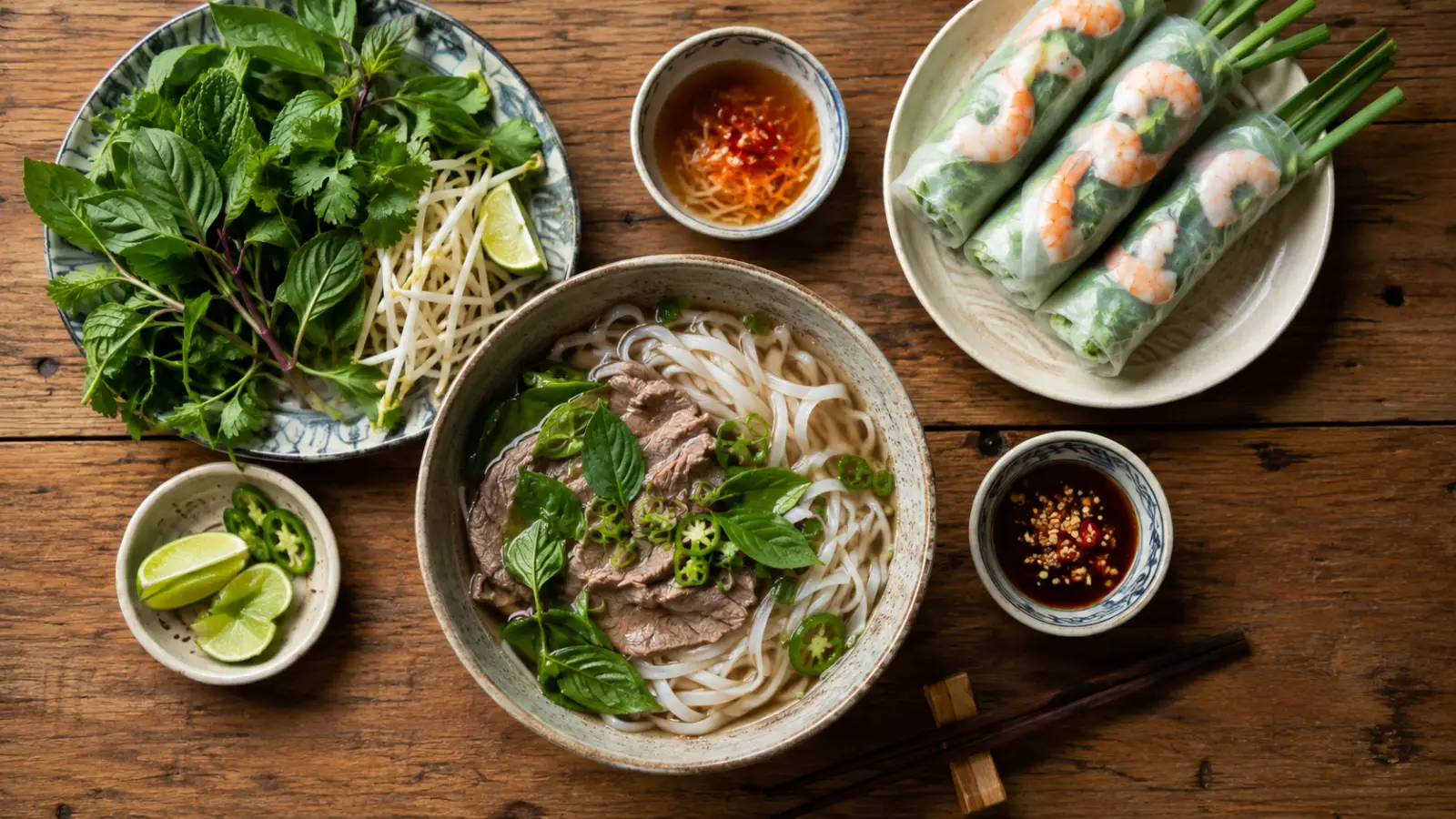
Pho is only the beginning. A useful first encounter with Vietnamese food does not mean chasing a long list of unfamiliar names. Choose one representative dish from the north, centre and south: bún chả in Hanoi, mì Quảng or bún bò Huế in central Vietnam, and cơm tấm or bánh xèo in the south. You will taste how broth, rice noodles, herbs, rice, sauces and serving styles change across the country.
A dish name is not a promise that food is vegetarian, mild or free from allergens. Broth may be made with meat or fish; a sauce may contain fish sauce; and a vegetable dish may be cooked in a shared broth. If you have a serious allergy, show a written Vietnamese explanation of the specific allergen and choose a dish only when the staff can answer clearly.
The north: grilled flavours, dipping sauce and delicate rice dishes
| Dish | What it is | How to approach it |
|---|---|---|
| Bún chả | Grilled pork, rice noodles, herbs and a light sweet-sour dipping sauce. | Add small amounts of noodles and herbs to the bowl of pork and sauce. |
| Bánh cuốn | Thin steamed rice rolls, commonly with pork, mushroom, onion or sausage filling. | Ask about the filling; the rice wrapper alone does not make the dish vegetarian. |
| Xôi | Sticky rice served in savoury or sweet versions. | Ask mặn hay ngọt?—savoury or sweet—and whether it contains meat. |
With bún chả, the bowl of sauce is part of the dish rather than an optional condiment: it brings together grilled meat, noodles and herbs. On a first visit, add food gradually instead of emptying all the noodles into the bowl at once. That lets you find the level of sweetness, acidity and chilli that works for you. Bánh cuốn has a much softer texture, and its character comes chiefly from filling and sauce. It makes a good breakfast or light lunch, not simply another type of pho.
Xôi is a practical northern breakfast reference point. Sticky rice may arrive with meat and pâté, or with coconut and sweet toppings. The useful question is not a catalogue of variations: ask whether it is mặn (savoury) or ngọt (sweet), whether it has meat, and what is on top. It prevents the surprise of ordering what looked like a dessert and receiving a substantial meat breakfast.
Central Vietnam: concentrated flavour and clear contrasts
| Dish | What it is | Ask before ordering |
|---|---|---|
| Bún bò Huế | A fragrant, often spicy noodle soup whose broth and meat components matter. | Spice level, meats and broth ingredients; be specific if you avoid a meat or offal. |
| Mì Quảng | Wide rice noodles with a small amount of rich broth, herbs and crisp toppings. | It is not a large bowl of soup. Mix the noodles, liquid and toppings before eating. |
| Cao lầu | Hoi An noodles with pork, herbs and crisp elements. | Confirm meat and sauce; treat it as its own local dish, not a pho variation. |
Central bowls can look compact without being light. Mì Quảng uses only a little concentrated liquid; rice crackers, peanuts, sesame and herbs may be served separately. Taste the components before mixing everything if you want to notice the contrast between soft noodles and crisp toppings. Bún bò Huế centres on hot, aromatic broth. “No meat” is not a precise enough request if you avoid beef, pork, particular cuts or a broth ingredient—say what you cannot eat.
In Hoi An, cao lầu is worth trying as a local noodle dish in its own right. Different stalls can vary the quantity of meat, greens and sauce. A clear order is more useful than asking whether something is “authentic”: name the dish, say one portion, then ask about meat and chilli. What matters is what will actually be in your bowl.
The south: broken rice, fresh herbs and food made to share
| Dish | What it is | How to approach it |
|---|---|---|
| Cơm tấm | Broken rice, often with grilled pork, egg, vegetables and fish sauce. | Ask to leave out meat, egg or fish sauce before it is prepared; do not assume it is vegetarian. |
| Bánh xèo | A crisp rice pancake with fillings that vary by region. | Cut off a small piece, wrap it in lettuce and herbs, then dip; ask about shrimp, pork and fish sauce. |
| Gỏi cuốn | Fresh rice-paper rolls with herbs and a filling such as shrimp, pork or tofu. | Confirm both filling and dipping sauce; “fresh” does not mean allergen-free. |
Cơm tấm is a complete meal, not rice placed beside a piece of meat. Broken rice, protein, vegetables, egg and sauce create its balance. Bánh xèo works well for two people to share, but it is usually more filling and oily than its thin edge suggests. In the south, herbs and greens often arrive separately, which gives you control over each mouthful.
Fast food that deserves more attention: bánh mì and bánh bao
Bánh mì is not one standard “Vietnamese sandwich”. A crisp baguette may contain pâté, meat or egg, pickled carrot and daikon, cucumber, coriander, chilli and sauce. Tell the vendor the filling you want: bánh mì trứng is egg, bánh mì thịt is meat, and bánh mì chay is a vegetarian version. Then ask separately about pâté, mayonnaise, coriander and chilli. A vegetarian label does not automatically settle questions about sauce or shared utensils.
Bánh bao is a steamed bun. Its pale exterior can hide pork, egg, mushroom or a sweet filling, so ask nhân gì?—what filling is inside—rather than judging by appearance. It is useful for an early departure or a quick breakfast, but it should not be your only introduction to a region’s cooking.
Desserts: coconut, beans, jelly, fruit and ice
| Name | What it is | What to confirm |
|---|---|---|
| Chè | A broad family of sweet bowls and cups with beans, jelly, fruit, coconut milk, grains and ice. | Milk, beans, ice and the individual ingredients; it is a dessert, not simply a drink. |
| Chè ba màu | “Three-colour” dessert, usually layered beans, jelly, coconut milk and ice. | Every stall has its own combination; there is no single fixed recipe. |
| Bánh flan | Caramel custard, sometimes served with ice or coffee. | It contains egg and milk. |
| Xôi ngọt | Sweet sticky rice with coconut, beans, sesame or fruit. | It is dense and filling, not an automatically light snack. |
| Trái cây dầm | Fruit with ice, syrup or condensed milk. | Syrup, milk and ice can be adjusted separately. |
The appeal of many Vietnamese sweets lies in contrast: cold ice, rich coconut, soft beans and springy jelly. They should not be mistaken for a “healthy fruit meal”: condensed milk, syrup and coconut can turn a cup into a full dessert. If milk, egg, peanuts or sesame are a problem, name the exact ingredient and choose a simpler item with a clear composition.
What to drink besides coffee
| Drink | What it is | Ordering note |
|---|---|---|
| Nước mía | Fresh sugar-cane juice, sometimes with lime. | It is naturally sweet; ask for no extra sugar if that matters. |
| Nước dừa | Fresh coconut water. | Confirm the price before opening; coconut flesh and ice may be separate extras. |
| Nước cam | Orange juice. | Ít đường means less sugar; không đá means no ice. |
| Sinh tố | Fruit smoothie. | It may include condensed milk, sugar or ice, so say what fruit and sweetness you want. |
| Trà tắc / trà chanh | Kumquat tea or lemon tea. | Usually sweet; ask for less sugar if needed. |
Coffee deserves its own guide. For now, do not order “coffee” blindly if you do not want a sweet drink with condensed milk. For plain water, choose a sealed bottle. An iced drink is neither an automatic danger nor a guarantee of quality; use your own medical needs and judgment about the venue.
Build an order that fits your appetite
Choose one main dish and one contrasting item instead of two heavy meals at once. In Hanoi, that might be bún chả and a fresh drink; in Da Nang, mì Quảng followed by a small chè; in the south, cơm tấm plus gỏi cuốn shared with a companion. When eating as a pair, order a main each and one shared bánh xèo or dessert. You will notice more flavours and waste less food.
| Vietnamese | Meaning | Use |
|---|---|---|
| Một phần / hai phần | One portion / two portions | State the quantity clearly. |
| Không thịt, cảm ơn | No meat, thank you | Does not guarantee meat-free broth. |
| Không cá, không nước mắm | No fish, no fish sauce | Say both parts. |
| Món này có cay không? | Is this dish spicy? | Ask before ordering. |
| Tôi bị dị ứng với … | I am allergic to … | Add the exact allergen. |
At a market or small restaurant, look for the price and queue, point to the dish or show its name on your phone, state the number of portions, then ask about extra meat, sauce or drinks. These phrases are not a medical guarantee for a severe allergy: repeat the request, show it in writing, and choose another dish if the reply is unclear.
A two-day food route without a food marathon
Day one, northern city rhythm: bánh cuốn in the morning, bún chả for lunch, trà chanh while walking, then bánh flan or chè in the evening. Day two, central or southern contrast: mì Quảng or bún bò Huế for lunch; bánh mì for a short journey; bánh xèo or cơm tấm for an early dinner; and a less-sweet sinh tố if you want something cold. The point is not to “eat all of Vietnam”, but to compare hot broth, rice, herbs, sauces, crisp toppings and cold dessert at a comfortable pace.
Four rules that make ordering easier
- Name the dish, then the restriction. Point to the item, state the portions, then say which meat, fish, egg, milk or allergen must be avoided.
- Keep dislike and danger separate. Chilli and coriander can often be removed; a serious allergy cannot be managed through a vague translation.
- Ask before additions go in. Pâté, broth, sauces, chilli and condensed milk can change a dish more than its menu name.
- Leave space for water and a pause. Heat, sweet drinks and two heavy dishes in a row make the cuisine harder to enjoy.
Choose food for the time and your energy
Morning, a transfer day and a hot afternoon call for different orders. Bánh cuốn, xôi and bánh bao work well for breakfast: portions are easier to judge and the wait is usually short. For a real lunch, choose one regional bowl or plate—bún chả, mì Quảng, bún bò Huế or cơm tấm. If your next transport leaves in less than an hour, bánh mì and sealed water are more practical than a large soup. After walking in the heat, share chè, a fruit cup or one bánh xèo instead of ordering two heavy mains.
Do not build a “perfect” food day from ratings alone. At a restaurant without a menu you can read, look first at the prepared food, prices and queue. At a popular stall, choose an item made continuously, but still ask about any critical ingredient. In a hotel district, portion size and price may be aimed at visitors; in a market, at a local fast lunch. Neither format automatically makes food better. Choose a place where you can understand the ingredients, price and conditions that matter to you.
When you have dietary restrictions
For vegetarians, a place marked cơm chay is a useful starting point, but ask about eggs, dairy and sauces when they matter. If you do not eat pork or beef, name that product rather than using a general word for “meat”: recipes and broths differ. For allergies to peanuts, sesame, milk, egg, fish or shellfish, prepare a short Vietnamese card naming the allergen. Do not choose a dish because it looks as if the ingredient is absent; it may be in paste, broth, dressing or shared utensils.
Managing a dislike of heat is usually simpler: ask whether a dish is spicy and request chilli separately. Do not assume the phrase changes an already prepared broth or marinade. State the restriction before ordering, try a small portion, and keep a fallback dish with ingredients you know. This does not make the food experience smaller; it gives you room to try regional dishes without gambling on hidden ingredients.
Food souvenirs without avoidable mistakes
Choose an edible souvenir by its label and the import rules of the destination, not by the prettiest display. Sealed coffee, tea, spices, dried fruit and factory-packed sweets are usually easier to pack and carry than fresh food, large containers of sauce or products of animal origin. Check airline and customs rules for the destination before buying: they can differ for cabin baggage, checked baggage and specific ingredients.
If you want to preserve the taste of a trip, note the name of a dish, its neighbourhood and its key ingredient rather than photographing only the plate. At home it is then easier to find a close recipe or explain what you liked: the sour sauce of bún chả, herbs in mì Quảng, the crispness of bánh xèo or coconut in chè. That list is more useful than a generic instruction to “try everything”, and gives the next trip a considered starting point.
Sources: the Vietnam National Tourism Authority’s Vietnamese food guide and its central Vietnam guide. Vietnamese coffee is covered separately in the next article.