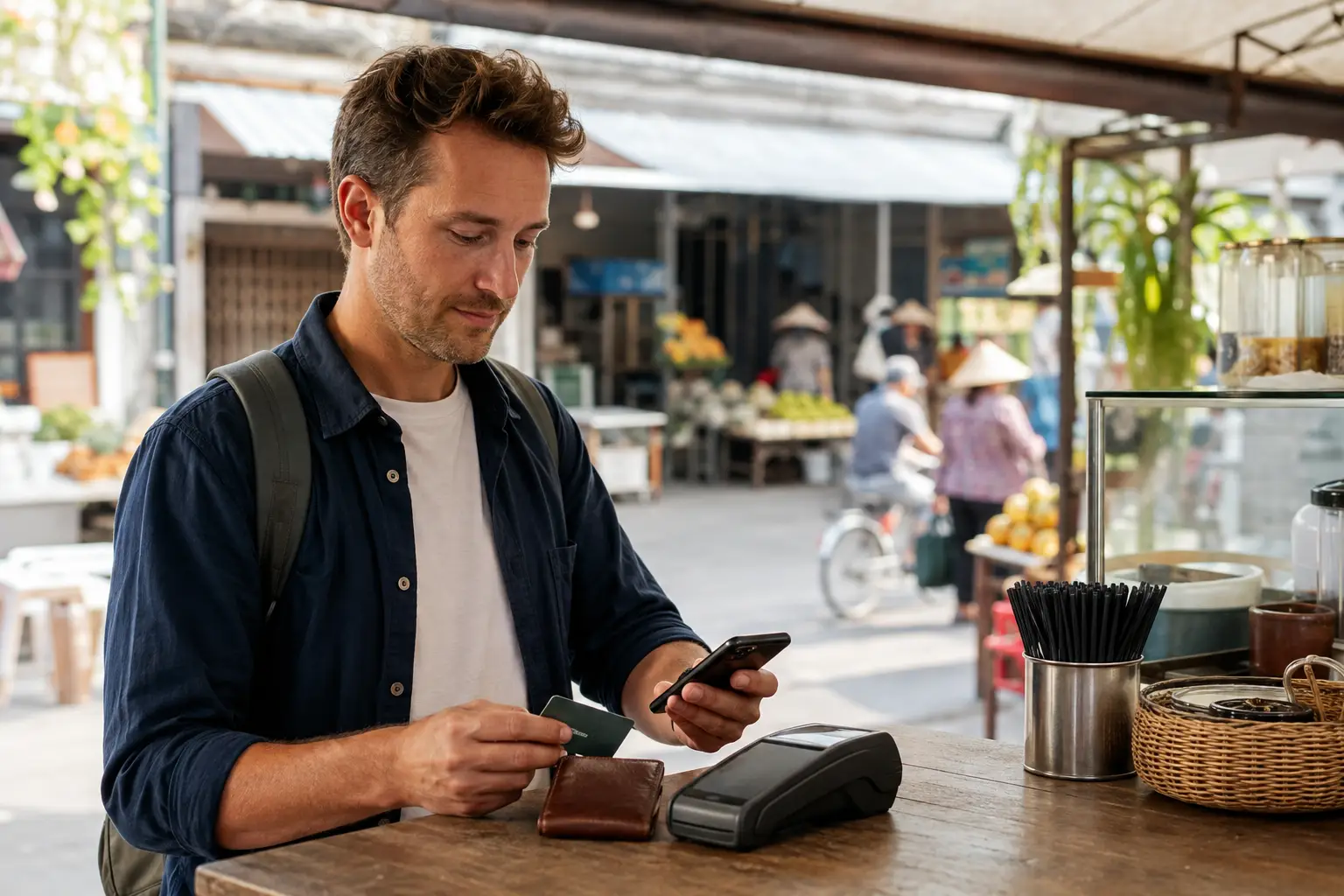
How to Pay in Vietnam in 2026: Cards, VietQR, Cash, ATMs and Currency Exchange
Vietnam is increasingly cashless, but cash is still useful, international cards are not accepted everywhere, and QR payments are now common even at very small businesses. In 2026, foreign visitors also have more ways to access this system directly: Chinese travellers can use Alipay and Weixin Pay with VietQRGlobal, Korean users can pay through GLN-linked apps, and several Southeast Asian countries already have cross-border QR connections with Vietnam.
So the old advice to “bring some US dollars and a Visa card” is no longer enough. The best payment setup now depends heavily on where your bank account is based and which payment network you already use at home.
The safest approach is to arrive with three independent options: one primary cashless method, a way to obtain Vietnamese dong in cash, and one backup payment method that does not depend on the same card or app.
What works best in 2026
| Your money is mainly in | Best primary option | Good backup |
|---|---|---|
| EU, UK, US, Canada, Australia and similar markets | Visa/Mastercard, Apple Pay or Google Wallet | ATM cash withdrawal + some VND |
| Mainland China | Alipay or Weixin Pay through VietQRGlobal | International card + cash |
| South Korea | GLN-compatible banking/payment apps | QR cash withdrawal at supported BIDV ATMs + bank card |
| Thailand | Participating Thai banking apps with cross-border QR | Card + cash |
| Singapore | Participating payment apps linked to VietQRGlobal | Card + cash |
| Countries without direct VietQR integration | International card | ATM cash + a QR intermediary such as Moreta |
The key point is that Vietnam’s QR infrastructure is becoming increasingly accessible to foreign visitors, but not every QR code is compatible with every foreign app.
How people actually pay in Vietnam
Vietnam’s everyday currency is the Vietnamese dong (VND). Prices in shops, apps, hotels and normal domestic contracts are quoted in dong.
In daily life, three payment methods dominate: VietQR, cash and bank cards.
QR is especially important. A tiny local café may not have a card terminal at all but will have a printed QR code at the counter. Street-food vendors, small shops and independent businesses often prefer QR or cash. Large supermarkets, hotel chains, malls and better restaurants are more likely to accept Visa and Mastercard.
Recent traveller reports in 2026 still show the same pattern: cards work well in larger businesses, but smaller places often prefer QR or cash. Some independent hotels, restaurants and tour operators also add a card surcharge of around 3%, although this is not universal.
If the amount is significant, ask before paying:
“Is there any card surcharge?”
VietQR: why QR codes are everywhere
VietQR is Vietnam’s national QR payment infrastructure, linked to local bank accounts.
For a Vietnamese customer, the process is extremely simple: open a banking app, scan the code, confirm the recipient and send the payment. This is why QR is common even at businesses where installing a traditional card terminal would make little economic sense.
NAPAS continues to expand domestic VietQRPay and the cross-border VietQRGlobal network.
For foreign visitors, however, one important distinction matters:
not every QR code is the same.
A small seller may display a QR code linked directly to a personal bank account. A larger merchant may use a merchant QR intended specifically for retail payments.
To a Vietnamese banking app, both may look almost identical. A foreign payment app may support the merchant QR but not an ordinary person-to-person bank transfer.
So if one VietQR code works and another does not, that does not necessarily mean the app is broken.
International Visa and Mastercard: still the easiest option for many visitors
For travellers with normal foreign-issued Visa or Mastercard cards, Vietnam is relatively straightforward.
Cards usually work at hotels, supermarkets, shopping centres, chain stores, larger restaurants, clinics and many tourist businesses. Contactless payment is increasingly common, and Apple Pay and Google Wallet can be used wherever the terminal and issuing bank support them.
The limitation is simply coverage: many smaller businesses still do not operate card terminals.
That is why even travellers with excellent international cards should keep some VND in cash.
Watch for card surcharges
Smaller hotels, tour agencies, restaurants and independent shops sometimes add roughly 3%, occasionally more, for card payment.
If a business accepts both QR and card, the QR route may be cheaper if your home-country app supports VietQRGlobal.
Large chains and supermarkets are less likely to add a surcharge, but it is still worth checking for expensive purchases.
ATMs: do not trust old “fee-free ATM” lists
ATM fees for foreign cards change regularly.
Banks that were famous among travellers several years ago for fee-free withdrawals may no longer be free in 2026. TPBank is a good example: older travel guides often recommended it, while newer travellers increasingly report local ATM fees.
VPBank is still one of the first ATMs worth trying with a foreign Visa or Mastercard, because many travellers continue to report no local withdrawal fee and reasonably high limits. But this is not guaranteed for every foreign card, and busy machines can run out of cash.
Some travellers also report successful fee-free withdrawals with certain cards at ACB or Eximbank.
The best rule is therefore not “Bank X is always free”.
It is:
Check the fee shown on the ATM screen before confirming. If you do not like it, cancel and try another bank.
You also need to account for any withdrawal fee charged by your own bank.
Always choose VND if the ATM offers currency conversion
When withdrawing cash, some ATMs offer to convert the amount directly into your home currency.
For example, instead of withdrawing 3,000,000 VND, the ATM may offer to charge your card in USD, EUR, GBP or another currency.
This is called Dynamic Currency Conversion (DCC).
In that case, the exchange rate is set by the ATM operator or its payment partner rather than by your card network and bank. The rate is often worse.
In most cases, choose:
VND
or options such as:
Continue without conversion
Decline conversion
and let your own bank perform the conversion.
Do not confuse “decline conversion” with cancelling the cash withdrawal itself. Some ATM screens word this choice poorly.
Mainland China: Alipay and Weixin Pay now connect to VietQRGlobal
For visitors from mainland China, payments became much easier in 2026.
NAPAS, Ant International and Vietnamese banking partners expanded Alipay compatibility with VietQRGlobal, allowing Chinese visitors to scan supported VietQRGlobal merchant codes using the app they already use at home.
In August 2026, cross-border support also expanded to Weixin Pay / WeChat Pay.
This is a major improvement because Chinese visitors no longer need to rely exclusively on international cards or cash for everyday retail payments.
However, this should not be interpreted as “Alipay works with every QR code in Vietnam”.
The integration applies to supported VietQRGlobal merchant codes. A personal bank-account QR shown by a small shop owner may behave differently.
A sensible setup for a Chinese traveller is therefore Alipay or Weixin Pay as the primary method, with an international card and some VND as backup.
South Korea: one of the most advanced cross-border setups
South Korean travellers now have one of the most interesting payment options in Vietnam.
NAPAS, GLN International, BIDV and Hana Bank have launched cross-border interoperability between VietQRGlobal and GLN. Users of compatible Korean banking and payment apps can pay participating Vietnamese merchants while conversion happens directly between KRW and VND.
There is also an unusual additional feature: cardless ATM withdrawal using a QR code.
Supported Korean apps can generate the required QR flow to withdraw VND from participating BIDV ATMs without a physical bank card.
Apps currently associated with this ecosystem include Toss, Purple GLN, Hana 1Q, KB Star Banking, Hana Money and Hana Pay.
For Korean travellers, this means both payments and access to cash can potentially be handled directly through familiar home-country apps.
Before travelling, check whether your specific account and app support Vietnam and what conversion or withdrawal fees apply.
Thailand: some local banking apps can scan VietQR directly
Vietnam and Thailand already have a two-way national QR connection.
Current Bank of Thailand information indicates that customers of participating Thai banks can scan supported VietQR merchant codes in Vietnam through their normal banking apps.
Examples include apps from Bangkok Bank, Krungthai and Krungsri.
If you already bank with one of the supported institutions, this can be more convenient than withdrawing cash or using an international card.
Again, check the cross-border QR section of your banking app before travelling because availability can depend on the exact account and app version.
Singapore, Laos and Cambodia
Vietnam has also expanded cross-border QR connectivity with other regional markets.
In 2026, NAPAS and partners launched further connectivity with Singaporean payment applications through VietQRGlobal.
Vietnam already has bilateral QR-payment links with Thailand, Laos and Cambodia as well.
The practical lesson is simple:
If you live in Asia, check your normal banking or wallet app before travelling. It may already contain an “Overseas QR”, “Cross-border QR” or “Vietnam QR” feature that you have never used.
If your country does not connect directly to VietQR
Travellers from Europe, North America and other countries without a direct national QR connection can use intermediary services.
One example is Moreta Pay. The service allows users to fund a wallet from a home-country card or bank account and then scan supported Vietnamese QR codes.
As of 2026, its published pricing includes a QR-payment fee plus a currency-conversion spread. This can still be useful in places where cards are not accepted but VietQR is available.
The important point is that services like this are usually about convenience, not necessarily the lowest possible cost.
If your normal Visa or Mastercard is accepted without a surcharge, the card may be cheaper.
There are also other tourist-oriented QR services, including LocalPay. With intermediary wallets, fees and exchange rates can change relatively quickly, so I would not keep a large travel balance inside them. Add what you expect to spend and keep the main reserve in your bank.
MoMo and ZaloPay are usually not worth setting up for a short visit
After seeing Vietnamese customers use MoMo, ZaloPay and local banking apps everywhere, a foreign traveller may decide to simply open the same wallet.
For a short trip, that is usually unnecessary.
Full access to Vietnamese wallets can require local identity verification, a Vietnamese phone number and, for many functions, a compatible local bank account.
For someone genuinely living in Vietnam with the right documents and a local banking relationship, these wallets can be useful. For a two-week visitor, international cards, cross-border QR and cash are generally much simpler.
Cash USD and EUR: still useful as a backup
Bringing part of your travel budget in cash USD or EUR remains a reasonable backup strategy.
US dollars are particularly easy to exchange in major tourist destinations.
However, there is an important legal point in 2026: exchanging foreign currency through unauthorised businesses can lead to administrative penalties.
This makes the old travel advice “just go to any gold shop, they always have the best rate” too simplistic.
Gold and jewellery shops are still used for currency exchange, and travellers sometimes report better rates there than at banks. But the important question is whether the specific shop is licensed to exchange foreign currency.
For a safer approach, use banks or authorised exchange counters.
Which US dollar notes are easiest to exchange?
The condition of the banknote can matter.
Fresh, clean $100 notes are usually the easiest to exchange and may receive the best rate. Damaged, heavily marked or torn notes may receive a worse rate or be refused completely.
A normal fold from carrying a note in a wallet is not a serious issue. But bringing a stack of old, damaged banknotes is unnecessary trouble.
At the airport, changing a small amount for immediate transport and food is reasonable if you do not yet have a working cashless option. There is rarely a good reason to exchange your entire travel budget there.
How much cash can you bring into Vietnam without declaring it?
When crossing an international border, cash must be declared if you carry more than:
USD 5,000 or the equivalent in another foreign currency
or more than:
15,000,000 VND
Bank cards are not included in this cash threshold.
So travelling with a very large amount of undeclared physical cash creates a separate customs issue.
Handling Vietnamese cash
The largest common banknote is 500,000 VND, so several million dong take up less space than the number of zeroes suggests.
The main practical challenge is reading denominations carefully. Foreign visitors sometimes confuse notes in poor lighting or when paying quickly, so check the printed number rather than relying on colour.
Avoid giving a street vendor a 500,000 VND note for a 20,000 VND purchase if you have smaller money available.
Large notes are easier to break at supermarkets, chain stores, cafés and larger businesses.
It is useful to keep a small amount of lower denominations separately for markets, street food, parking and situations where mobile Internet or QR payment is unavailable.
Exchange rates change faster than travel advice
This is one of the most important things to understand about payments in Vietnam.
The best method this month may not be the best method three months later.
Cross-border QR services use the rate of the participating bank or payment partner. Visa and Mastercard have their own conversion mechanisms plus your bank’s fees. ATMs add local fees or conversion choices. Exchange counters use live cash rates. Tourist QR intermediaries add their own service charges and spreads.
So do not memorise advice like:
“Method X is always the cheapest.”
For a large payment or withdrawal, compare the final outcome.
If you need 5,000,000 VND, compare how much your card would actually be charged, what the ATM fee is, what an authorised exchange counter offers, and what a cross-border QR app shows before confirmation.
A service advertising 0% commission can still have a worse exchange rate than another service charging a visible fee.
A practical setup for most international travellers
For most visitors with ordinary international banking, I would travel with two cards from different banks or networks, Apple Pay or Google Wallet if supported, and some VND cash.
If your home banking system has cross-border QR access, add that as well.
Before leaving home:
- Make sure your banking apps are logged in and do not depend on receiving an SMS on a SIM you will not have abroad.
- Check foreign transaction and ATM fees for your cards.
- Enable international payments if your bank requires it.
- Keep one backup card separate from your main wallet.
- Do not rely on a single physical card for the entire trip.
This setup covers almost every normal situation in Vietnam.
What to do if a payment fails
Do not immediately repeat the same large transaction several times.
First check your banking app. Sometimes a POS terminal or QR screen shows an error even though the money has already been placed on hold or the transfer has actually gone through.
With QR payments, always verify the recipient name before confirming. Many bank-transfer-style QR payments are effectively final and may not offer the same chargeback process as a credit-card purchase.
If an ATM does not dispense cash but your account is debited, photograph the ATM, record the address, exact time and amount, and contact both your own bank and the bank that owns the ATM.
If an ATM offers an exchange rate you do not understand, cancel rather than accepting it automatically.
What payment mix is most practical?
You can now travel through much of Vietnam with very little cash, but I would still not travel with zero cash.
QR works extremely well in places without card terminals. Cards are convenient in larger businesses and for online purchases. Cash remains useful when there is no mobile signal, a foreign QR app cannot read the specific code, or a small seller simply prefers cash.
The biggest change is that foreign travellers are no longer completely outside Vietnam’s QR-payment ecosystem. Chinese visitors can use Alipay and Weixin Pay, South Koreans can use GLN-linked apps and even withdraw cash through QR at supported ATMs, while Thailand, Singapore, Laos and Cambodia have growing cross-border QR connections.
For travellers from countries without such integration, the most reliable setup remains international card + some cash + ATM access, with an intermediary VietQR service only when it adds real convenience.
The question is no longer simply “card or cash?”
In 2026, the better question is:
Which combination of card, cross-border QR and cash is easiest and cheapest for the banking system I already use?
That answer can change over time, so for any major trip it is worth checking current fees and exchange rates shortly before departure rather than relying on a two-year-old travel guide.
Updated: September 2026.
Main sources: State Bank of Vietnam; NAPAS / VietQRGlobal; Bank of Thailand; GLN International; Apple and Google payment-support documentation; current Vietnamese foreign-exchange regulations; ATM and payment-network information; recent traveller reports and payment-app user experiences.
Comments
Read also
All articles
How to Rent an Apartment in Vietnam: Contract, Deposit, Utilities and What to Check Before Paying
Renting an apartment in Vietnam is usually easier than in many European countries. Landlords rarely ask for a credit history, salary statements or references from…

What to eat in Vietnam beyond phở: a regional food guide
Regional Vietnamese dishes, ingredients, serving, ordering and phrases for dietary questions.
How to Promote an Event in Vietnam: Event Listings, Social Media and Partners
Even a well-organized event may attract few people if the audience hears about it too late or cannot understand from the announcement what will actually…
How to Find What You Need in Vietnam: Why Post a “Demand” Listing
When you need to find an item, a place to live, a tradesperson or a service in Vietnam, the first reaction is usually obvious: open…

How to earn from tourism services in Vietnam: partners, commissions and first customers
Choose a city and tourism niche in Vietnam, find local providers, agree commissions, publish a clear listing and learn how to handle your first customer…
How Much Does One Month in Vietnam Cost? 2026 Travel and Living Budget
How much does one month in Vietnam cost? Plan 18–25 million VND for a simple monthly lifestyle, or 28–40 million for more comfort. Compare housing,…