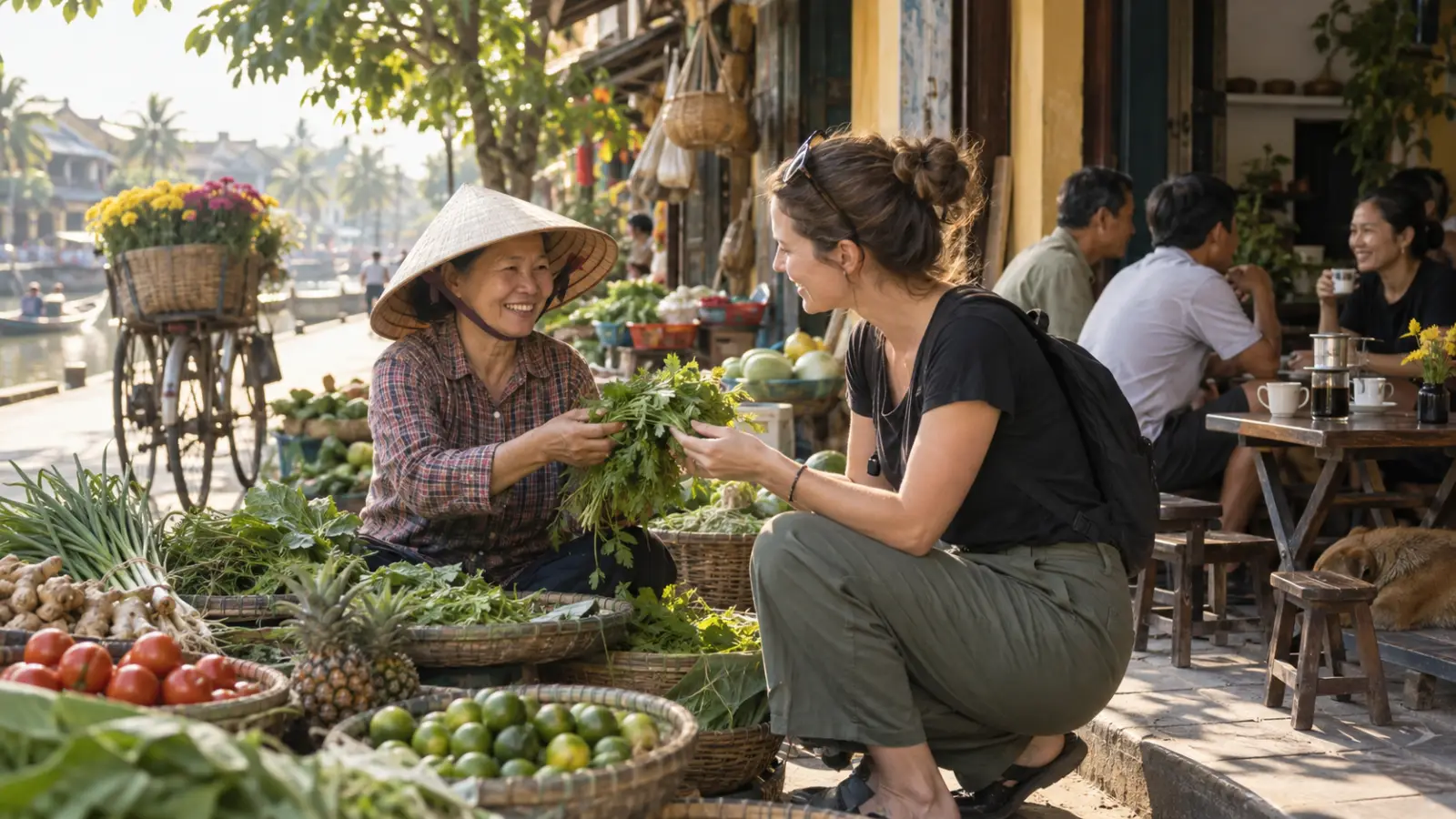
Everyday Vietnam: How to Communicate at Markets, Cafés and in Vietnamese Homes
Travellers in Vietnam rarely need a deep understanding of local etiquette. Mispronouncing a word, choosing the wrong form of address or not knowing where to pay for your coffee will normally be taken in stride. What matters much more is the overall style of communication: avoid raising your voice, do not publicly embarrass someone, and pay attention to how people around you behave.
A few everyday habits, however, make life much easier. Bargaining at a market can be perfectly normal, but not in a supermarket. In a small café, you often call a waiter rather than silently waiting for someone to approach. A person’s age influences how you address them. When visiting someone’s home, you check whether shoes are left at the entrance, while meals are commonly served as shared dishes rather than individual courses.
Once you understand these details, everyday Vietnam starts to feel much less chaotic. Many situations that initially seem unusual to a foreign visitor actually follow a fairly clear social logic.
The most important thing in Vietnamese forms of address is age
One of the first things you notice when you begin to understand even a little Vietnamese is that a single universal equivalent of English `you` is not really enough.
People constantly position themselves relative to one another by age and social relationship. That is why asking someone’s age soon after meeting them can be completely normal. It is not necessarily intrusive curiosity: age helps determine the appropriate way to address each other.
For everyday travel, knowing a few forms is enough:
| Form | Generally used for |
|---|---|
| em | someone noticeably younger than you |
| anh | a man somewhat older than you |
| chị | a woman somewhat older than you |
| cô | a woman roughly of an aunt’s generation |
| chú | a man roughly of an uncle’s generation |
| bà | an elderly woman |
| ông | an elderly man |
When calling someone, ơi is usually added after the form of address.
For example:
Em ơi! — when calling a waiter or seller who is clearly younger than you.
Chị ơi! — when addressing a woman somewhat older than you.
Anh ơi! — for a somewhat older man.
Cô ơi! / Chú ơi! — for someone clearly from an older generation.
Vietnam’s official tourism guidance recommends these forms to visitors as well. If you genuinely cannot judge the person’s age, Bạn ơi! — roughly “hey, friend” — can serve as a more neutral option.
In practice, foreigners do not need to treat this like an examination. If you misjudge someone’s age slightly, nothing disastrous will happen. Openly rude or commanding behaviour matters far more than getting every pronoun perfect.
Why it is normal to call the waiter
Visitors from some countries may feel that calling out to a waiter is rude.
In Vietnam, it is completely normal.
In a small restaurant, staff may not repeatedly come to the table to ask whether you need anything else. When you want to order, get another drink or ask for the bill, you simply call someone:
Em ơi!
or:
Anh ơi! / Chị ơi!
This does not carry the same meaning as rudely shouting “hey, you”. The form of address itself already contains a social relationship.
You can then add:
Cho mình hỏi... — roughly, “Can I ask...?”
or simply make your request once the person comes over.
How to order when the menu is only in Vietnamese
In many local eateries, you do not need much conversation at all.
A small restaurant may serve only one main dish with a few variations. Vietnam Tourism even suggests that if you do not know what to order in a street-food place, simply pointing to something being eaten at the next table can work perfectly well.
A handful of phrases cover most everyday situations:
| Vietnamese | Meaning |
|---|---|
| Cho tôi cái này | I’ll have this |
| Một cái này | One of these |
| Không cay | Not spicy |
| Ít cay | Only a little spicy |
| Không đá | No ice |
| Ít đá | Less ice |
| Không đường | No sugar |
| Thêm một cái | One more |
| Bao nhiêu tiền? | How much is it? |
| Tính tiền | The bill / I’d like to pay |
| Cảm ơn | Thank you |
For a visitor, imperfect tones and pronunciation are inevitable. If someone does not understand you, showing the phrase on your phone, pointing to a photo or typing a number is usually more effective than repeating the same word increasingly loudly.
A local café may work differently from a familiar restaurant
In a small phở, bún or cơm place, service can be very simple.
You may order at the entrance or directly from the person cooking, sit at any available table, eat, and then pay on the way out. There may be no printed bill at all: someone simply remembers what you ordered or quickly totals it.
At busy times, a stranger may sit at the same table. That is also normal, particularly in inexpensive popular eateries with small tables and limited seating.
In mid-range cafés and chains, the system is often more familiar to international travellers. Some places have you order and pay at the counter first; others take orders at the table.
The easiest way to understand the system is simply to watch what the people ahead of you do.
Do not assume someone will always bring the bill
In small eateries, you often need to go to the cashier yourself or say:
Tính tiền!
In a more conventional restaurant, you can call the waiter:
Em ơi, tính tiền!
roughly meaning, “Could I have the bill?”
If you are paying cash in a small establishment, handing over money with your right hand or with both hands is a polite option. Vietnam Tourism also recommends using the right hand or both hands when giving objects or money to someone.
But there is no need to turn a 25,000 VND coffee purchase into a ceremony. Everyday Vietnamese life is much less formal than many etiquette guides make it sound.
Tipping: do not import the American system
Vietnam does not traditionally have a culture of obligatory tipping.
At an ordinary café, phở shop, street-food stall or local restaurant, Vietnamese customers will normally just pay the stated price. Official Vietnam Tourism guidance also notes that tips in restaurants and cafés are not required, although they are welcome for particularly good service.
The situation is changing somewhat in tourist areas. Tips are more common at upscale restaurants, hotels, spas and with private guides. Some businesses already add a service charge to the bill.
So before automatically adding 10–20%, check the receipt.
At a normal café, simply paying the bill is sufficient. If the service was especially good, a small extra amount is a pleasant gesture rather than an obligation.
Bargaining at markets is normal — but not everywhere
Bargaining is a normal part of shopping in many traditional markets and tourist shopping areas. Vietnam Tourism recommends asking several sellers for the price before buying so that you understand the approximate range, and then negotiating calmly.
Useful phrases include:
Bao nhiêu? — How much?
Bao nhiêu tiền? — How much does it cost?
Bớt một chút được không? — Can you reduce the price a little?
Đắt quá! — Too expensive!
The last phrase works best with a smile rather than as an accusation.
Your phone calculator is extremely useful. The seller enters a number, you enter another, and the negotiation can happen without any shared language at all.
Where you should not bargain
The fact that someone is standing behind a counter does not mean the price is negotiable.
Do not bargain in supermarkets, convenience stores, pharmacies with displayed prices, chain cafés, shopping centres, restaurants with menus or shops with fixed price tags.
Markets are different, particularly for clothing, souvenirs and some non-food items.
With food, the rule is less universal. Prices for fruit, vegetables or seafood at traditional markets can also be negotiated, especially when buying larger quantities, but trying to bargain over a few thousand dong on a tiny purchase is often pointless.
Good bargaining is not a confrontation
Some travellers treat market bargaining like a contest in which they must force the seller to surrender.
That is unnecessary.
Ask a few prices, make your offer and calmly decide whether the final amount works for you.
If the seller refuses, smile, say thank you and walk away. If they call out a new price, the negotiation is continuing. If they do not, they simply do not want to sell at your price.
Vietnamese etiquette guidance specifically advises avoiding loud arguments, public criticism and situations in which another person is embarrassed in front of others.
A ten-minute argument over 20,000 VND is therefore one of the least useful things you can do in a market.
Should you worry about the “foreigner price”?
At markets without displayed prices, a foreign visitor may indeed be quoted a higher opening price than a regular local customer.
That does not mean every seller is trying to cheat you.
In many markets, the first price assumes some negotiation. A visitor may also have no idea about the season, variety, quality of a particular batch or its normal local price.
The practical solution is simple: ask at two or three stalls first.
If everyone says 70,000–80,000 VND, the realistic price is probably not suddenly 20,000. If one seller says 200,000 and the others say 80,000, the choice becomes fairly obvious.
A smile is often more useful than perfect Vietnamese
Vietnamese people are accustomed to visitors who do not speak the language.
Even a few words are usually appreciated:
Xin chào — hello.
Cảm ơn — thank you.
Xin lỗi — sorry / excuse me.
In actual everyday communication, however, tone and behaviour matter more than vocabulary.
Trying calmly to explain something with gestures and your phone usually works much better than becoming annoyed because the other person does not speak English.
This becomes especially obvious outside major tourist zones, where a cashier, market seller or driver may genuinely know almost no English.
Why Vietnamese people may ask very personal questions
How old are you? Are you married? Do you have children? How much do you earn? Why do you not have children? How much did your apartment cost?
To many Western visitors, some of these questions sound unexpectedly personal.
The boundary between “private” and “normal small talk” is simply drawn somewhat differently in Vietnam.
Age, for example, has a practical role because it helps determine how people address each other. Official Vietnam Tourism guidance specifically notes that being asked your age when first meeting someone should not automatically be interpreted as rude.
You do not need to give a detailed truthful answer to a question that makes you uncomfortable. Smile, answer vaguely or change the subject.
The question itself does not necessarily signal hostility.
Do not turn “saving face” into something mystical
Many articles about Vietnam explain the concept of `face` so dramatically that travellers begin to think any direct conversation could trigger a cultural crisis.
Everyday life is simpler.
If a restaurant made a mistake on your bill, you can calmly point it out.
If your driver went to the wrong place, explain the address.
If a product is not what you agreed to buy, you can refuse it.
Problems arise more when a disagreement becomes public humiliation: shouting, mocking someone or loudly accusing them in front of others.
A calm “there seems to be a mistake, could we check it?” works much better than trying to establish who is to blame.
When visiting a home, first look at the shoes by the door
If you are invited into someone’s home, the first simple rule is to look at the entrance.
If the hosts’ shoes are outside or gathered by the doorway, remove yours as well. Vietnam Tourism specifically recommends taking shoes off before entering a Vietnamese home.
Sometimes the hosts provide indoor slippers; sometimes they do not.
There is no need to ask what the rule is when ten pairs of shoes are already sitting outside the door.
A similar principle applies at many temples and pagodas, although you should follow local signs and observe what others are doing.
What should you bring when invited to someone’s home?
There is no need for an expensive gift.
Official tourism etiquette guidance suggests simple things such as fruit, sweets, biscuits, flowers or soft drinks.
For a foreign visitor, something characteristic of your home country can also work well if it travels easily and is not excessively expensive.
The gesture usually matters more than the monetary value.
For an ordinary dinner invitation, there is no need to make the gift presentation ceremonial. Handing it over with your right hand or both hands and thanking your hosts for the invitation is enough.
Greet older family members first
Age hierarchy becomes particularly visible within families.
If you enter a home where grandparents, parents and younger relatives are all present, it is respectful to greet the older family members first.
Vietnam Tourism also recommends greeting the eldest members of a household before others when visiting a Vietnamese home.
This helps explain why age-based forms of address are not simply a linguistic curiosity but part of a wider social structure.
At the same time, foreigners are allowed much more room for mistakes than Vietnamese relatives would be. Nobody expects a visitor to understand every family relationship correctly within the first five minutes.
A family altar is not interior decoration
Many Vietnamese homes — and even family-run businesses — have an ancestor altar.
It may be mounted high on a wall, placed on a dedicated cabinet or positioned relatively low. It is an active part of family life, not a decorative photo corner.
Do not put your belongings on it, sit on it or step over low altar structures. Vietnam Tourism also advises visitors not to step across low household altars or unnecessarily walk directly in front of them.
If you want to photograph an altar or religious ritual, ask the hosts first.
Meals at home are usually shared
A typical Vietnamese family meal does not work like a restaurant where everyone orders an individual main course.
Several shared dishes are placed in the middle of the table, while each person has a small bowl of rice. Everyone takes small portions of meat, fish, vegetables and other dishes from the shared plates.
Vietnam Tourism describes this family-style format as a normal part of Vietnamese dining.
A host may place food directly into your bowl, often choosing a particularly good piece. There is no need to refuse every time. It is usually an expression of hospitality.
If you genuinely cannot eat any more, politely repeat that you are full:
No rồi — I’m full already.
or:
No quá — I’m very full.
Do not leave chopsticks standing vertically in rice
This is one of the well-known etiquette rules that has a real cultural reason.
Chopsticks standing vertically in a bowl of rice visually resemble incense sticks used in rituals for the dead.
When you stop eating, place the chopsticks beside the bowl or across its edge instead. Vietnam Tourism also advises against leaving them upright in rice.
And again, if a foreign guest does this once without knowing, nobody is likely to decide they are a terrible person. It is simply useful to know in advance.
Who pays for dinner?
Among ordinary groups of friends, anything can happen: one person pays, the bill is split, or people take turns treating one another.
In more traditional social situations, a common rule is that the person who clearly invited you to dinner pays. If there is no obvious host, the oldest or most senior person may take the bill. Vietnam Tourism also notes this practice.
A foreign visitor can offer to pay or split the bill, but there is no need to physically fight over the cheque.
If your host firmly insists several times, sometimes the best response is simply to accept the hospitality and invite them next time.
Why people keep offering you food
In Vietnamese families, food is one of the main ways people show care.
A host may ask repeatedly whether you have eaten, keep putting food into your bowl, offer fruit five minutes after dinner and worry that you have barely eaten anything.
Vietnam Tourism even describes the phrase “Ăn cơm chưa?” — “Have you eaten yet?” as such a common expression of care that it functions almost as an everyday way of checking on someone.
So another spoonful of food is usually not an attempt to invade your personal space.
If you really do not want more, decline warmly a few times.
Ask before photographing people
At a market, in a village or in a small café, someone in a conical hat may look like the perfect travel photograph.
For that person, it is simply a normal working day.
Vietnam Tourism recommends asking permission before photographing people.
You do not need a complicated sentence. Point to the camera and ask:
Chụp ảnh được không? — May I take a photo?
If the person shakes their head or turns away, simply do not take the picture.
Photographing someone from very close range and then walking away without even acknowledging them is particularly unpleasant.
Not everything unfamiliar is rude
People at a market may speak more loudly than you expect.
A waiter may not smile throughout the conversation.
A seller may ask your age.
A stranger may share your table in a busy local restaurant.
Someone may call a waiter across the room.
A person may make a very direct comment about your height, weight or appearance.
Some of these things feel rude to foreigners simply because their own culture places the boundary somewhere else.
That does not mean “anything goes” in Vietnam. Rudeness exists here just as it does anywhere else. But before interpreting an everyday interaction as an insult, it is useful to see whether local people speak to each other in the same way.
A few phrases are enough for a week
You do not need to memorise a phrasebook with a hundred expressions.
For everyday travel, a dozen phrases are much more useful:
| Vietnamese | Meaning |
|---|---|
| Xin chào | Hello |
| Cảm ơn | Thank you |
| Xin lỗi | Sorry / excuse me |
| Em ơi / Anh ơi / Chị ơi | A way to call someone |
| Bao nhiêu? | How much? |
| Bớt một chút được không? | Can you make it a little cheaper? |
| Không cay | Not spicy |
| Một cái này | One of these |
| Tính tiền | The bill / I’d like to pay |
| Không hiểu | I don’t understand |
| Được | Okay / possible |
| Không | No |
If your pronunciation fails, a translation app is more effective than repeating the same word ten times.
The most useful rule is not to try to act Vietnamese
A foreign visitor does not need to choose every pronoun perfectly, memorise dozens of dining rules, bargain like a professional or perform every household ritual correctly.
It is much more natural to behave like a respectful guest.
Notice whether people remove their shoes. Greet older family members first. Do not shout over a small pricing mistake. Ask before taking a photograph. Bargain calmly at the market. Do not be afraid to call a waiter in a café. If your host puts food in your bowl, understand it as hospitality rather than an invasion of personal space.
Everyday Vietnamese culture is much less formal than it can appear after reading long lists of “things you must never do in Asia”. Foreigners are easily forgiven for most honest mistakes.
A few simple habits — smiling, saying `Cảm ơn`, using a respectful form of address and not turning a small misunderstanding into a confrontation — will take you much further than trying to master perfect local etiquette in one week.
Updated: September 2026.
Main sources: Vietnam National Authority of Tourism guidance on everyday etiquette, forms of address, home visits and dining; Vietnam Tourism guidance on money, tipping and market bargaining; official Vietnam Tourism materials on street food and everyday Vietnamese culture.
Read also
All articles
Entering Vietnam in 2026: Visa-Free Travel, e-Visa and Entry Requirements
Vietnam entry rules for 2026: who can travel visa-free, when to apply for an e-Visa, and which documents to check before departure.

SIM Cards and Mobile Internet in Vietnam: Which Operator Is Best for Foreigners in 2026
Buying a SIM card in Vietnam is easy. Buying one that is actually registered to your foreign passport, will not suddenly be blocked, and can…
How to Rent an Apartment in Vietnam: Contract, Deposit, Utilities and What to Check Before Paying
Renting an apartment in Vietnam is usually easier than in many European countries. Landlords rarely ask for a credit history, salary statements or references from…
Health in Vietnam: Insurance, Hospitals, Pharmacies and Emergency Care
A practical health guide for Vietnam: emergency numbers, hospitals, pharmacies, travel insurance, animal bites, fever and upfront payments.

Vietnam in 14 days: three routes without racing across the country
Three workable two-week routes through north, central and south Vietnam: nights, transfers, weather buffer and booking order.

Hue, Da Nang and Hoi An in 5–7 Days: A Practical Central Vietnam Itinerary
Hue, Da Nang and Hoi An are close enough to combine in one trip, but they should not be treated as three similar stops. Hue…

Comments
Share your thoughts or ask a question about this article.